It’s natural for many sellers to be hesitant to accept the first offer they receive on their home. They may want to entertain multiple offers from interested buyers and could even be thinking about potential bidding wars.
In certain circumstances, however, the first offer on your home may actually be the one you should accept. It might make more sense, especially if it is a fair one and you are living in a fast real estate market.
Here are specific cases where the first offer on your home is the one worth taking:
Whether you need to relocate quickly for financial reasons or if you are experiencing a major life event, such as a divorce or a job transfer, your main goal is to sell the property as quickly as possible. It will be a huge relief for you and your family since you can reduce the amount of time you have to pay to cover your living expenses at two homes.
Explain your situation and motivation to your real estate agent so he or she can market the property to secure the best selling price from a serious buyer to avoid the deal falling through.
If your home has been sitting on the market for weeks now for whatever reason, the first attractive offer that comes could be your best bet, especially if it isn’t a lowball offer. Accepting it might make more sense if you don’t want your property to continue losing its value.
You may want to consider if a buyer gives you an all-cash offer. Cash buyers are usually a safe bet since they don’t have to wait on their mortgage to be approved and their offer comes with fewer to no contingencies. This offer can give you a much smoother transaction even if it’s not necessarily the best deal. An all-cash offer is also great if you need to move quickly for financial reasons or if you’re experiencing a major life event. Just make sure to carefully assess the buyer with your realtor to ensure a smoother transaction.
Houses that are considered weird, quirky, or contemporary won’t likely appeal to the general buyers, which means they can be trickier to sell. Just check this “dome home” in Sedona, Arizona, for example. This 2,400-square-foot octagonal property with four bedrooms and two baths prompted many agents to worry on how to make its peculiar features marketable.
There’s a good chance that offers will be few for those kinds of houses because of its small group of interested buyers, so the first offer will likely be your best option.
If you’ve inherited a home from a deceased loved one and your main concerns are to get a fair price and have a smooth transaction, the first attractive offer that comes your way may be the one worth accepting. This way, you can sell the house as soon as possible and move forward to the next phase of your life.
Your home may be your biggest financial asset and investment, but once you decide to sell, everyone will agree that it’s also more of an emotional journey. After all, you’re not just leaving a home that you loved—you’re ending a “love affair” with a place you’ve had for a long time and have lots of memories tied to it. It’s where you’ve raised your family; held countless Thanksgiving (or friendsgiving) dinners and parties, so it’s completely normal to be sad about moving.
If you are not able to deal with the emotional stress of selling your property, it can hinder you and your realtor from achieving your goals and creating your ideal financial result. This is why it’s also worthwhile to take into account the emotional attachment you have with your home. Here are some tips to get you through what can be a taxing sales process, especially if you fail to deal with it early.
If you’re having apprehensions about selling your property, try to reframe your mindset and start thinking that you’re no longer a “homeowner” but a “home seller.” This will help you adopt a more objective attitude towards the process, and gradually accept that your home is now a product that you have to sell and that others will hopefully want to buy.
Changing your perspective might take some time, so don’t be afraid to give yourself a few weeks or months to separate your emotions and set your expectations right, especially if you have the luxury of time to do so. It might be helpful to do some research, such as talking to friends who have sold their homes or reading about other people’s home-selling journey, so you’ll have a clearer idea of what you are getting into. Hopefully, doing your due diligence will also help make the transition easier.
When preparing to list your home for sale, one of the crucial things to do is to make it less personal. This means removing framed family portraits, mementos, travel souvenirs, diplomas — anything else that is personalized and screams that you own the home. The main goal of this process is to make it easier for potential buyers to envision themselves in the house, especially during showings.
However, packing up your photos and mementos earlier rather than later will also help you as a seller to let go. Likewise, try to change the little parts of the home that you’ve come to love so much, such as your favorite wall color in the bedroom or dining room.
Once you’re used to not seeing them, it will make it easier for you to detach yourself and see the home as merchandise waiting to be sold. Hopefully, it will also help you realize that the house isn’t the one that carries precious memories, but you and your family. Take the time to reflect on how the house has served its purpose for however long you lived there, and that you’re letting it go to move on to your next.
Don’t forget the old adage “home is where the heart is” to help you think of home in terms of the people you love rather than in terms of a place. May it be your spouse, children, parents, or even friends whom you treat as family members, remember that your real home is wherever the people you love are. Take photos of the property, revisit old memories with them, and reminisce about how you all loved living there. The process will hopefully aid in accepting your emotions throughout the home sale.
It’s natural to be anxious and stressed about moving. It’s even natural to grieve when thinking about the old memories you’ve had at your home. After all, you won’t just be letting go of the house per se, but you’ll also be leaving a community you’ve grown with.
But no matter how hard it seems, remember the reason why you’re selling in the first place and what you’ll gain afterwards. List these things out, then look at that list whenever you’re feeling down about relocating. If you’re selling so you can downsize, think about the extra money you’ll be able to save. Same thing if you need money from the home sale to pay off other debts. Whatever reason you have—whether it’s to downsize, upsize, for retirement, or just be closer to an adult child or to other family members—try to focus on that instead of entertaining the feelings of losing your beloved home.
It might be difficult to do at first, but once you think positively about these changes, you’ll look forward to moving on to a new home like it’s another adventure that’s bound to happen.
When you figure out your “why” and establish your goals for selling, it’s crucial to find and choose a partner who will be your guide as you go through one of the most important decisions you’ll make.
Hiring a top realtor to help you sell your home is beneficial to your emotional and financial well-being. You will share your goals with them, and then work together to create a game plan to achieve those goals as much as possible. Your agent will be responsible for marketing your home for sale, negotiating your deals, helping you review purchase offers, guarding your interests, and guiding you in making informed decisions by providing adequate knowledge.
Your agent will help you navigate the complex home selling process while being compassionate about your feelings. This is why it’s imperative to partner up with an expert realtor who has worked with many sellers in the past who have gone through the same things. Your agent will be the one to maintain an emotional detachment and treat the sale solely as a business transaction. If you trust your realtor and their strategy, you can focus your emotional energy on finding your next home, making the entire process less stressful and hopefully more enjoyable.
If you are thinking about buying a house this year or even in the near future, one of the things you might have been asking yourself is whether you need to hire a real estate agent or not. After all, you know how to browse through online listings (which is something you might already love doing during your free time). It should be easy enough to find a property you like, contact the listing agent, and then go from there to get your dream home. So why bother using a realtor? What’s the point?
In reality, purchasing a home isn’t as simple as buying something online or even buying a car. It’s one of the most significant transactions you’ll ever deal with. Here are just some of the few risks you’ll be leading yourself into when you decide not to hire a buyer’s agent and enter a complicated real estate transaction without representation.
House-hunting nowadays may have been made easier by the internet. Buyers are now able to see homes available for sale in various real estate websites. However, real estate agents have access to a wider variety of available listings that aren’t listed on traditional channels. Likewise, a buyer’s agent will help you to widen your search terms so you’d see more homes that fit your needs.
Also, your expectations will be matched with the reality of what is currently available in the market and what houses you can afford. Having a professional who has their pulse on all the data will make the arduous home search process more bearable.
Without a realtor, you’re going through this journey with no neighborhood specialist to rely on. Sure, you can and (actually need to) research vital information such as school districts, zoning codes, crime rates, local trends, current market values, etc. But local real estate agents will be able to tell you more about those things, and give you reputable data and other facts about the neighborhood you’re considering. They probably even know the best coffee shops or restaurants in town, making them the best resource if you want to familiarize yourself in your potential neighborhood.
Besides, doing some research on your own is a tedious task that is best to have help with, especially if you have no idea where to start.
When touring houses, many first-time home buyers don’t know how to spot potential problems that could cause issues in the sale later on. They may be blinded by the cosmetic finishes and upgrades instead of being on the lookout for these potential issues.
But your agent will be able to recognize any telltale signs of issues in a property, such as mold, roofing problems, pests and insect infestation, water leaks, damp or wet basement, cracks in the foundation, and others. With their keen eye and experienced judgement, they will be able to help you determine if there are additional inspections necessary, including radon or mold inspection. Your realtor will also tag along during the home inspection to hear what the inspector finds, and help to accurately convey the information to you as a buyer.
Even if you think of yourself as an expert negotiator, you will need a professional who is adept at negotiating the best price for your home purchase.
By analyzing the value of the home you’re looking to buy through comparable sales or “comps”, an exceptional buyer’s agent will help you come up with a competitive offer. They will also advise you on what should be your next steps once the seller responds.
They will help you look at the current conditions of the property to find any issues that could be leveraged during negotiations, especially after consulting the home inspection report. By having a talented negotiator in your corner, you’ll be assured that the price you intend to pay is the price that the home is worth.
When you decide to buy a home without getting the help of a real estate agent, you’ll be left to review and understand on your own the tons of documents involved in a real estate transaction. The real estate industry is already full of legal jargon—but more so the multiple contracts and paperwork that also have to be 100 percent correct. Sure, any confusing term is just a Google search away, but would you want to take such a huge risk when your biggest investment is at stake?
Real estate agents can explain the impact of those terms or clauses to you so you can have a thorough understanding of what you’re getting into. They can clarify the difference between a disclosure and an agreement, go over seller disclosures, or explain every contingency that might affect the deal and put you on the losing side. By having an expert on your side, you’ll be able to ask the right questions, cover every base, and to make sure you’re not being taken advantage of by the other party.
Buying a house can be stressful and overwhelming so it’s definitely something you wouldn’t want to DIY. From questions surrounding the home buying process, crucial information about the neighborhood you’ve been looking forward to calling your home, to understanding the fine print of your contract—the benefits of hiring a realtor are immeasurable. Now more than ever, you need someone who understands your unique situation and will help you achieve your dreams of homeownership in the best possible way.
Having enough money to put as a down payment is one of the biggest roadblocks to purchasing a house, especially to first time buyers. If you’re one of the many people who aspire to turn their homeownership dream into a reality, you probably know that among the many things you need to start doing is to save money for a down payment.
However, it’s easier said than done and may be dependent on many factors, such as your income, current debt, responsibilities, etc. Even your current savings play a huge role in how much you still have to save.
So whether you’re planning to buy a home this year or even in 2022, here are six savvy ideas—you can even think of them as new year’s resolutions—to help you achieve your savings goals to buy your dream home sooner.
If you’re having a hard time sticking to your budget, start by seeing where your money goes to each month. Keep track of your daily purchases and payments through a spreadsheet or an expense tracker app, then review them at the end of each month. You may be surprised how much of your budget goes toward non-essential expenses that are making little dents in your account.
Since the pandemic started, many of us may have already been conscious about our spending habits. This time around, figure out how you can tighten up your spending by limiting or reducing your expenses. By making these small cuts or sacrifices in your daily routine, you’ll be amazed at how much money you can save, which is a huge deal if you really want to make your dream home a reality.
Here are some ideas to reduce spending, depending on what applies to you and your lifestyle:
Minimize eating out and take out, and save them only for special occasions.
Review and limit your monthly subscription services. Is your cable bill costing you hundreds of dollars a month, but you’re more of a Netflix guy? It might be time to totally cut it out.
Cut down on designer coffee and other expensive beverages. Also limit your alcoholic beverages whenever you eat out.
Reduce your clothing budget, especially if you’ve already been working frequently from home.
Speaking of reducing your expenses, there are ways to slash some dollars off your grocery bill and get huge savings. Shop smarter by sticking to your grocery list to avoid any impulse buys. It might also be helpful not to buy on an empty stomach. Choose to shop at grocery stores with cheap prices or at local farmer markets, rather than at an upscale grocer. Lastly, make an effort to switch to cheaper but quality store brand labels.
Any unexpected money that isn’t part of your monthly income are known as “windfalls” in the financial industry. These windfalls could be an annual bonus at work, inheritance, cash gifts, tax refund, a birthday check you received from your parents or grandparents, and any other instances in which you get extra money. Instead of spending them on a new gadget, appliance, or on a shopping splurge, stash them away as part of your down payment savings.
It might not look fun, yes, but remember that you’re working towards a more ambitious goal. That extra money is a surefire way to fast-track that goal. Likewise, it will be crucial just in case you encounter an unexpected expense and you can’t afford to deposit your usual savings. So if you’ve been itching to buy that latest big-screen TV using that holiday bonus, tell yourself that it can wait. Besides, chances are it will suit your new home better.
Challenge yourself to go on a spending freeze or a spending “diet”. Let’s say for two weeks or even a month, you will drastically cut your spending to only your living expenses and necessities—no new clothing, no dining out, no new gadgets, no adding to cart, etc. At the end of the month, review what areas of your budget are you willing to forgo to keep up with your new spending habits that will eventually increase your savings.
Creating a separate account for your down payment savings, with no linking debit card or checks, will help you keep your finances in order and track your progress. It will also discourage you from spending your hard-earned money on other things other than its purpose, which is to achieve your dream of becoming a homeowner.
Bottom Line
Saving for a down payment isn’t something that can be done overnight. It’s a huge, collective effort that can be achieved with enough determination and the right circumstances. To help you set a clear goal and determine how much you really need for a down, it’s better to talk with a local and knowledgeable real estate professional who will help you get started.
Buying a home is a ‘purchase of a lifetime.’ It’s a major financial step that requires a lot of planning and preparation. If 2021 is the year you’ll put an end to your rental days and find your dream home, here are things you can realistically start doing now to finally become a homeowner within next year.
1. Check your credit score and take steps to improve it.
Your credit score and credit history play a major role in whether or not you will get a mortgage and could affect the interest rate lenders can offer you. Start monitoring your credit report by getting free copies from national credit reporting agencies. Then, work on improving your credit profile by paying your bills on time and keeping your credit card balances as low as possible.
2. Research first-time home buyer grants or assistance programs.
Do your preliminary research and see if you qualify for any first-time home buyer programs being offered by your city or state, where you can get down payment and closing cost assistance, or even special loan programs with lower interest rates.
3. Shop for a lender and get pre-approved.
Once you’ve taken care of your credit but before you officially go house-hunting, shop around with various lenders to compare their offers and find the best deal available.
Likewise, getting pre-approved will help you know how much you can borrow so you will only shop for what you can afford. It will also show sellers and agents that you’re a serious buyer.
4. Find a local and knowledgeable real estate agent.
Even if you’re still months away from entering the housing market, start looking for a real estate professional who will guide you through the complicated home buying process. Your agent will provide you crucial information on homes and neighborhoods, answer any questions you have about the process, and will look out for your best interest so you’ll be satisfied with your biggest investment. Start getting recommendations from family and friends, read online reviews, and interview several agents before making the final decision.
5. Set up a new budget and live on it to anticipate the costs of owning a home.
Create a new budget and practice living on it. Make sure you add in the costs of owning a home, because aside from your monthly mortgage payments, there’s utility bills, repair and maintenance costs, property taxes, homeowners insurance, etc. With these in mind, you will have a good idea of how much you can comfortably afford and you’ll avoid straining your budget once you’ve become a homeowner.
For many first time buyers, saving for a down payment is one of the most challenging steps in fulfilling their dream of purchasing a home. Oftentimes, they know they can afford their potential monthly mortgages (which could be less or equal their current rents), but the upfront costs of buying, such as down payment and closing costs, may be too much for them to pay.
This is why it’s possible to get a little help in the form of a down payment gift from a family member or relative, close friend, or even a charitable organization. And it’s actually becoming more popular, especially among millennials. In the National Association of REALTORS® 2020 Generational Trends Report, 13 percent of home buyers (and 27 percent for ages 22 to 29) indicated their source of down payment to be a gift from their relative or friend.
So if you’re lucky enough to find down payment fund as one of your gifts under the Christmas tree this year (or maybe you’re the one who wants to give it), it may not be as simple as opening your cash gift (or handing someone a wad of cash) and going straight to the lender to use it to buy a home.
Down payment gift funds, whether you’re giving or receiving it, are closely regulated by lenders and must meet certain requirements. Here are certain rules that the gift giver and recipient should know to avoid trouble down the road.
While we may automatically consider a family member, like parents or siblings, when thinking about who can give a mortgage down payment gift, there are other entities who could also be eligible gift sources. But because cash can come with strings attached, and lenders want to make sure that the gift money is nothing but a gift (which will be discussed later on), there are restrictions on who can give money (or who you can give money to) to help purchase a home.
For conventional loans
If you are getting a loan through Fannie Mae or Freddie Mac, gifts can only be from a family member or relative. This may be your spouse, child, siblings, parents, grandparents, or anyone related by blood, marriage, adoption, or legal guardianship. Soon-to-be family members such as your domestic partner, fiancé, or even future in-laws are also eligible to give funds for a down payment.
For FHA loans
The Federal Housing Administration (FHA) has its own set of rules when it comes to giving or receiving down payment gifts, although they offer a broader eligibility range. If you are getting an FHA loan, you can receive down payment funds from family members, friends who have a clearly defined and documented interest in your life, employers, labor unions, government agencies, and even charitable organizations.
For USDA and VA home loans
VA loans (backed by the U.S. Department of Veterans Affairs) and USDA mortgages (given by the U.S. Department of Agriculture)may have fewer restrictions, but the down payment gift funds cannot come from anyone who would benefit from the proceeds of the purchase, such as the seller, developer, builder, your real estate agent, and some other entity.
There are no limits on the amount of money someone can give you for a down payment or to cover closing costs. However, rules still apply depending on the type of loan and property you’re purchasing. Some types of loans may need you to contribute a certain amount of the down. The key is to check with your lender for the latest regulations on how much you can really use.
Likewise, there can be tax implications on the person giving the gift funds. They may be liable if the amount exceeds the gift tax exclusion limit. As of 2020, for instance, any individual can give funds up to $15,000 without a tax penalty. On the other hand, parents who are married and are filing jointly can give up to $30,000 per child for a mortgage down payment (or any other purpose), without incurring the gift tax. For a down payment gift that exceeds the said amounts, the donor must file a gift tax return to disclose the gift.
You need to confirm the relationship between you and the giver and provide the right paperwork.
If you’re fortunate enough to have a family member or any eligible entity who can give you funds towards your home’s down payment, you’ll need to confirm your relationship with the gift-giver and provide your mortgage underwriter more information about where the funds came from.
For lenders to confirm that the new money isn’t a loan, you’ll need these things:
1. A down payment gift letter – If your lender has a template letter for this purpose, you will need to send it to the funds’ donor. If there isn’t a template, you might want to ask what information should be included so you can draft your own.
The letter typically includes details about the gift-giver, such as the name, address, contact phone, relationship to the borrower, and address of the property to be purchased. The date when the gift was transferred and the amount of funds given to the borrower must also be indicated. The donor should also write a sentence explaining that the fund is a gift and that there isn’t any expectation of repayment. The letter must be signed by both the gift-giver and the borrower.
2. The gift-giver’s bank statements – This is to show they have the funds to give the buyer as much money as promised.
3. A bank slip from the buyer’s account – This is to indicate when the money was transferred, to verify that the cash is from a legitimate source and that the borrower has an appropriate relationship with the donor, and to confirm the information provided in the letter.
Remember: you can’t pay back the gift.
Down payment gift funds need to be just like that—a gift and not a loan that is expected to be paid. You need to make it clear with your mortgage lender that the money you received was entirely gifted and not something that you need to pay back eventually, because by then it will be considered mortgage or loan fraud. Besides, it can also put your loan qualification at risk since your debt-to-income ratio will be factored when you get a mortgage.
Try to make it a “seasoned” gift money.
It might make more sense to try and make your gift money “seasoned”, especially if you know that someone is going to help you buy a home (often in the case of parents or other relatives). Lenders refer to it as seasoned money when it has been sitting in your bank account for some time, at least for two months. When the gifted money is given in advance, you often don’t have to worry about writing gift letter documentation.
Bottom Line
Down payment gift funds make it easier for first-time home buyers to afford a home. If you anticipate accepting help, remember to consider the rules above so you can accept such a gift in a proper manner. Be upfront with your mortgage lender if you plan on using gift funds for the down payment. Don’t forget to also talk to the individual or entities who are planning to give you money about the tax implications and other considerations.
It may not be the ideal time, but with the delay in the spring market due to COVID-19 that caused pent-up buyer demand, many people’s search for their dream home continues even during this busy time of the year.
Here are three huge reasons not to wait until the next year and consider listing your home during the holiday season:
1. Those who are house-hunting are committed and serious to buy.
Despite this busy time of the year, buyers who have been actively looking for their dream home are serious and ready to buy. They also want to take advantage of the historically low mortgage rates so they continue to be on the lookout.
Holiday buyers are also more motivated to move on the right home especially if they’ve been purposefully searching since fall or they need to relocate as soon as possible, making them easier to negotiate with and more eager to close the sale.
2. There’s less competition for you as a seller.
The holidays might look like an unexpected time to list your home, but in reality it’s actually more favorable. There are fewer homes on the market to satisfy buyer demand, giving your house a chance to emerge as a good (if not the best) option for motivated buyers. The minimal competition and huge demand can lead to multiple offers that would help you make a sweet sale.
After the holidays, there’ll be more homes that will be available in the market. Builders’ confidence is also ramping up in many states, which means more new construction will be available for sale. If you’re still contemplating on whether to list your home, with these stats in mind you might want to make the holidays an opportune time to finally sell.
3. Homes decorated for the holidays are more appealing.
You’re already cleaning, organizing, and decorating your home for the holidays, which means there’s no better time to show if off than now. A holiday-decorated home gives off a homey, comfy vibes that stirs warm memories, no matter what we’ve been through this year. Buyers will be more likely to imagine themselves celebrating festive times and making memories with their loved ones in their potential new home.
If you live in a snowy state and worried that it might be more difficult to entice potential buyers, remember that just keeping the sidewalk and driveway clear of snow and ice can already make a huge first impression. During a showing (whether it’s virtual or in-person), you and your agent can set the mood with festive holiday lights and decorations that will make your home more attractive. Plus, with many people adorning their homes, your neighborhood will be more appealing, giving buyers a chance to see it in a different light.
Bottom Line
Despite the prospect of shorter days and colder weather (in many parts of the country), selling your home during the holidays presents numerous opportunities. Moreover, there’s a huge potential for a greater and faster real estate deal because of the serious buyers and fewer seller competition. If you’re already determined to sell this holiday season so you can celebrate at your new house, connect with a local real estate agent who will help you turn any potential challenge into an opportunity and make the most out of your biggest investment.
A multigenerational household is typically made up of aging parents, their adult children, and their teenage or young grandchildren. This setup has seen a steady rise in recent years, with over 64 million Americans living and sharing a multigenerational household, according to a 2018 Pew Research Center analysis of census data. It’s a large-scale change that continues to alter the way people buy and build homes.
What’s fuelling this shift?
There are many factors that can help explain the rise of multigenerational living. According to the 2020 Profile of Home Buyers and Sellers by the National Association of Realtors (NAR), 12 percent of home buyers purchased a multi-generational home (same as last year) to take care of aging parents, because of children over the age of 18 moving back home, and for cost-saving.
Likewise, experts cited the growing immigrant population, economic, and cultural factors that are fuelling this trend. The Asian and Hispanic populations are growing steadily, and they are more likely than whites to live in a multigenerational household, according to the Pew Research Center report.
Skyrocketing rents and home prices, especially in some cities, are also affecting a growing number of people. Many of them decide to move back to their homes, especially those who are struggling to get good-paying jobs or still paying off student debt. Also among them are millennials who want to save up more money to be able to return to school or save for a down payment for a home.
Likewise, adult children offer their home to their aged parents as a convenient and cost-effective option. They can save up on child care expenses while helping with caregiving, which helps family members to save money. These are just some of the practical, economic, and emotional benefits that a multigenerational living situation gives to these families.
Many of the homes built for these customers include multiple kitchens, a separate living room, bath, laundry, and garage, among others. They may also include a “granny suite” or in-law suite with a separate entrance or a walkway that connects it to the main house. Most of these dwellings also have modern amenities such as dual thermostat controls and other features that cater to the needs of the older family members. No wonder why it is called “a home for all generations,” or “a home within a home,” and more families are embracing this kind of living arrangement.
1. Managing household costs and budget
This could be the biggest drawback of families who are moving in together. They should agree firsthand on how they will handle household costs, such as mortgage, utilities, bills, and even groceries. Families should analyze their expenses and go over their budgets to address any concerns. Members should never get the idea that sharing these expenses won’t be a big deal just because “they’re all related.”
2. Maintaining privacy
When multiple generations live together, one thing that can be very difficult to maintain is privacy. It can disrupt family harmony, especially for adult children and their aging parents. So families should consider a home with separate entrances or walkways, kitchens, and bathrooms. This way, they can preserve family harmony while still living in the same roof where they can depend on each other.
3. Dealing with zoning issues and restrictions
Granny studios or granny flats, in-law suites, and other accessory dwelling units and structures are subject to local building codes and zoning restrictions. Some cities are fine with homes that have separate kitchens and entrances. In California, for an instance, laws have been passed to ease restrictions on building a second unit on the same piece of land.
However, other cities impose stricter rules since they want to draw a line on whether a home is designed only for family use, as opposed to being used as a rental.
Bottom Line
For families who have decided they want this kind of arrangement and are starting to look for a home, find a real estate agent or broker who has experience in selling multigenerational homes and also knows the area well. Your agent can help make the process smooth-sailing since he or she should be familiar with the multifamily market and can better understand your family’s special arrangements.
We may have been cooking more at home ever since the COVID-19 pandemic hit, but the days leading to the Thanksgiving holiday are when most of us will spend the entire day in the kitchen preparing and cooking everything—from the glorious turkey, to potatoes, pumpkin pies, and any other side dishes and desserts that’s part of our traditional feast.
While our gatherings might be scaling back this year due to health restrictions, we will still prepare and cook for our Thanksgiving dinner. And safety is still more important than ever, especially when it comes to kitchen fires. According to the National Fire Protection Association, cooking is the leading cause of residential fires in the U.S., with over 1,600 home cooking fire incidents on Thanksgiving Day in 2019.
Here are some important reminders to help protect your family and your property from kitchen fires:
1. Prep and clean your equipment.
Before you get excited about preparing any part of your Thanksgiving dinner, deep clean your oven, cooking appliances, and other equipment so they’ll be free of crumbs or grease, especially if you’ve been cooking frequently. Also, make sure they are in good working condition before you use them.
2. Don’t overload your outlets.
Overloading wall outlets or power strips, especially if you’re using all of your kitchen appliances at once, is another recipe for electrical fire. The NFPA recommends using only one cord per receptacle outlet, so make sure you space things out. Also, look out for any frayed cords or bare wires, which could also present a fire hazard.
3. Make sure your smoke detectors and alarms are working.
Before you turn on the stove to boil the potatoes or fire up the oven to bake some of the pies, check all of your smoke detectors and alarms, even those not near the kitchen. Test each device and replace the batteries of those that are no longer working properly. By ensuring your smoke alarms are working properly, any potential fire hazard can be caught before flames break out.
4. Have your fireplace cleaned and inspected.
If you haven’t done it yet, have your chimney cleaned to avoid any buildup that could cause fire when you light it up. Also, make sure you don’t keep anything flammable anywhere near the fireplace.
5. Never leave the kitchen unattended while you’re cooking.
Unattended cooking was cited by the NFPA as the leading cause of cooking fires and injuries. And because most cooking fires involve the kitchen stove, it’s critical to never leave the kitchen while you’re cooking, especially if you’re frying or grilling food. If you are roasting, simmering, or baking something which could take quite some time, make sure to stay in the home, check on it frequently, and use a kitchen timer to keep track of the cooking time.
6. Keep flammable objects away from the stove, oven, and any other hot surfaces.
Keep any items that can easily catch fire—oven mitts, potholders, wooden utensils, hand towels, curtains, food packaging, etc—away from the stovetop, oven, or any other hot surfaces (including the area around the fireplace).
If you are using candles to add ambiance to your table setting, remember to keep them away from flammable objects, kids and pets at all times, and never leave them unattended.
7. Have a fire extinguisher nearby.
Store the fire extinguisher in a place that’s easily accessible in the kitchen and/or dining area, but still far away from potential fire hazards. This way, you can easily reach them out in case a grease splatters on a hot burner or a candle was accidentally knocked over. Make sure you know how to properly use one and read the instructions and safety labels. Also, confirm the fire extinguisher’s expiration date so you’re guaranteed it’s not yet expired before starting your preparations for this year’s Thanksgiving menu.
Whether you’re getting your first home loan or are re-entering the housing market after a long time, choosing a mortgage product is definitely a tricky affair. There are many factors to consider aside from your financial situation, such as the current interest rates, how long you plan to live in the house, and so on.
One valuable thing you need to know are the key differences between a fixed-rate mortgage and an adjustable-rate mortgage. Here we’ve laid them out for you so you can evaluate each of the pros and cons before making that big decision.
Fixed-Rate Mortgage
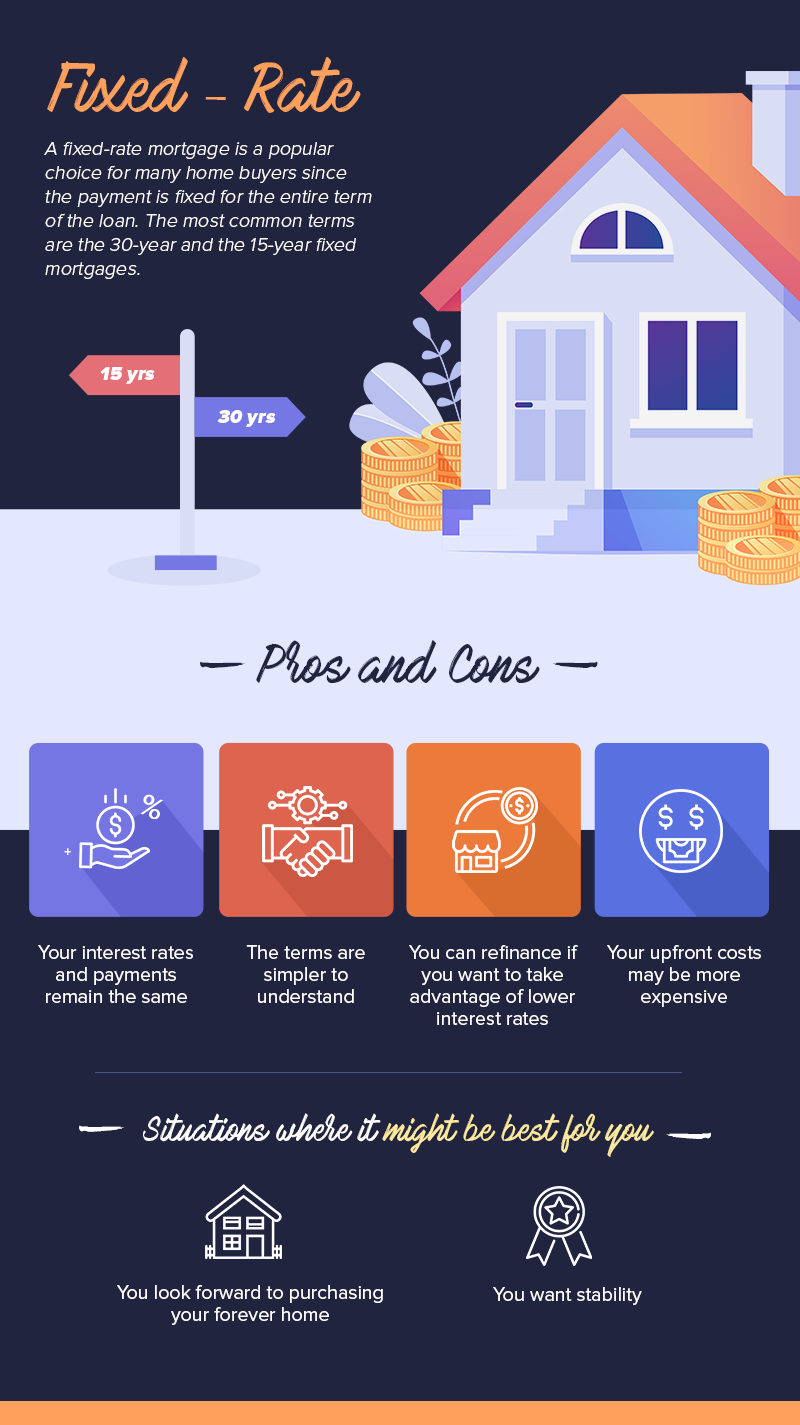
A fixed-rate mortgage is a popular choice for many home buyers since the payment is fixed for the entire term of the loan. The most common terms are the 30-year and the 15-year fixed mortgages.
For the 30-year fixed mortgage, the monthly payments can be relatively low because of the long amortization period. It’s a great choice for many borrowers who want to free up some of their money to achieve other goals and build a safe cushion of emergency funds.
On the other hand, while the 15-year fixed is also popular, monthly payments are higher since the entire loan must be paid off in half the amount of time. It’s best for those who have enough room in their budget and don’t want to be stuck in a substantial period of 30 years.
So if you are ready to settle down in an area or neighborhood, you’re content with your career and want a house that will accommodate your growing family, a 30- or a 15-year mortgage with their locked-in rate can be your best choice.
Pros and Cons
1. Your interest rates and payments remain the same.
Your rates and mortgage payments remain the same throughout the life of your loan so you are protected against the market’s fluctuating interest rates. Even if the mortgage market turns for the worse, there’s no need to worry about paying more in interest. This offers the stability and certainty that many homeowners want since they can easily control their budget.
2. The terms are simpler to understand.
This is an advantage for first-time home buyers who may feel overwhelmed with the different loan terms and options. Fixed-rate mortgages are also virtually identical from lender to lender.
3. You can refinance if you want to take advantage of lower interest rates.
Since fixed-rate mortgage holders will be stuck with the same interest rates and payments, the only way to take advantage of lower rates later on is to refinance.
4. Your upfront costs may be more expensive.
Despite the security and stability that fixed-rate mortgages offer, they can be more expensive. The typical closing costs and monthly payments are often higher compared to an adjustable rate mortgage. Because of this, borrowers with poor credit may have difficulty getting a good deal using this mortgage term.
Situations where a fixed-rate mortgage might be best for you
You look forward to purchasing your forever home.
It’s great for buyers who already want to settle down and stay in their home for the most of their lives or for people who plan to age in place. Instead of choosing an adjustable rate mortgage where they may end up paying more on interest due to varying rates, a 30-year or 15-year home loan with regular monthly payments is a great financial tool. It may help you assess your financial capability, plan your budget, and reduce the risk of paying more in interest over the life of your loan.
You want stability.
You don’t have to deal with anything unexpected when paying your mortgage payments, making budgeting easier. It decreases the uncertainty you can otherwise get if you use an ARM. Your housing payments don’t change so you can manage your finances better, especially since you also need to deal with other costs of homeownership.
Adjustable-Rate Mortgage
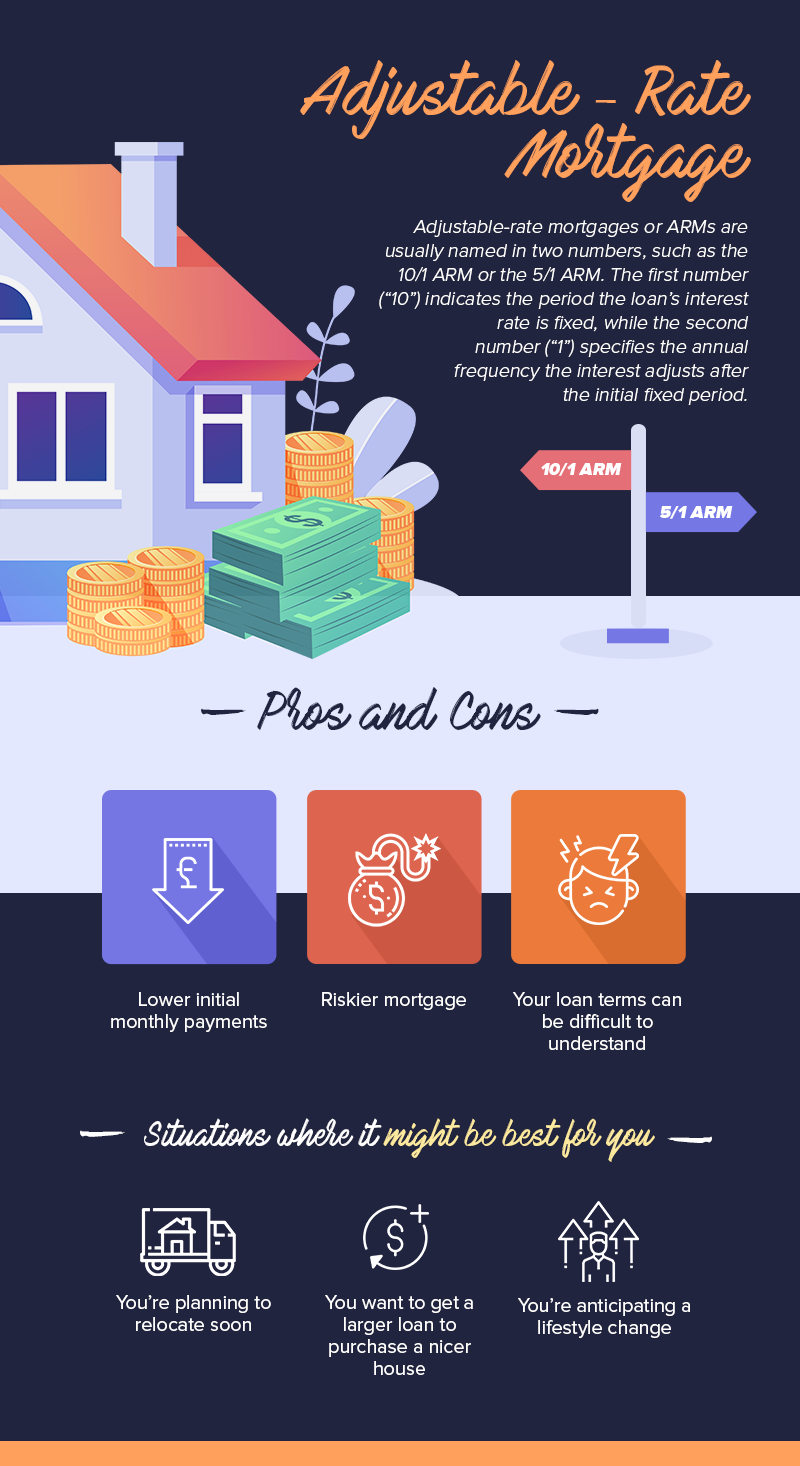
Adjustable-rate mortgages or ARMs are usually named in two numbers, such as the 10/1 ARM or the 5/1 ARM. The first number (“10”) indicates the period the loan’s interest rate is fixed, while the second number (“1”) specifies the annual frequency the interest adjusts after the initial fixed period. For that example, the introductory rate lasts 10 years and after that, the rate can change once a year after one year.
The introductory rate may last for five years (5/1 ARM), seven years (7/1 ARM), and 10 years (10/1 ARM). These conditions may depend on what the lender offers and the specific terms of your loan.
The ARM rate adjusts annually based on the benchmark interest rate chosen by the lender. The most common benchmarks include the one-year London Interbank Offer Rate (LIBOR) and the weekly yield on the one-year Treasury bill.Other ARMs also have specific caps on how high or low the interest rate can go.
Pros and Cons
1. You’ll have lower initial monthly payments.
In the initial fixed rate period of your ARM, you will pay less in principal and interest than you would with a traditional loan. Whether it’s the first 5, 7, or 10-year period, it can help you save money that you can use to purchase items for your new home or allocate on other high-yielding investments. In some loan terms, you can also pay off your loan early without having to deal with prepayment penalties.
2. It’s a riskier mortgage.
You need to know what you are getting into when you choose an ARM. It can be a gamble because while the initial interest rate is fixed for a specific amount of time, it’s highly possible to have a higher interest rate in the future. This uncertainty makes it riskier than a fixed-rate mortgage. However, the potential increase in your interest rate will still depend on the terms of your loan.
Home buyers should evaluate whether they can handle these associated risks and if there is enough wiggle room in their budget just in case rate rises in the future.
3. Your loan terms can be difficult to understand.
Unlike the terms in a fixed-rate mortgage, ARMs can be difficult to understand. Lenders typically have more flexibility when determining specific requirements, such as margins, adjustment indexes, caps on the annual adjustment, and other factors. It can also be customized depending on the needs of the borrower. These things might sound confusing or overwhelming to many borrowers, especially first-time home buyers.
Situations where an ARM might be best for you
You’re planning to relocate soon.
ARMs might make more sense and more appealing to younger, first-time home buyers who want to purchase a starter home. They are the ones who usually have plans to move to a new place after 5 to 7 years or don’t want to settle in one place for long, such as those who will need to relocate due to employment.
You want to get a larger loan to purchase a nicer house.
Lenders can use the lower rates and payments early in the loan’s term when qualifying borrowers. Through this, borrowers can buy larger homes than they could afford with a traditional fixed mortgage. If you’re this kind of buyer, the ARM might be the way to go. This strategy was popular among many borrowers during the housing boom.
You’re anticipating a lifestyle change.
If you’re expecting a significant salary increase or will be advancing in your career soon, an ARM may give you the most advantage. With the lower monthly payments, you can save money now while you have limited income. And then when your income increases just in time, you will then be comfortable with the prospect of making higher payments when your ARM adjusts.
An ARM is also a good choice if you want to keep your long-term options open and not be restricted with a fixed rate mortgage, where the payments will neither go up nor down.
Fixed rate vs ARM: Which one wins?
While ARMs have some appeal, especially to younger, first-time home buyers who want lower initial payments and flexibility, make sure that your income can handle the higher monthly payments once the rates increase. Otherwise, a fixed-rate mortgage remains the ideal option if you don’t want to push beyond the boundaries of your budget to own your dream home. For both loan options, you and your lender will need to carefully assess your financial situation, your long-term plans, and whether choosing one over the other will make more sense to you in the long run.


 Facebook
 X
X
 Pinterest
 Copy Link