Buyer April 19, 2018

Top 5 Things Home Buyers Forget To Check During Home Viewing

The viewing is usually the most exciting part of looking for and purchasing a home. It is the biggest purchase anyone ever makes, and home sellers usually go above and beyond when staging their homes. Because of this, home buyers find it so easy to fall in love with a home that looks great at first sight. But if you really want to make sure that you’re buying a home you won’t hate after all the staging is gone, you need to be aware of the things that aren’t easily assessed with a single look.

Here are the top 5 things home viewers miss when they view a house for the first time. Read up to make sure you don’t make the same mistakes!

1. Storage Units

Storage spaces are extremely valuable assets, and yet they are often overlooked. It’s easy to be blown away by a home’s massive living room, kitchen, or master’s bedroom, but if storage spaces are scarce, your newly bought home may end up looking like a cluttered mess once you move in. Make sure there’s enough built-in spaces for you to stow away your vacuum cleaner, chinaware collection, and beloved linens.

Ask about hidden storage areas in every room, and make sure that they are well-maintained. Just because storage areas are only used to store things doesn’t mean that they’re allowed to be in poor condition.

2. Where the house is facing

You may be wondering why it is important to know whether a house is facing north or south. The answer may not bother you during cooler months, but if the sun hits your house in all the wrong places during hotter days–summers in your home can be unbearably warm.

To avoid this, ask the listing agent or the owner about the sources of sunlight into the house. You don’t want a house that gets scorchingly hot in the summer, but you also don’t want all the walls blocking the sunshine and making the house extremely dark during gloomy days.

3. Dampness & Humidity

Dampness is not always be easy to spot in a home, which is why home buyers often miss this very important detail. Dampness in bedrooms and other rooms can pose serious health risks, so be sure to survey the house carefully and ask the agent if there have been any flash floods in the area in recent memory. Also watch out for musty smells, rusting and discolorations, as well as mold and mildew forming on walls. A newly painted room may also be a sign of a damp cover-up, so be wary of that.

4. Roof issues

The roof is a challenging area to check, but don’t risk skipping this during the viewing. Ask about the materials used for the room, as well as how often they’ve been maintained over the years. If you can, have a look yourself. However, if you can’t have safe access to the roof, check the attic and see if the interiors of the roof structure bear any signs of leaks. If so, this is an indication of a poorly-maintained roof (possibly with missing shingles!)

5. Soundproofing

If you turn off all the noise from inside the house, can you still hear what’s going on outside? If you’re a light sleeper, or someone who often works from home, loud noises from your neighbor’s houses or the street outside can be intolerable. When viewing a home, move past what you see and bring your attention to what you hear as well. Listen closely and make sure that the house is adequately soundproofed. If possible, try visiting the house during the day and night and check if you like what you hear, or in this case–what you don’t.

Buyer April 11, 2018

20 Smart and Simple Ways You Can Start Saving For A Down Payment On A Home

You may think that buying a house still isn’t in your realm of possibility. In fact, you may even feel a wave of panic just thinking about where to get the money for your down payment.

For many young people, saving up to buy a house is the least of their priorities, especially when you’re still in debt from student loans (and even from simply trying to get by until your next paycheck).

However, there are a few, small steps you can make for you to get a little bit closer to that goal. Depending on your lifestyle, there are different ways you can make small changes in the way you spend your money. Once you feel that you’ve already had a jumpstart in saving up for a house, you’ll see that you’re actively seeking more ways to set aside money for your first home.

Set a goal amount and break it down into less intimidating steps. It can be daunting to look at a five digit number that you have to produce for a down payment on a home. The key is to set realistic short-term goals that will eventually add up. Set aside a small amount from every paycheck, and label these savings specifically as “down payment money.”

Choose a bank with the most returns. If you’re not yet ready to invest your money in stocks, you can start by being smart about where you keep it. If the money you have right now is sitting in the bank, pick one with no ATM fees, high interest on savings accounts, and other perks that you can take advantage of.

Switch to hobbies that don’t consume electricity. If you’re fond of watching television (or keeping it turned on while you do something else), try pulling the plug (literally) on this bad habit. Instead of watching shows on TV, try exploring different electricity-free ways of entertaining yourself such as reading, playing outdoor sports, or taking long naps! Turning the TV off also means that you don’t get lured by ads into buying things you don’t need!

Schedule trips to the ATM. Withdraw a set amount of cash per week and stick to it. Divide the money into a fixed budget for each of your weekly expenses such as food, rent, leisure, etc.

Pay your future self first. Consider your savings as the amount you bill to your future self. With this in mind, make sure to pay yourself FIRST before anything else. You can ask your company’s HR department to deposit a specific percentage of your paycheck to your savings account each month.

Wait 30 days before making a purchase. Sometimes, the urge to buy something you don’t really need wears off after a few weeks. If you’re eyeing a pair of expensive shoes, don’t buy it just because you have cash at hand. See if you can live without it for another 30 days, and you’ll see that most of the time, you can.

Make your own coffee. The average American spends $1,100 a year on coffee. You can bring this amount down to less than half if you brew your coffee fresh at home every morning!

Stay healthy. This is a no-brainer. A healthy body means fewer trips to the doctor, and less hospital bills. Make exercise a habit (or an electricity-free hobby, like what we talked about earlier!), and eat your vegetables!

Get in on some food hacks. Speaking of vegetables, a cheaper but equally healthy alternative to fresh veggies are frozen ones. If you’re on a budget, those cheap, frozen broccoli are still a better option than a $3 burger. Look for easy-to-prepare meals you can store and reheat throughout the week, and by the end of the week you’ll be surprised with how much money you’ve saved by not eating out!

Invest. Investments don’t have to be huge. Some banks even allow you to start investing in the stock market via mutual funds with only $50 per month.

Do-It-Yourself. If there’s something you want to buy, do a quick search online to figure out if you can make it yourself. So many people take on DIY projects because it’s fun and can save you a lot of money!

Cancel your gym membership. No, this doesn’t mean that you shouldn’t be prioritizing fitness. There are a lot of ways you can exercise without relying on gym equipment, such as running outside and taking advantage of online workouts which you can do at home.

Kick the cigarette habit. Like hitting two birds with one stone, ditching the stick will save you up to $2000 a year, AND keep you healthier in the long run. It’s hard to quit, but doesn’t that extra $2000 a year sound amazing?

Spend moderately at restaurants. If you do have to eat out, one easy way to not splurge too much is to stick to water. The cost of alcoholic beverages and other flavored drinks are marked up by up to 3 or 5 times at most restaurants, so it’s better to just skip them. Desserts are also quite expensive at fine places, so just buy the ice cream at the supermarket and have dessert at home if you can!

Find generic alternatives. Ask your doctor if you can switch your brand-name drugs to generic prescriptions drugs. If yes, you may save a couple hundred dollars on your annual medicine consumption.

Say NO to email ads. Clean up your email by unsubscribing from marketing emails of your favorite brands. Online shopping is too convenient, which is why people often overspend without thinking twice. The only way to get rid of temptation is to look away!

Swap your stuff instead of buying. Look for things at home that you no longer use and swap them for things you actually need! Deals like this are great for replacing furniture, used books, CDs, and other things that are just stowed away to collect dust in your home.

Don’t spend your tax refunds! If you’re expecting a tax refund, bonus, or any large sum of money this year, give that cash some purpose by sending it straight to your down payment fund. It’s not everyday that you get this kind of money, be wise about where to put it!

Record your expenses. Keeping track of your spending habits is a great way make sure that your finances are under control. If you know where your money goes every month, it’s easier for you to make the necessary adjustments that can save you a lot of money.

Treat yourself! Depriving yourself too much will only take a toll on your spending plans. You want to save as much money as you can, but don’t do it to the point of unhappiness! You deserve to get yourself that delicious piece of steak every now and then.

See? Saving money doesn’t have to be hard and intimidating. You can still live a comfortable life now while saving up for your future home.

Follow this guide for a year or two and you may be surprised with how much money you’ve managed to set aside for a down payment on a home. Start today!

Buyer April 11, 2018

What Is An Interest-Only Loan And Who Is It For?

Are you considering buying a house with an interest-only loan? We rounded up the 5 most common questions about this type of loan and came up with the best answers from the experts.

What is an interest-only loan?

The interest-only period typically runs for 5 years (10 years max), after which the loan converts to the normal principal and interest repayments. However, borrowers are also given the option to pay the balloon (principal owed) as a bulk payment.

During the interest-only period, monthly payments are significantly lower than if you were approved for a traditional amortizing loan.

How are interest-only mortgage payments different from those of a traditional loan?

To understand how an interest-only loan works, keep these definitions in mind:

Payments for conventional mortgages combine the cost of the principal and the interest for every payment, while payments for interest-only loans include exactly what the loan says: interest ONLY.

Monthly payments on interest-only loans are relatively low since the principal is excluded during the loan term. Borrowers will then have to start paying the principal interest once the interest-only term expires, which is usually after 5 to 10 years. This means that higher monthly payments will still occur after the interest-only period.

How do you calculate the payment on an interest only loan?

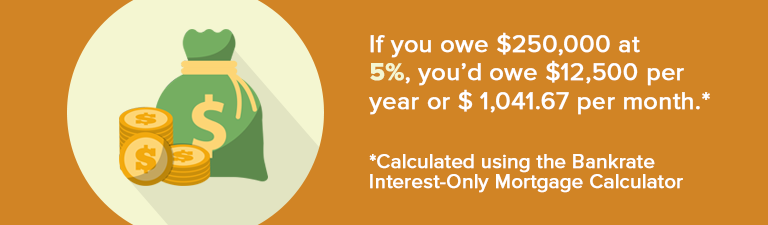
The calculation of payments for interest-only loans is pretty straightforward. The loan balance is simply calculated by the interest rate.

For example:

It is important to note, though, that the payment rises and falls with the LIBOR rate (London Interbank Offering Rate), which is the benchmark most lenders (including banks and financial institutions) use to determine interest rates for short-term loans. If LIBOR rises, the interest payment increases.

You must also make sure that you fully understand the terms of your agreement, as this varies among lending institutions. The key is to be aware that interest rates are usually variable, and will adjust regularly according to the terms of your mortgage.

Who are interest-only loans for?

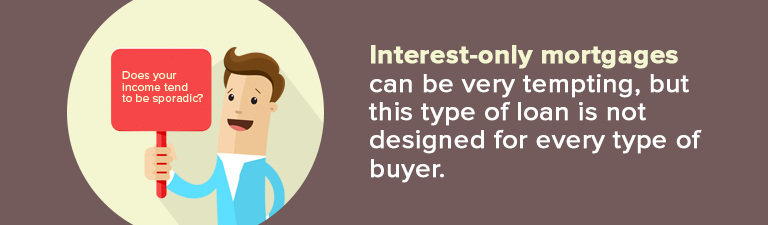
In fact, you should consider an interest-only loan only under certain circumstances, such as the following:

  • Your source of income tends to be sporadic (i.e. commission-based, dependent on periodic bonuses, etc.).

  • You’re an investor who receives dividends in quarterly or semiannual payments, or a high net worth individual who wants to maintain liquid assets for higher yielding investments.

  • You’re a young professional who is confident that your income will considerably increase by the time the loan reverts to a conventional mortgage with higher payments.

  • You’re a short-term homeowner planning to refinance or sell your home before the interest-only term expires, who prefers to have cash on hand rather than build equity.

These are just some situations in which interest-only mortgages can be a good idea. Still, borrowers must fully understand the risks involved in taking this kind of loan. Investors, for example, should make sure that they really invest the difference they save from low mortgage payments. Young professionals must be realistic about their future income, since optimism doesn’t always translate into money. There is also the risk of a market collapse, in which case first-time homebuyers cannot expect low interest rates.

Interest-only loans may not be ideal if you are a standard home buyer who wants to pay less on your monthly repayments. You’ll only end up paying more in interest over the years, since low monthly repayments on the principal will translate to higher loan interests over time.

How can I qualify for an interest-only loan?

The mortgage industry has started implementing stricter qualifying processes with tougher requirements. But if you have done your research and are sure that an interest-only mortgage is the best option for you, consider taking the time to consult with a professional or ask your agent to walk you through the process.

Interest-only mortgages also require “good” credit, which means that you need to have a score of 680 or higher. This also goes without saying, but you have to make sure to find a home which you are 100% sure you can afford for the foreseeable future!

Buyer April 11, 2018

12 Tips For Writing A Compelling Offer Letter That Will Win Sellers Over

In a very competitive housing market, buyers need to step up their game in every way possible. They need to establish that they have a good credit score, a mortgage pre-approval, and a reasonable offer with fewer contingencies. However, if sellers are faced with multiple offers from buyers who are all on a level playing field, a well-crafted offer letter can be a great advantage. It certainly helps humanize the complex process and can help buyers create an emotional connection with the sellers. Here are our tips for writing a compelling offer letter:

Dear Home Buyers,

1. Write it yourself

Your offer letter should be penned by you—not by your trusted real estate agent, not by your bestfriend, or whoever you think can draft it better. Since a purchase offer letter is a unique strategy available to you as a prospective buyer, take the time to write it well. Think of how you can sincerely express your love of the property and connect with the seller while maintaining authenticity.


2. Tell what you greatly love and appreciate about the home (because maybe you love everything about it)

Don’t just directly tell the seller that you want the house—explain why you want it. It’s true when they say “flattery can get you anywhere,” so remember that when writing your offer letter. Find details and features of the home that appeal to you most and mention those. Do you love the seller’s furniture selection? That big but well-maintained backyard? Did that master walk-in closet grab your attention? Tell the seller what you love about the home, but keep everything sincere. It will also help the seller know that you didn’t just send a generic offer letter you’ve copied somewhere. Those genuine compliments about the home’s details that you’re drawn to will surely flatter the seller since he or she must have handpicked many of those. Also, appreciate the fact that the seller took great care of the property.


3. Create a visual memory

“From the moment I first walked through your Craftsman-style door, it already felt like home…”

This may sound like something you read in novels and pocketbooks, but if that was what you felt when you first entered your potential home, then tell it in your offer letter. Because simply telling that “I love the home and would like my child to finish school here in this neighborhood” won’t just do the trick. Be descriptive in telling how you feel about the house, and how you envision yourself in it. Describe how you see yourself and your family having barbeque parties in that sun-kissed backyard, or lounging in a chair in that big, front porch with a book in your hands. Sellers will remember better what they’ve read if what you described provoked a visual memory to them.


4. Briefly give details about yourself

Introduce yourself and your family (Yes, even your fur-babies!) to the sellers. Briefly share details about your career, personal interests and hobbies, and other interesting things about you, as well as your connection to the area. If you’re buying with your significant other, you can briefly recall how you two met and, in a nutshell, describe your future plans in buying the home together.

You can also make it clear that you are going to be a buyer who’s easy to work with. Mentioning what you do for a living can help in presenting yourself as a stable buyer, and to reassure the sellers that they won’t have to deal with a shaky transaction.


5. Establish a personal connection

Try to know the things that the seller values and establish a connection from there. If you share a common interest or hobby with the seller, mention it in your offer letter to make yourself relatable. Indicate any similarities, however simple, that you think will strike an emotion and create a unique bond between you and the seller. It can be kids, pets, or their love for a particular flower or sport.


6. But don’t be too sentimental

Keep the emotions of your offer positive and upbeat. Don’t make your letter dreary by telling the seller how many homes you’ve already lost on; that you struggled with a recent divorce; or about a family member’s illness. Those situations can make the sellers feel uncomfortable, which in turn could backfire on you and come off as phony. Use enthusiastic but sincere language, and maintain a hopeful impression.


7. Exclude your plans to remodel the house

Sellers are, of course, still emotionally attached to their homes. So don’t mention any of your plans to remodel or renovate parts of the house in your offer letter because it might sound offensive to the seller. Avoid phrases that indicate that you want to change or tear down something and focus instead on what you love about the home.


8. Be humble

Since it’s up to the sellers to make a decision on whose offer to choose, stay humble and sincere throughout your letter. Ask for their blessing and stay modest. You could say things like “We would be so honored to be the next owners of your beloved home” instead of saying that you are confident that you will get the home, especially if you gave a generous offer.


9. “Honesty is the best policy”

Remember this golden rule when outlining everything you want to say in your offer letter. You may want to establish a connection or any common interest to the seller, but don’t lie if you can’t find anything that will relate you to them. The same goes for other details you include. Don’t say that your dog will like that big backyard if you don’t have any, or if you don’t really like dogs and don’t plan to get one anytime soon. Be honest and expressive in anything you say in your letter.

Similarly, if your offer is considerably low compared to others, be honest and explain why you’ve given that offer. If you have a young family who’s just starting out, you can say that your budget is still limited. Then make a powerful but sincere statement sharing what it would mean for you to have this house despite your limited budget.


10. Be creative but make it concise

In a very competitive market where sellers can get multiple offer letters, find a way to make yours stand out by being creative. Create a beautiful offer letter with eye-catching fonts and layout (just remember to not overdo it). Then include photos of you and your family that will complement the personal stories you shared. Aside from a creative format, the photos will set yours apart from the rest.

Want some ideas? This L.A. couple’s offer letter in 2016 stood out after they shared details of their unique careers and included pictures of themselves and their rescue kittens (meow!). Likewise, this buyer’s “epic” offer letter won them their house. The letter was designed in an eye-catching format featuring the family, their beagle Charlie (I told you, pets do count!), and specified their favorite features of the home.


11. End it with a sweet “Thank you”

If flattery can get you anywhere, a simple thank you can work wonders. Express your gratitude by ending your offer letter with wholehearted phrases like “Thank you for your time” and “We are very grateful for this opportunity.” It will let the sellers know that you value their time and effort in reading your letter and considering your offer.


12. Bonus Tip: Don’t forget the spell check and grammar check

Remember that your offer letter could create a strong impression to the seller, so it’s important that you write the best letter possible. Even if you don’t have the luxury of time in a tight market, proofread thoroughly to make sure that it’s free from any spelling mistakes and grammatical errors. If grammar isn’t something you’re really good at, utilize free online writing apps or get help from someone who’s good at it. You never know if the house you love belongs to an English teacher or a professor, who may just cringe at the sight of misspelled words and grammatical mistakes that won’t just be considered as typos.

BuyerSeller April 11, 2018

Home Appraisals 101: Factors an Appraiser Looks At To Determine a Home’s Value

An appraisal is an integral part of the home buying process as it determines the objective value of a property. Lenders require an appraisal to help them evaluate a home before they issue a mortgage. Appraisals are done by trained and licensed appraisers, who will then give an unbiased report of the home’s market value.

We’ve already uncovered some of the most common misconceptions about the home appraisal that most buyers and sellers have, and it’s a first step to understanding this valuable process. Now, the next important question is: “What do appraisers really look at during a real estate appraisal?”

Most appraisers use the Uniform Residential Appraisal Report by Fannie Mae, which includes a set of standards that determine the scope of an appraiser’s inspection. They look at a number of factors to get an accurate appraisal, including:

The home’s exterior

The appraiser will pay serious attention to the structural aspects of a home, specifically its foundation, the walls, and roof. The checks will determine the integrity and functionality of those three major components, as well as any defects or damage in the general construction. Any problem with the roof or foundation can immediately dismiss the home unlivable. The inspection will also assess the age of the home, any issues with siding or guttering, and evidence of leaks, cracks or water damage. Be aware that the appraiser will greatly focus on these things as they could definitely impact a home’s value.

Other external factors that will be checked include any potential issues like flood-prone areas and dead trees, parking facilities, and the home’s observable external condition.


Size of the property

When the home is being evaluated, the size of the lot and the size of the home itself are all important considerations. An appraiser will be concerned with the total square footage and the home’s functional layout, as well as the number of bedrooms and bathrooms. The more bedrooms and bathrooms there are in a home, the higher its expected value because most buyers would want the most number of rooms.


The condition of the home’s interior

For an appraiser, the condition of the home’s interior is just as important as its exterior. Appraisers will check the materials and condition of the windows and doors, flooring, plumbing and electrical systems, the number and quality of appliances, the kitchen, bathroom, and all other important parts of the home. He or she will also check for health and safety issues, such as fire escapes and handrails. If the home has undergone a major remodel, it is his/her job to check the code compliance requirements for certain renovation projects. Appraisers will also look closely and itemize all appliances and fixtures installed in the home, including the dishwasher, refrigerator, washer/dryer, oven, and others.


Quality home improvements

The appraiser will also be very interested in any improvements you made to your home, as well as the quality of those improvements. Quality upgrades that make your home more desirable will be considered by the appraiser to determine your home’s overall value.

A new floor, a renovated kitchen or bathroom, new HVAC system, upgraded appliances, insulated windows, renovations to the attic, a garage, and any smart technology systems installed, can all add to the lasting value of the property. These upgrades are all critical elements and will be itemized during the home appraisal. Appraisers will also check for amenities like a fireplace, patio, fence, porch, and other home additions.


Using Comparable Sales or “Comps”

The home’s location and neighborhood also have an impact on its value since appraisers also use “comparable sales” when finding the value of a home. Comparable sales refer to the prices of homes in the neighborhood that have similar age, size, and construction to the home being appraised and which have been currently sold. Appraisers will chiefly consider the square footage and the number of rooms of the home and compare it to other properties. The comparison should be apples to apples, meaning, residential homes will be compared to other homes and condos are compared to other condos. Appraisers can then make adjustments with these “comps” based on the features and qualities of the subject property. A home can be priced higher if it has more bedrooms, or its value can be lowered if there’s a problem with the roof or its foundation.

Bottom Line

Remember that an appraisal is not an exact science but only an opinion of a home’s value based on the comps and the actual condition of the home. In other words, appraisers are looking for any items that can affect the home’s value. The final valuation will be based on real estate market trends, current sale prices, and the specific characteristics of the home. The final appraisal report includes the information used by the appraiser, details about the subject property, and the explanations of the valuation results. The report will be given back to the lender, who will then use it as a guide before making a decision about the loan.

BuyerEmpty Nester April 5, 2018

How To Find The Best Retirement Home For You

The process of looking for a home in your golden years could be a bit different from when you were looking for a home to build a family in. Now, you can focus on what will make YOU happy. Your children have found homes of their own, and you’re now free to choose a new home to create new memories in.

For retirees and senior citizens, location is no longer just about finding a nice house in a pretty neighborhood. It is more about being closer to your family, being just a stone’s throw away from important amenities, and finding a peaceful place where you can comfortably relax. It’s a personal choice that will depend on your lifestyle and what you want to prioritize the most as you age.

Here a list of things to keep in mind when looking for the perfect retirement home for you:

The house itself

The following items on this list focus on location — but before we discuss those, it’s important to keep the obvious one out of the way. When buying a house to retire in, you should start with the basic questions about what type of house you’re looking for. Most retirees choose to downsize, but this entails the same questions: How many rooms? Bathrooms? One-storey or two-storey?

Remember that you’re buying a house that can serve you well as you age. This means that living in it must be convenient for you as you enter your golden years. With this in mind, choose a home with very minimal upkeep, and one that wouldn’t require you to climb up and down the stairs every time you need something from your room. Find an adequately-sized property that will make it easy for you to get from one part of the house to the other–but make sure that it’s still spacious enough for you to move around comfortably.

Proximity to family

To most retirees and empty nesters, family is still what matters most when choosing the location of a retirement home. If you want to be closer to your children and grandkids, choose a location where they can easily visit you, or one that is near the airport and other public transportation options so that it’ll be easy for you to visit them. Being able to spend time with family during the holidays becomes increasingly important as you age, and you wouldn’t want to miss any opportunity to see them more often.

However, pre-retirees must also think long and hard whether moving to a different city, or even to a different state, is really necessary. There is nothing wrong with looking for a new house within your hometown, especially if it allows you to stay close to friends and family, and near the places you most enjoy spending your time.

Weather and climate

If you’ve made your decision to retire in a place that is relatively far from your current residence, do consider whether you can easily adapt to certain lifestyle changes the move might entail.

A drastic change in weather and climate may take a toll on your health, so make sure that you’re moving to an area with a temperature you can enjoy and not just tolerate. Decide whether warmer areas suit you better than cooler ones, or if you’d rather find a house where the breeze is always cool.

Accessibility of important amenities

Making sure that you won’t have a hard time going to places you need to go to is the most important part of finding the right location for your retirement home.

Identify all the important facilities that you will need to visit on a regular basis, and make sure that these places wouldn’t take more than a 20-minute drive. If you take frequent trips to the doctor for check-ups and other medical appointments, ensure that the house you’re buying is near a hospital or clinic. If you like eating out at healthy places, find a house that is near organic or vegetarian restaurants.

Community

One can only truly enjoy a place if the existing community is a good match. To find a place you can truly enjoy, you’ll need to live amongst people you can see yourself interacting with. Check if there are recreational activities you can join nearby and meet like-minded individuals, or see if the Home Owners’ Association (HOA) conducts gatherings or recreational activities you may be interested in. If you’re looking to join exercise classes or educational courses for retirees, you can ask your agent to point you towards the direction of the perfect community where this is possible.

Seller April 5, 2018

5 Things You Save When You Hire A Real Estate Agent To Sell Your Home

Time

You may think that you’re saving a lot of time by not going through the process of looking for and hiring a realtor. However, not having an expert to oversee all of your transactions can actually cost you more time in the long run.

Even if you’ve sold one of your houses before and have a pretty fair idea of how it’s done, neighborhood trends may have changed drastically since–and only a real estate agent can help you navigate recent market trends you may no longer be familiar with.

Dealing with contracts can also cause setbacks if you fail to take all conditions into account. Make sure you protect yourself by hiring an experienced real estate agent who deals with contracts and conditions on a daily basis.

Money

On average, an agent’s commission is 6% of the home’s sale price. This may look like a pretty huge amount to some sellers, which is why some are tempted to eliminate the agent’s commission altogether by doing it the FSBO way.

While it’s true that some people turn out to be perfectly capable of selling their homes without the help of an agent, there is a high risk involved when it comes to pricing your home correctly. Only qualified real estate agents can determine the correct listing price of a home by performing a Comparative Market Analysis (CMA), and by making sure that the listing price draws in proper exposure for the house to be sold within an average of three weeks.

If you price a home incorrectly, it may stay on the market for a long time. This will drive down the value of your home, leaving you with no choice but to settle at a selling price that is much lower than you originally set out for.

Energy

It goes without saying that it takes a lot of effort and experience to market a home to qualified buyers. Looking for interested buyers is taxing enough; pre-qualifying them can even be an added hassle especially if you have a 9-to-5 job to worry about.

On the other hand, a real estate agent’s full time job is to market your home extensively to qualified buyers–most of whom you don’t personally know. An agent does this by posting your home on the Multiple Listing Service (MLS) database, placing ads where it’s necessary, and aggressively following up on potential leads. If you can’t imagine doing all of these by yourself, think twice before deciding to sell your house without an agent.

Relationships

You never thought real estate agents can save relationships, did you? To be clear though, we’re talking about the relationships you have with your potential buyers.

A real estate agent does the tricky business of playing the middleman between you and your buyers. Some interested buyers often have a few things to say that may be offensive to sellers, and it is the job of the real estate agent to create an atmosphere wherein potential buyers are comfortable airing out their concerns about the house. Most of the time, it is difficult to speak directly to the seller without putting the relationship at risk, so it is strongly recommended that you let a professional agent do the talking AND listening on your behalf. This will keep things from getting personal, and will maintain a safe and professional relationship between you and your buyer.

Sanity

If you’re lucky, your house will garner so much interest that you’ll be caught in the middle of multiple offers. While this is what one may call a “happy problem,” it can still take a toll on your schedule, and can sometimes ruin the balance you have in your current life.

This can be quite overwhelming to sellers with full-time jobs, and can often end up being a disorganized mess of negotiations and offers. Sometimes, sellers face too much stress that they end up accepting a certain offer that may not necessarily be the best one, just to get things over with.

If you don’t want to risk disrupting the flow of your current life, save yourself from the craziness of home selling by looking for a real estate agent who will help keep your sanity in check.

BuyerParents April 5, 2018

6 Steps To Choosing A Great School District When Buying A Home

According to the National Association of Realtor’s Schools and Home Buying Decision article, proximity to good quality schools is one of the most influential factors in a buyer’s decision when purchasing a home. It is a major factor especially for buyers with families or young couples who are planning to have children. Homes that are located near top-quality school districts usually translate into higher property values and generally have a huge resale potential. In the NAR 2015 Profile of Home Buyers and Sellers, 25% of home buyers listed school quality and 20% listed proximity to schools as the deciding factors in their home purchase. Many home buyers are even willing to forgo certain home amenities just to have access to quality schools.

As you do your house-hunting, it’s important to also have an analysis of the schools and school districts you’re considering. Here are some things you can do to help you choose an excellent school district wisely:


1. Create a checklist of the qualities and values that are important to you and your child’s education

If you consider a good school district as one of the major factors in your home-buying decision, contemplating about what values matter to you most when it comes to your child’s education is also relevant. A school will be your child’s second home, so you might want to be clear about your preferences. Do you prefer a traditional or an alternative style of learning? How important are extracurricular and skill enhancement activities to you and your child’s development? What are your child’s skills, strengths and weaknesses, and how can these be improved? What sort of contributions are you willing to make to improve your child’s learning? These are just some of the questions you have to ask yourself so you can be clear about the kind of school you want your children to be in.


2. Do your online research

Most schools and school districts have their respective websites where anyone can get extensive information. Spend some time checking the sites of each school you’re considering and read parent and local reviews. Also check out other resources that provide valuable information, such as GreatSchools, NeighborhoodScout, the National Center for Education Statistics, and others. Take time reading downloadable school newsletters and calendars to familiarize yourself with the local news and events. It is also worth looking at some of the following information:

  • Standardized test scores

  • The curriculum being offered

  • The latest rate of students attending higher education

  • Awards and certifications the school has recently received

  • Student-to-teacher ratio

  • The educational attainment of most teachers

  • Languages offered; and

  • Any specialized programs for gifted or needy students


3. Ask your local real estate agent

Your experienced local real estate agent can be one of your best resources in knowing the local market. He/She should have a good understanding of which school districts are top-quality and which are less desirable and could provide you with an objective opinion of the schools. Consider your realtor’s recommendations, and then verify other information you gathered before weighing the pros and cons.


4. Use your network to get more insight

Whether you’re searching for a new home in the next street or heading into a completely new neighborhood, your network of family and friends could be helpful in your quest to finding a good school district. They may have some knowledge of a particular school district that you still don’t know about, or they may also have encountered that school you’re considering during their house-hunting.

Either way, you can reach out to those people you know (and trust) and ask for their advice about a particular area and school. You may also utilize your social media accounts by posting on Facebook and on trusted community groups and pages to find out if people have any experience or insight to share. It will be worthwhile if one of your networks has a friend who’s a teacher or a school staff member who can give you an insider’s perspective, which could be more valuable than online information. At the end of day, it wouldn’t hurt to ask!


5. Talk to parents whose children already attend the school system

You may have done your online research about particular schools and their reputation, but hearing the personal experience of local parents whose children already attend the school system is more valuable. Speaking to them can give you a general understanding of what it is really like learning from a specific school, and whether their children attend any great after-school programs or individualized education programs that will also be beneficial for your children.


6. Visit the schools if you can and if possible

There’s no such thing as going “overboard” when you really want to find a good school district that will benefit your children’s education and the potential resale value of your property. After performing your research, narrow down your top choices and visit the schools in person to better evaluate each school. You can see for yourself how the schools operate and the interactions taking place. If you’re from miles away, call and ask permission first before visiting as some schools may have certain restrictions. See the classrooms and common areas and get a feel of the school’s culture and values through observing its people and surroundings.

BuyerSeller April 5, 2018

Home Appraisals 101: Common Myths Buyers and Sellers Should Stop Believing

What is an appraisal?

An appraisal is a professional estimate of the value of a home done by a certified appraiser. It is a critical process for buyers because lenders always require a home appraisal before they issue a mortgage. Meanwhile, for sellers, a good understanding of the appraisal process will help them understand how their home’s value is determined.

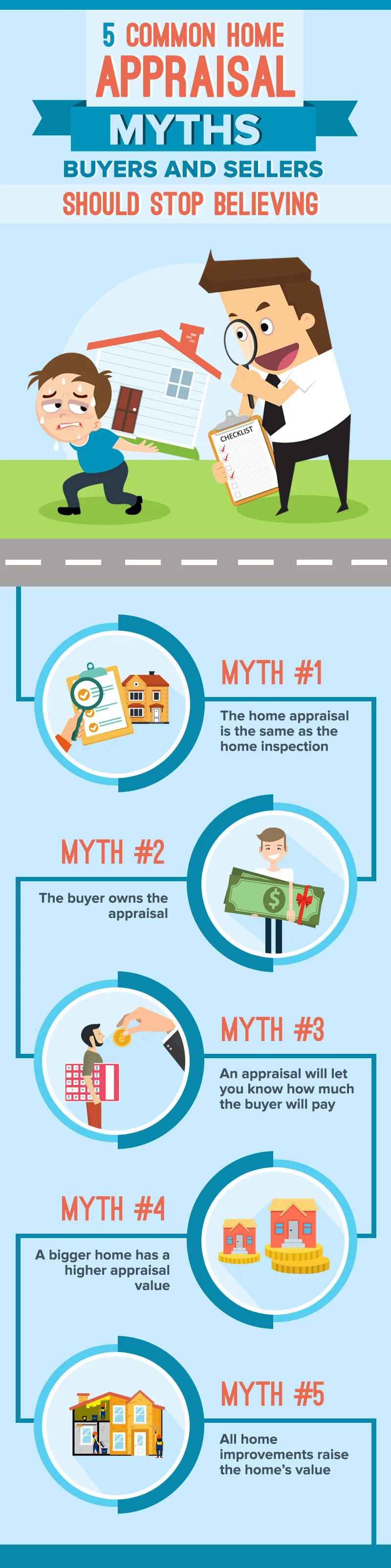
Here, we uncover the most common home appraisal myths to help both sellers and buyers better understand this valuable process in real estate.

Myth #1: The home appraisal is the same as the home inspection

This is probably the most common home appraisal myth that most buyers and sellers believe. While the home inspection and home appraisal are both used to determine the condition of a property to protect the buyer and the buyer’s lender, the two tasks are entirely different. A home inspection is done to identify issues with a home. The home inspector looks for issues that all parties should be aware of before the deal goes on. It is the inspector’s job to look for anything that might be problematic, like mold manifestations, problems with the foundation, plumbing and electrical problems, roof issues, and so on.

The appraiser’s job, on the other hand, is to find the objective market value of the property. The appraiser will look into similar homes in the area that have been sold recently, also known as “comps,” to determine a value. Yes, it’s the same thing you and your realtor used to come up with a list price. Appraisers also take into account your home’s condition, square footage, location, and quality and use the information to make their accurate assessment of how much your home is worth.

The only time an appraiser also takes the role of a home inspector is when the borrower is getting an FHA or a VA loan. In that case, the appraiser will also look for certain deficiencies in a home and may flag those problems during an appraisal.


Myth #2: The buyer owns the appraisal

Since the buyer pays the appraisal, does the appraisal belong to the buyer?

It’s easy to assume that the appraiser works for the buyer. However, while the buyer certainly pays for the appraisal, the appraiser actually works for the lender. An article written by Ryan Lundquist, a certified appraiser, shows a copy of an appraisal report and clears up this common misconception. An appraisal report during a typical loan indicates that the client listed is the lender and that the buyer is listed as the user.

It is the lender who engages the appraiser to do the job. The appraisal is actually an “investigation” to protect the buyer’s lender from a bad deal. The report will help the lender evaluate the property and make a decision about the loan. Rest assured, appraisers are trained to be unbiased and ethical. It’s also a crime to put any pressure on appraisers for them to come up with a certain value. Likewise, a buyer is also legally entitled to have a copy of the appraisal from the lender, especially in Fannie Mae or Freddie Mac mortgages.
 

Myth #3: An appraisal will let you know how much the buyer will pay

Rather than being an exact science, the appraisal is only an opinion of a home’s value based on the comps and the actual condition of the home. It could never indicate how much the buyer should pay, or how much the seller should accept to complete the deal. The appraisal report only provides guidance to the lender and serves as a safeguard for his/her investment.

If the appraisal doesn’t match the contract price or if the home is appraised lower than the price the seller and buyer agreed upon, discussions will proceed on who pays for the shortfall. No, the lender definitely isn’t going to give more money to cover the difference. Instead, the seller and buyer can agree to negotiate a new purchase price that will match the appraisal.


Myth #4: A bigger home has a higher appraisal value

The biggest home in the area doesn’t guarantee that it will be appraised way higher than its neighboring homes. In fact, having an exceptional home in an otherwise average neighborhood can actually do more harm than good. An appraiser will greatly consider the size and amenities of other homes in your neighborhood to determine the price of your home. If your home is super-sized but is actually surrounded by lower-priced homes, its value will still be lowered. The real estate cliche that says it’s better to “buy the worst house in the best block” is still true. It’s because being surrounded by higher-priced homes will also bring up your home’s value, so location remains a top factor.


Myth #5: All home improvements raise the home’s value

It isn’t surprising that most sellers assume they will get equal value for every home improvement project they complete. But what they don’t know is that there are some home improvements that could actually lower its value, and appraisers won’t actually applaud you for those. If you converted your garage into another living space or removed a bedroom to give way to a bigger room, well, you may be in for a surprise. Appraisers base their judgment on measurable aspects of the house, such as the square footage, number of rooms, the home’s foundation, and others. So it’s important to note that every necessary home feature should serve its primary purpose. Having four bedrooms in a neighborhood with mostly three-bedroom houses can bring up your home’s value more than a fancy garage-to-gym conversion.

Likewise, overly improving your house with intricate amenities that don’t even exist in surrounding homes won’t be beneficial. It’s because there will be no nearby sales data that the appraiser can use to evaluate how much those amenities are worth. When it comes to home appraisals, not all renovations can proportionally raise your home’s value, so be careful and educate yourself before removing or adding any amenities.


Bottom Line

Thankfully, working with a trusted local real estate agent can help a seller be more prepared for the home appraisal. Realtors can fill in any information that can be beneficial to the process since they understand what appraisers are looking for. They can look up comparable properties and they know and understand the local market where the home is located. Realtors can also help a seller point out the features and improvements on the property that can help increase its worth.

Seller March 26, 2018

How To Be A Home Seller That Buyers Love

You may think that your house is the only thing that needs to be in its best shape during the selling period. But the truth is, how you are as a seller holds an equal amount of importance to your potential buyer. They may like the house, but if they don’t like who’s selling it, they probably won’t push through with the purchase.

So, to ensure that you are also at your best behavior while your house is on the market, take note of the following guidelines:

1. Stay away.

We know that it’s still your house, and you have every right to stay in it. However, if you’re trying to show it to its potential new owners, you may want to keep yourself from hovering over their shoulders.

Let potential buyers properly envision themselves living in your house without you watching their every move. Of course, the best way to do this is to let your agent do the tour on your behalf. This way, the viewers of your home can be more comfortable looking at the house and asking questions, and you on the other hand will also be spared from possibly saying the wrong things that can jeopardize a sale. Listing agents are trained to respond professionally to buyers, so just sit back and relax somewhere else, and let your agent do the talking.

2. Make your parking space available.

When leaving the house for the viewing, make sure that you bring your car with you as well. Parking issues can cause delay and turn off buyers, so make sure that you’re off to a good start by making sure they have a place to park their car. Let them pull up in your driveway as if it’s their own.

3. Don’t leave your pets.

Yup, your pets have to go, too. Your dog may be great with sporting some puppy dog eyes, but this isn’t going to help you sell your home to potential buyers. Some buyers may be allergic to certain types of animals, or some will simply find pet smells off-putting. Some DO love animals, but you also don’t want your pet to draw attention away from the home. Just take them with you during the viewing, or ask a kind neighbor to babysit them for you.

4. Make important documents available for viewing.

Since you won’t be there to answer the questions yourself, you can at least make it easy for potential buyers to find the answers in writing. Making necessary documents available leaves a good impression on buyers since it signals that you are a responsible owner and seller.

Put out important documents such as your home inspection report, appraisal, and home warranty. You can also give them an idea of their potential monthly bills by leaving recent utility bills and proof of any major repairs.

5. Don’t be in a hurry to get feedback.

Not all buyers express their dislike or even their enthusiasm during or immediately after the viewing. Some of them need to think it over and process everything they just saw. Remember, this is possibly one of the biggest purchases they’ll ever make, and buyers need enough space and time to come up with an offer. Asking them for their feedback right after they leave your home can make them feel that you’re pressuring them too much into a decision.

It is normal practice to ask for feedback from your realtor after the viewing, but expect to hear from the buyer’s agent no earlier than 2 days. Simply assure them that you are patiently waiting for what they have to say, and that you respect their space and time.

6. Trust your agent.

Never forget that your agent is a trained and experienced professional–and, if everything goes well, he or she will be able to close a deal for you and be handsomely compensated for it. If you’re sure you’ve found a responsible and reliable agent, just relax and let him do his job. Allowing your agent the space to negotiate on your behalf is good practice and will ensure that the transaction goes smoothly.