The housing market continues to shift and change, and in a fast-moving landscape like we’re in right now, it’s more important than ever to have a trusted real estate agent on your side. Whether you’re buying your first home or selling once again, it’s mission critical to work with an expert who can guide you through each unique step of the process.
The reality is, not all agents operate the same way. To truly make a powerful and confident decision as you buy or sell a home, you need a real estate expert who uses their knowledge of what’s really happening with home prices, housing supply, industry projections, and more to give you the best possible advice. Someone who can provide clarity and trust like that is essential to your success. Jay Thompson, Real Estate Industry Consultant, explains:
“Housing market headlines are everywhere. Many are quite sensational, ending with exclamation points or predicting impending doom for the industry. Clickbait, the sensationalizing of headlines and content, has been an issue since the dawn of the internet, and housing news is not immune to it.”
Unfortunately, when information in the media isn’t clear, it can generate a lot of fear and uncertainty for consumers. As Jason Lewris, Co-Founder and Chief Data Officer at Parcl, says:
“In the absence of trustworthy, up-to-date information, real estate decisions are increasingly being driven by fear, uncertainty, and doubt.”
But it doesn’t have to be that way. Buying a home is a big decision, and it should be one you feel confident making. You can lean on an expert to help you separate fact from fiction and get the answers you need.
The right agent can assist you in figuring out what’s going on at the national level and in your local area. They can debunk headlines using data you can trust. Experts have in-depth knowledge of the industry and can provide context, so you know how current trends compare to the normal ebbs and flows in the housing market, historical data, and more.
Then, to make sure you have the full picture, an agent can tell you if your local area is following the national trend or if they’re seeing something different in your market. Together, you can use all that information to make the best possible decision.
After all, making a move is a potentially life-changing milestone. It should be something you feel ready for and excited about. And that’s where a trusted expert comes in.
Bottom Line
If you want sound advice and trusted information about our local housing market, let’s connect.
There’s been talk about a recession for quite a while now. But the economy has been remarkably resilient. Why? One reason is employment and wages have stayed strong. Let’s look at the latest information on each one and why both are good news if you’re thinking about selling your house.
More Jobs Are Being Created
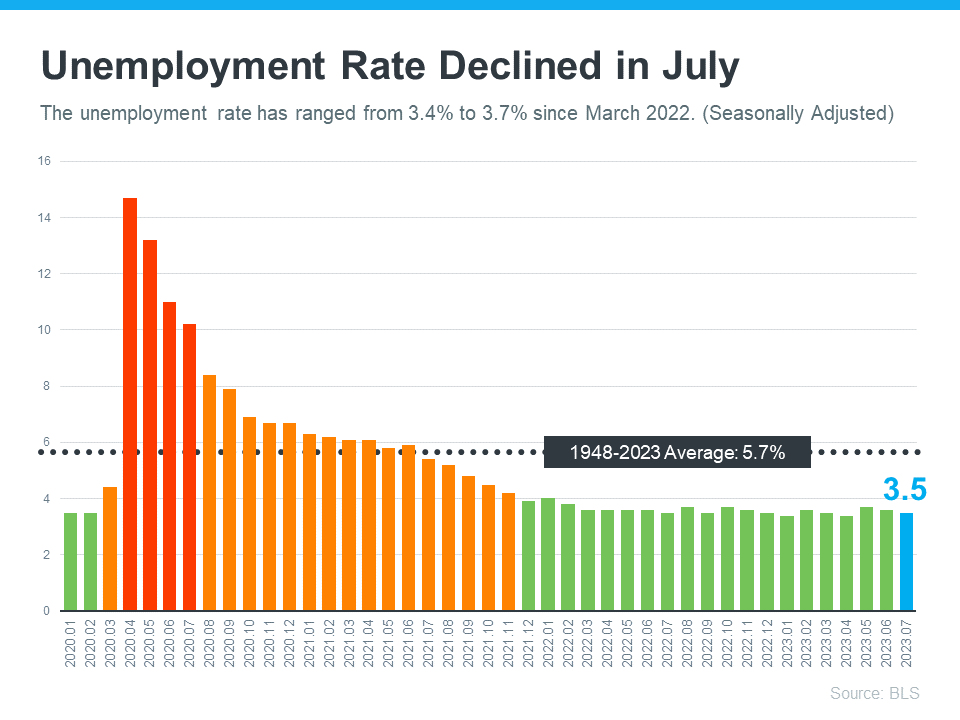
Instead of facing the job losses typical of any recession, the economy has been growing and adding jobs. According to the Bureau of Labor Statistics (BLS), 187,000 jobs were created in July, which is up from the 185,000 created in June. That means more people are finding work. In fact, so many jobs are being added that the unemployment rate is far lower than the long-term average of 5.7% (see graph below):
A low unemployment rate means that most people who want to work are finding jobs. When people have jobs, they have steady incomes – and that can help set them up to consider homeownership.
People Are Making More Money
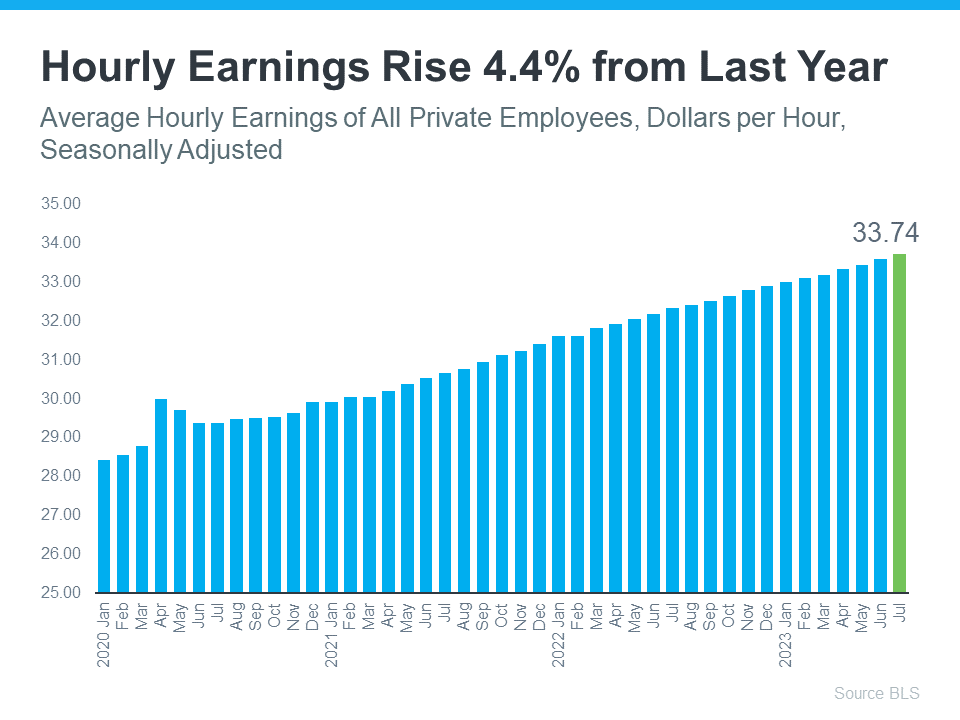
And data also shows hourly earnings have been going up pretty steadily over the past few years (see graph below):
When wages rise, people have more money that they could save or use toward buying a home. This increase in income helps offset some of the affordability challenges in the housing market today. Affordability depends on three main factors: wages, home prices, and mortgage rates. With higher home prices and mortgage rates right now, Builder Online summarizes how growing wages can help:
“The housing market has been a beneficiary of the strong economy and labor market. Many of those employed have saved money over the past few years and used those funds toward a down payment on a home.”
If you’re thinking about selling your house, a strong job market, growing wages, and the resulting buyer demand is fantastic news. It means there’s a larger pool of potential buyers out there who are in a position to pursue their dreams of homeownership.
Bottom Line
With more jobs and rising wages creating eager buyers, there’s a lot going in your favor. Let’s connect so you have someone who can guide you through the process of selling your house, from setting the right price to getting your home ready to show.
The youngest generation, Gen Z, is charging into the housing market with a determination to put down roots and achieve financial independence. Startlingly, the latest report from the National Association of Realtors (NAR) reveals that 30% of Gen Z buyers are skipping the traditional route of living with their parents and are instead diving straight into homeownership.
The Driving Forces Behind Gen Z’s Homeownership Dreams
A recent survey by Rocket Mortgage delves into the motivations driving Gen Z buyers:
Growing Families: For 34% of those surveyed, the desire to start or expand their families is the primary motivator. Homeownership becomes the cornerstone for establishing a stable family base.
Embracing Stability: Stability ranks high, with 20.8% citing it as a key reason to buy. Owning a home with a fixed-rate mortgage secures a steady monthly payment, shielding against the unpredictable rise in rental costs.
Gen Z’s Preferred Destinations: Balancing Urban and Suburban Life
Wondering where Gen Z is planting their roots? Insights from LendingTree suggest they are strategically seeking affordability and nature’s tranquility while still craving the vibrancy of city living.
The Expertise of Real Estate Professionals: Locating the perfect blend of city excitement and natural serenity requires the guidance of trusted real estate professionals. They can help you find a home within your budget, pinpoint desirable neighborhoods, and explore the advantages of remote work in broadening your search.
Bottom Line
If you’re a Gen Z member ready to embark on your homeownership journey or eager to learn more about the process, reach out to us. With our expertise, you’ll have a reliable partner to help you discover a home that aligns seamlessly with your lifestyle and budget. Gen Z is making waves in the housing market, and now is the perfect time to ride that wave towards your dream home.
You’ve only just started your house-hunting journey and learned that a house you’re interested in is located in a neighborhood with an HOA. You might have heard them before, but you might still be wondering, what is an HOA? More precisely, what does it do and how does it affect your home-buying decisions?
If you haven’t had dealings with an HOA before, we’ll walk you through exactly what it means, what it does, and what are the most crucial things you need to know before living in a community that has one.
What is an HOA?
HOA, which stands for homeowner association, is a private organization and the governing body of a subdivision, condominium or townhouse complex, or any planned development. It is run by a board of volunteers who are residents of the community. The HOA makes and enforces the rules for the properties and their residents, helps manage, organize, and preserve the community, as well as protects and increases property values.
If you become a homeowner in a neighborhood with an HOA, you automatically become a member. This means you’ll agree to their terms, owe them monthly or yearly payments, and be able to enjoy the shared amenities and services they provide.
How does an HOA work?
HOAs usually form when a community is built. When a developer acquires land for a planned community, they create the homeowners association and then hand it off to the people who buy houses in that community. The homeowners vote for a board of directors to run the association. The board then decides on the community’s features and services, collects monthly, quarterly, or annual fees to cover the expenses, and sets community rules and standards. These rules are described in a governing document called a Declaration of Covenants, Conditions, and Restrictions or CC&Rs.
Although some states have statutes that govern how HOAs run, most states do not oversee or control how HOAs function. Instead, many homeowner associations are governed through voting and member participation.
5 crucial things to know before buying a home in a neighborhood with an HOA
Living in a community run by an HOA can have its pros and cons. Here’s what you need to know before making that purchase!
The rules and regulations, often referred to as the CC&Rs, often cover all kinds of community standards and violations. Request copies of these documents and read through them carefully ahead of time. It will help you become familiar with the rules concerning the following:
Pet regulations – There may be limitations on the type of pets, breed, size, and how many pets or animals you can have. You might be looking for a house with a huge backyard where you can raise chickens or bees, for example, but your HOA might have some restrictions when it comes to any backyard farming.
Parking – Be mindful of any rules regarding parking overnight on the street, leaving your garage door open for an extended period of time, or parking for any commercial vehicles and RVs or trailers.
Property modifications – Some changes you might want to make may require approval from the board and/or your neighbors. Likewise, some property additions might not be allowed at all.
Leasing or renting restrictions – You may need to get permission from the HOA board to be able to rent the home. Or you may be required to join a waitlist if there are already too many homes in the neighborhood that are being rented. This is crucial if you want to use your home as a future investment property.
Don’t forget to also explore any rules regarding:
Noise levels
Yard decorations
Yard work and maintenance
Fencing height and placement
Exterior paint colors and other design choices
Use of shared amenities and common areas (pools, parks, community centers, basketball courts, etc.)
Before joining a neighborhood with an HOA, it’s crucial to get a clear understanding of the financial obligations that come with it. One of your responsibilities is to pay HOA fees, which are regular payments made by members to cover various expenses such as maintenance, repairs, and upkeep of the common amenities.
By being aware of exactly how much these dues are and how often you need to pay them, you can calculate them into your total monthly costs. You can then determine whether the HOA fees align with your financial capabilities and expectations.
Furthermore, you should also review the HOA’s financial statements and keep an eye out for the association’s financial health. These documents provide insights into the association’s income, expenses, and reserves. You’d want to ensure that the HOA has a well-maintained reserve fund that can be used to handle unexpected expenses, such as repairs and emergencies.
It’s also a good idea to review the minutes of recent HOA board meetings to become familiar with the issues they’re discussing, including any planned assessments, common homeowner requests, and the timeline for completion of small and large projects.
HOA fees also vary depending on the range of amenities and services that the community offers. When considering a home within an HOA, check what amenities are available and how they could affect your membership. Is there a community pool? Do they have playgrounds for kids? Are there basketball or tennis courts? These extras can be beneficial to your daily life and help cultivate a vibrant sense of community.
However, remember to be vigilant when it comes to the quality and upkeep of these amenities. It’s not just important that they are available and accessible; also check whether these spaces are being kept clean, well-maintained, and in safe condition.
In addition to amenities, don’t forget to check the scope of services provided by the association. These may include tasks such as landscaping, trash collection, snow removal, security, and other maintenance and repair duties.
Every community’s HOA works differently. Typically, people within the community elect the members that they believe will best represent community interests, making up the board of directors or a similar governing body. But some HOAs are professionally run.
Ask your real estate agent or a community representative for the HOA’s contact information so you can ask them questions directly. This extra step will help you understand how the HOA board communicates, how they handle disputes, their decision-making process, and the level of influence and input individual homeowners have in shaping the community’s policies and rules. Are homeowners encouraged to attend board meetings and are they able to voice their concerns and opinions? You can then get a glimpse of the sense of transparency and inclusivity that the community fosters.
If the association in the community you’re interested in is being managed professionally by a private company, you might want to investigate its reputation. You might want to avoid investing in a property in a community whose HOA is involved in frequent drama and petty politics.
Understand that HOAs are legal entities and that they have the legal right to enforce rules and issue punishments for rule-breakers. Before settling in a particular neighborhood governed by an HOA, explore how rules are set and enforced, what penalties are in place for not following them, and the process for resolving disputes.
In some HOAs, the consequences may include being fined or sued, or worse, having the HOA place a lien on your property or foreclose on your property.
A gallery wall is a grouping or collection of paintings, photographs, art prints, and other personal treasures and items that are hung on a wall. Gallery walls are not just a decor trend but a decorating staple. They were able to stand the test of time simply because they are one of the most striking yet cost-effective ways to add a touch of visual interest to an otherwise blank and boring wall.
Furthermore, a gallery wall doesn’t just add character and personality to your living space. It’s also a great opportunity to showcase your memories—special family moments, travels, favorite life events—and turn them into a striking piece of art. You can also think of it as a collage of the things or images that you like to look at every day and make you the happiest.
Best places to hang a gallery wall
Since a gallery wall is a terrific solution to liven up forgotten spaces, the perfect and most common spots include the blank walls in the living room, especially the space over the couch or under the stairs, hallways, and staircase walls. Other places may include a wall in your home office, above the baby’s crib, over a bar cart, above a fireplace mantel, or even on two adjoining walls.
5 Tips For Hanging A Gallery Wall Like an Expert
If you recently got your home keys and are looking forward to incorporating your personality into your living spaces, or you’re a homeowner who wants to simply refresh your place, these expert tips can help you in curating and designing your gallery wall.
If this is the first time you’re making a gallery wall, take the time to decide what your theme or subject matter will be so you won’t be overwhelmed with your collection. For personal photos, you may group them by themes, e.g. special family moments, memorable places, travel photos, children’s artworks, etc. If you’re using art or a collection of prints, you can keep your display cohesive by grouping those with the same type of frames, similar artwork, or with the same color theme.
But if you don’t want to get limited by any themes, you can arrange an eclectic mix of all your favorites. You’re also not just limited to photos or prints, as you can add a variety of items such as mirrors, small sculptures, plates, and even plants and unusual objects.
When your collection is ready, you’d want to choose a picture or object that will be your gallery’s center or hero piece. It could be the biggest picture you have or the largest and most stunning art piece. If you’re arranging an eclectic collection, your focal point could be a large mirror, a clock, or any of your largest treasures. Then you could tuck in the smaller pieces all around the largest piece to give it a balanced look, depending also on your chosen layout or template.
If you’re hanging photos, remember that frame selection is also important. You decide whether to put them on simple, minimalist frames that will help the art to stand out on its own. Likewise, you can also use different styles of frames with the same color, or opt for similar frames with lots of different colors. Using ornate frames can also add layers of narrative, especially for historic artworks. You can also leave some pieces unframed to create texture and contrast, making the decor more visually appealing.
Take the time to draw out your layout first before you start hammering. This extra step helps take the guesswork out of the process by making sure you got proper spacing and symmetry in your arrangement.
Extra steps to make sure you end up with an aesthetically pleasing gallery wall:
Measure your wall space.
Lay out all of your possible pieces on the floor first, then measure the overall height and width of the grouping to make sure it’ll fit on the wall where you plan to hang it.
Trace the outline of the pieces onto a large piece of paper and then cut them out. You can then move them around on the wall with painter’s tape until you’re satisfied with your desired layout.
For the spacing around your pieces, design experts suggest allowing 3 to 4 inches between each piece.
For the spacing around your pieces, design experts suggest allowing 3 to 4 inches between each piece. Make sure that there’s even distance between frames so that the gallery wall won’t look uneven or messy. Likewise, keep the entire collection between two-thirds to four-fifths of the size of the wall so it won’t look cramped or awkward.
The process of moving into a new house, even when you’ve done it a couple of times already, will always be stressful and difficult. It’s much more than relocating to a new place, especially when you have to leave a home you’ve lived in for years. It’s where you’ve made thousands of memories with your loved ones and shared countless meals and meaningful conversations with friends. Maybe this was your first home with your spouse or the house where you had your firstborn. If you’re moving to a different neighborhood or state, it might be even more difficult to part ways with the people you love and care about in your neighborhood.
Saying goodbye is never easy, even to a place you’ve loved and called home. However, moving is an inevitable part of life, so we’re here to make it a little bit easier for you. If you happen to find yourself feeling lonely about this huge transition, especially for families with children, here are sweet ways to say farewell forever to a place that was so much more than four walls and a roof.
Go through each room, either by yourself or as a family, and take the time to reminisce about your favorite memories from each specific space. Let everyone bid their own special farewell by sharing a fun or interesting story that happened in that particular room.
Think back on the happy times you spent with your kids in their bedrooms, reading their favorite books or telling them stories. Or the renovated bathroom where you enjoy relaxing bubble baths at night. Your dining room must have a treasure of memories of awesome family meals and get-togethers. After each family member has given their goodbyes, leave the room together and close the door behind you as a symbolic gesture of moving on.
Of course, one of the best ways to help you remember your old home is to make sure you have plenty of photos. Once you’ve decided to sell and before packing all of your belongings into moving boxes, snap pictures of each room, even when they’re messy. Or if you’re someone who already likes taking photos, collect those you’ve already taken, especially when you’re enjoying the little moments with your loved ones—chilling in front of the TV on a weekend night, your kids playing in the garden, you and your spouse lounging on the patio with your favorite drinks, and so on. Anything special to you around the house and the neighborhood, snap a photo of it to help you remember.
You could print the photos out and arrange all of them in an album, with the address and the dates you lived there on the front cover. For those with younger kids, you can encourage them to help you make a scrapbook. If you want to go all out, grab a camcorder and film everything. All of these will serve as a lovely and realistic record of your time at your old home. And if you’re having mixed feelings about moving, these honest images showing the good and bad elements of your house might help you become more excited about your new abode.
Another way to help you remember the time of your life at your beloved house is to commission a painting or a professional photograph. This could be your departing gift to yourself that will always remind you of your old house and the memories you had there, and which you can put up in your soon-to-be home.
If a tangible keepsake is what you’re looking for, check around your property and see what you can bring as a souvenir. One common suggestion from moving experts is repotting your favorite small plant, shrub, or young tree that you can bring to the new house. Even seeds from fruit trees, which you can grow at your new property, can be a meaningful souvenir as a symbol of uprooting and replanting.
You’ve probably had a housewarming party when you got the keys to your home. Now, it’s the time for the opposite: a house cooling party. Even though moving is stressful and busy, it’s an amazing way to share memories and say goodbye to your house. It doesn’t need to be fancy, and never mind if you’ve already started to pack. Besides, it’s a great way to empty your pantry and fridge before your move.
Your immediate family members and long-time friends, as well as your trusted neighbors and other local acquaintances, should be in attendance. And for sure, they won’t mind a few boxes when it’s time to share a final good meal together and reflect on the happy times you’ve had as you lived in the home. Of course, don’t forget to raise a glass to your home and take lots of pictures.
As the summer temperatures rise, finding ways to stay cool becomes a priority for both humans and animals alike. In Richmond, a remarkable initiative at the local zoo has been capturing attention and hearts. With their ingenious approach, the Richmond Zoo has found a way to help their animal residents beat the heat by providing them with refreshing frozen treats. In this blog article, we’ll explore how the Richmond Zoo keeps its animals cool and happy during the scorching summer months.
1. Understanding Animal Needs: The welfare of the animals at the Richmond Zoo is a top priority, and the staff recognizes the importance of creating a comfortable and stimulating environment. Animals have different ways of regulating their body temperature, and providing them with appropriate cooling methods is vital. Understanding each species’ natural behavior and preferences allows the zoo to develop effective strategies to help the animals beat the heat.
2. Frozen Enrichment Treats: One innovative way the Richmond Zoo helps animals cool down is by creating frozen treats that not only provide relief from the heat but also stimulate the animals’ natural behaviors. These treats are carefully designed to mimic the animals’ natural diets and are made using a variety of ingredients, such as fruits, vegetables, and even meat for carnivorous species. The frozen treats not only help regulate body temperature but also provide mental stimulation and enrichment, keeping the animals engaged and content.
3. Cooling Pools and Misters: In addition to the frozen treats, the Richmond Zoo provides cooling pools and misters in various animal habitats. These water features allow animals to cool off by dipping or enjoying the refreshing mist. Elephants, for example, are known to relish water activities, and the zoo ensures they have access to large pools where they can splash and bathe, providing both physical relief and entertainment.
4. Shaded Areas and Ventilation: The zoo also ensures that animals have access to shaded areas and well-ventilated enclosures. Natural shade provided by trees and constructed shelters helps shield animals from direct sunlight and excessive heat. Additionally, enclosures are designed with proper ventilation systems to maintain a comfortable temperature for the animals, reducing the risk of heat-related stress.
5. Collaborative Efforts and Education: The Richmond Zoo’s commitment to animal welfare extends beyond its facility. They actively collaborate with other zoos, conservation organizations, and researchers to share knowledge and best practices for managing animals’ well-being in hot climates. Furthermore, the zoo uses this opportunity to educate visitors about the importance of animal conservation, the challenges they face in the wild, and the efforts taken to ensure their comfort in captivity.
The Richmond Zoo’s creative approach to helping animals beat the heat with frozen treats showcases their dedication to providing exceptional care and enrichment. By addressing the animals’ needs for temperature regulation, mental stimulation, and physical relief, the zoo ensures its residents a comfortable and enjoyable environment, even during the hottest summer days. As visitors, we can appreciate the importance of these initiatives and support the Richmond Zoo’s ongoing commitment to animal welfare and conservation. So, the next time you visit the zoo on a scorching day, take a moment to admire the cool treats and refreshing habitats that contribute to the well-being of the incredible animals that call the Richmond Zoo their home.
When it comes to purchasing a home, it’s easy to get caught up in the excitement of finding your dream property. However, it’s important to consider the potential drawbacks of maxing out your budget for this significant investment. By buying a home that is within your means, you can maintain financial stability and preserve the ability to pursue other important financial goals.
In this blog, we will explore several compelling reasons why stretching your budget to its limit when buying a home may not be the wisest choice. After all, homeownership isn’t cheap, and the expenses that come with it don’t just end at the closing table.
Maybe you love to travel but still want to settle roots in one location. Or you want to start saving as early as now for your retirement. Or maybe you just want to guarantee you’ll have enough funds in case of emergencies. Buying less house than you can afford means you’ll still be able to free up money in your budget which you can use for your other goals: savings, travel and leisure, emergency fund, college fund if you have kids, and even retirement fund. You don’t want to give up these objectives just to pay a large mortgage payment, ensuring that you have the freedom and flexibility to live your life as you’d like.
If you borrow the maximum amount you can afford, you might find it harder to stay current on your mortgage payments in case your life situation changes. Just think of any of these worst-case scenarios that can happen after you sign the dotted line: you lose your job, take a pay cut, your car breaks down, or you or anyone in your family have had a medical emergency.
Depleting your savings just so you can buy a bigger home puts you at a greater financial risk in case such things happen. You can lessen this risk by keeping your monthly mortgage payments affordable and ensuring you have an emergency fund that won’t leave you financially vulnerable.
While your potential mortgage payments are more fixed than rent and you think you can afford it, remember to give yourself as much wiggle room for rising costs. Higher grocery bills and energy costs, especially if you’re moving to a bigger home, can make it harder to figure out a budget that you can comfortably afford each month. Likewise, homeowners association fees and property taxes also go up every year. While no one can plan for inflation, try to leave enough room when you’re putting together a post-home buying budget.
Perhaps one of the things you’re looking forward to the most when it comes to having your own place is decorating it to your style and liking. And since most homes don’t have furniture and appliances, you’ll most likely need to buy these big-ticket items, which could dent your wallet. Even things such as rugs, blinds, and other necessary fixtures aren’t cheap. Purchasing a house within your budget will help you afford pieces of quality furniture and decor that will complement your space, as well as durable appliances that will last.
Finding the perfect property is a dream come true until you realize you aren’t truly prepared for situations like leaky pipes, pest infestation, tree removal, or even gutter cleanings. If you’ve been renting for a long time before buying your first home, know that you can no longer count on your landlord to come over and fix things.
Maintaining and improving a home isn’t cheap, nor will it be easy. This is why it’s critical to limit your spending during your home search so you can have extra funds available for any maintenance and repair. It’s safer as well to have a cash cushion for renovation projects after move-in day so you can improve your home to your specifications and enjoy your space comfortably.
Being house poor means you’re spending most of your total income on homeownership expenses, including mortgage payments, property taxes, maintenance and repair costs, utilities, and insurance, among others. If you’re living paycheck to paycheck and are having a hard time making ends meet because your mortgage is too expensive, the bliss and excitement of living in your dream home could be short-lived. You will soon find yourself stressed out just thinking about your house-related bills, and having little cash for the occasional splurge or a well-deserved vacation.
If you’re in the process of looking for a home today, you know the supply of homes for sale is low because you’re feeling the impact of having a limited pool of options. And, if your biggest hurdle right now is that you’re having trouble finding something you like, don’t forget that a newly built home is a great option.
As a recent article from the National Association of Realtors (NAR) says:
“Home buyers continue to be met with limited housing options during what’s typically the real estate market’s busiest season. . . . The current supply of existing homes is about half the level it was in 2019 . . . Meanwhile, the market for new construction is a bright spot.”
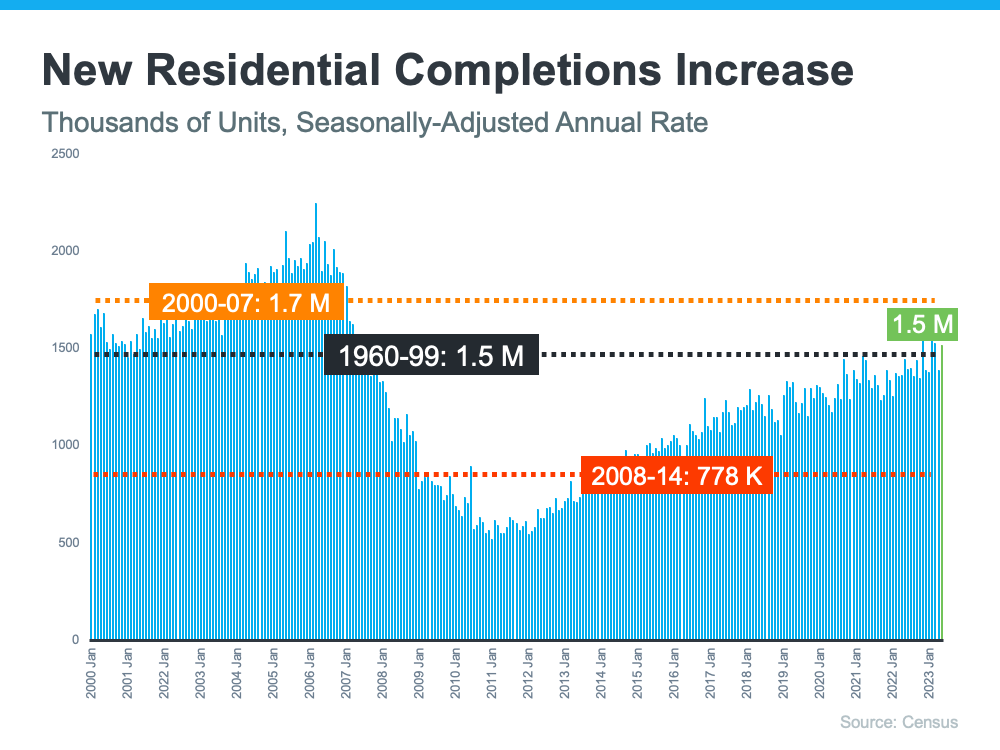
Here’s a look at a key metric that shows just how much new home construction is ramping up nationwide. It’s called new residential completions. Basically, completions are newly built homes that are finished and ready to move into.
The graph below uses data from the Census to show the trend of new-home completions over time, including the long-term average for the number of finished housing units (shown in black on the graph):
As you can see on the left (shown in orange), leading up to the housing crash, builders exceeded that average. The result was an oversupply of homes on the market, so home values declined. That was one of the factors that led to the housing crash back in 2008.
Since then, the level of new home construction has fallen off, and builders haven’t built enough homes to meet the historical average (shown in red). That underbuilding left the housing market with a multi-year inventory deficit. And, that deficit is part of what makes inventory so low right now.
But, here’s the good news. The green on the right shows that according to the latest report from the Census, builders are matching the long-term average right now. And that means they’re bringing more newly built homes to the market than they have in recent memory.
And residential starts and permits are also gaining momentum. Starts are homes where the construction has officially kicked off. Permits are homes where builders are planning to break ground soon. Since both are up, it’s a sign there are even more newly built homes coming soon.
What This Means for You
More newly built homes in various stages of the construction process means your pool of options just got bigger. If you’re looking to move right now and timing is important to you, reach out to a local real estate professional to explore the homes that were recently completed in your area. If construction is done on those homes, you should be able to move in quickly.
But, if you can wait a bit and the idea of customizing a home from the ground up appeals to you, ask that same agent about the homes in your area that are in the process of being built. If you buy a home that’s still in the works, you can help pick the features and finishings along the way. And when none of the homes you’ve looked at so far are to your liking, being able to tailor one to your taste may be your best option.
Either way, a trusted real estate agent is a crucial part of the process. They’ll know exactly what’s available in your area and can base their recommendations on your unique needs, desired neighborhoods, and more.
Bottom Line
So, if you’re having trouble finding a home you like while inventory is so low, it may be time to consider looking into new-home construction. If you’d like to start that conversation, let’s connect so you’re working with an expert on what’s available in our area.
When it comes to selling your house, you want three things: to sell it for the most money you can, to do it in a certain amount of time, and to do all of that with the fewest hassles. And, while the current housing market is generally favorable to sellers due to today’s limited housing supply, there are still factors that can cause delays or even prevent a house from selling.
If you’re having trouble getting your house to sell in today’s sellers’ market, here are a few things to think about.
Limited Access – If You Can’t Show It, You Can’t Sell It.
One of the biggest mistakes you can make as a seller is limiting the days and times when buyers can view your home. In any market, if you want to maximize the sale of your house, you can’t limit potential buyers’ ability to view it. Remember, minimal access equals minimal exposure.
In some cases, some of the most motivated buyers may come from outside of your local area. Because they’re traveling, they might not have the luxury to adjust their schedules when faced with limited options to tour your house, so make it available as much as possible.
Priced Too High – Price It To Sell, Not To Sit.
Pricing is a critical factor that can significantly impact your home sale. While it’s tempting to push the price higher to try to maximize your profit, overpricing can deter potential buyers and lead to your home sitting on the market longer.
“. . . sellers who price and market their home competitively shouldn’t have a problem finding a buyer.”
Not to mention, buyers today have access to a number of tools and resources to view available homes in your area. If your house is priced unreasonably high compared to similar homes, it may drive potential buyers away. Listen to the feedback your agent is getting at open houses and showings. If the feedback is consistent, it may be time to re-evaluate and potentially lower the price.
Not Freshened Up Before Listing – If It Looks Good, It’ll Make a Good Impression.
When selling your house, the old saying “you never get a second chance to make a first impression” matters. Putting in the work on the exterior of your home is just as important as what you stage inside. Freshen up your landscaping to improve your home’s curb appeal so you can make an impact upfront. As an article from Investopedia says:
“Curb-appeal projects make the property look good as soon as prospective buyers arrive. While these projects may not add a considerable amount of monetary value, they will help your home sell faster—and you can do a lot of the work yourself to save money and time.”
But don’t let that stop at the front door. By removing personal items and reducing clutter inside, you give buyers more freedom to picture themselves in the home. Additionally, a new coat of paint or cleaning the floors can go a long way to freshening up a room.
For all of these things, lean on your real estate agent for expert advice based on your unique situation and feedback you get from buyers throughout the process.
Bottom Line
If your house isn’t getting the attention you feel it deserves and isn’t selling in the timeframe you wanted, it’s time to ask your trusted real estate agent for advice on what you may need to revisit or change in your approach. To get those expert insights, let’s connect.


 Facebook
 X
X
 Pinterest
 Copy Link