Buyer April 14, 2020

How to Continue Your Home Buying Journey While Staying Safe at Home

Before the coronavirus crisis, what were your home buying goals?

As the current pandemic impacts our lives and businesses, we’re all left wondering how long will it last. Many families are affected, our frontline workers are risking their own health to save lives, and the economy is expected to have a cycle of downturn. “Non-essential” businesses and services are closed to restrict activities, and we are given a critical stay-at-home order to help flatten the curve.

Major changes have been imposed in the real estate industry, including new policies and guidelines when buying and selling homes. Such policies include strict social distancing, proper and frequent disinfection, and other recommendations by the Centers for Disease Control and Prevention (CDC). With extreme measures in place, many people have decided to put off buying a home for now until this health crisis settles down.

But there are some who are still looking to pursue their real estate plans this year or just want to continue their house-hunting journey even while staying home. If you’re one of them, here are three things you can do to keep your home search on track while giving your best to stop the spread of the virus.

1. Do as much online research as possible.

You may have restricted outdoor and social movements for now, but you can translate it into more time to do research that will definitely be a huge help in your home buying journey. Take this time to do some legwork and investigate these stats and information so you can have a clear path forward once the lockdown is over:

  • Median price of homes sold in your area

  • Average days on the market before sale

  • Schools zones and school reports

  • Transport links

  • Property taxes

  • Crime rates

  • Local neighborhood facilities, such as parks and gardens

  • Neighborhood groups and organizations

  • Common HOA fees, rules, etc.

Likewise, take this time to:

  • Check various down payment assistance programs available in your area.

  • Investigate ways you can reduce your closing costs.

  • Assess your cash flow.

  • Determine your budget.

  • Figure out how much you need to set aside for annual home maintenance and repairs.

  • Make a clear list of your must-haves (want vs need).

2. Connect with a trusted real estate agent.

Because of the quarantine, many brokers and agents are also working remotely and maximizing technology in conducting their businesses. You can call or virtually connect with your trusted real estate agent to be informed about the local property market and ask for any general advice. Schedule video consultations through apps like Skype, Zoom, or Facetime to let them know what you’re looking for.

A reliable realtor will also listen to how you feel about this pandemic, especially if you’re feeling stress or anxiety about the ongoing uncertainty. You may not be inclined to go through showings and buy a home for now, and a good real estate agent will understand that. When you hire such an agent, you know you haven’t just found someone who will help you work through the complex homebuying process when this crisis is over—you’ve also gained a lifetime friend!

3. Take advantage of virtual house tours.

If you don’t want to put your homeownership plans on hold even if you’re stuck inside, you can still look online for available listings and properties in your target area. Because of cancelled open houses and showings to prevent the spread of virus, taking a virtual or digital tour is becoming the new norm.

Thanks to cell phones, drones, 3D cameras, and other software and hardware, potential buyers are now able to conduct a walk-through of the properties instead of just relying on online pictures. You can even ask your agent if a 360 degree virtual viewing of the home is available. With social distancing measures in place, you can now live chat or FaceTime your agent to have them walk you through a property, or check the surrounding areas and neighborhood. They won’t hesitate to advise you on what is being allowed in your state or area when it comes to virtually shopping for homes.

Bottom Line

Our usual activities may have been put on the sidelines for now, but with the guidance and advice of experts, continuing your home buying journey is still possible. We may press pause on our home buying plans, but it’s better to always be ready and informed about what’s happening in the market. It’s being hopeful and wise, and a great reminder that this too shall pass.

Homeowner April 7, 2020

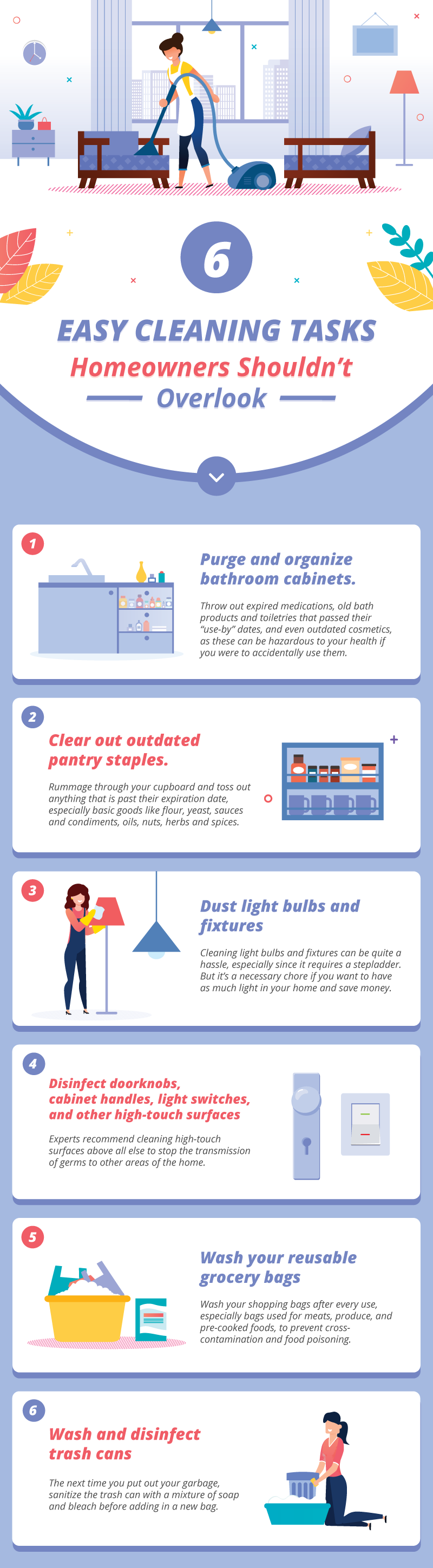
6 Easy Cleaning Tasks Homeowners Shouldn’t Overlook

Whether we admit it or not, there are some cleaning tasks that our minds seem to neglect every now and then. We may be guilty of one or two of these, and that’s totally fine. Nobody says we can’t catch up with our spring cleaning duties, especially now that we’re mostly stuck in our homes for a while.

Check this list to see if there’s any spot or task that still needs your attention:

1. Purge and organize bathroom cabinets.

If you’re looking for a place to start organizing and cleaning, look inside your bathroom cabinet or medicine cupboard. Throw out expired medications, old bath products and toiletries that passed their “use-by” dates, and even outdated cosmetics, as these can be hazardous to your health if you were to accidentally use them. 

It may not be a huge project, but it can still be rewarding as you’ll be freeing up valuable storage space for more important supplies.

2. Clear out outdated pantry staples.

Rummage through your cupboard and toss out anything that is past its expiration date, especially basic goods like flour, yeast, sauces and condiments, oils, nuts, herbs and spices. These kitchen items can go rancid or simply lose their flavor if they’d been opened a long time ago. Also, getting rid of the ones you will never use will clear out much needed storage space for new and more important items. Going forward, try buying in smaller quantities to reduce waste, especially spices you don’t often use.

3. Dust light bulbs and fixtures

Cleaning light bulbs and fixtures can be quite a hassle, especially since it requires a stepladder. But it’s a necessary chore if you want to have as much light in your home as possible and save money. According to the U.S. Department of Energy, dirty light bulbs shed 30 percent less light than clean ones. 

Because light bulbs these days have much longer lifespan than they used to because of LED and CFL technology, they’ll eventually get dirty and should be cleaned. Just remember to exercise some caution when cleaning them. Turn off the electricity to the fixture and put a piece of tape over the switch to make sure no one else turns it on while you’re working. Then wipe them with a dry microfiber cloth to get rid of dust and dirt. Refrain from using a damp cloth as water can get into the crevices in the lamp that can damage electronics. Likewise, don’t spray cleaning solutions directly onto the light bulb to avoid damaging it.

4. Disinfect doorknobs, cabinet handles, light switches, and other high-touch surfaces.

Especially during these uncertain times, we can’t afford to forget to clean things that are always right under our fingertips. Experts recommend cleaning high-touch surfaces above all else to stop the transmission of germs to other areas of the home. These surfaces include light switches, doorknobs, cabinet pulls and drawer handles, railings, faucets, remote controls, desks, countertops, even the handle on your oven or microwave, and knobs of the stove.

These surfaces are some of the germiest places in your house because of the number of times they are touched by different hands in a day, especially when family members are all at home. Make sure to disinfect these spots at least twice a day, even a couple of times if there’s a family member who’s sick. 

5. Wash your reusable grocery bags.

Can you remember the last time you washed your grocery totes? It’s great that you’re doing your part in saving the environment and reducing plastic waste, but your reusable grocery bags harbor bacteria that can be easily moved to food, and then to your refrigerator. Wash your shopping bags after every use, especially bags used for meats, produce, and pre-cooked foods, to prevent cross-contamination and food poisoning. 

Throw them in the washer or wash by hand, depending on the bag’s material. And do not ever leave unwashed bags in the car, as the high heat will serve as a perfect ground for bacteria to multiply.

6. Wash and disinfect trash cans.

The next time you put out the garbage, sanitize the trash can with a mixture of soap and bleach before adding in a new bag. It’s where we throw all the gross stuff and yet we often forget that we also have to clean it. If your garbage can is placed inside a cabinet, disinfect the cabinet as well to make sure nothing icky remains.

Here’s a few tips to remember when cleaning and organizing your home:

  • Wash your hands properly and frequently.

  • Wear gloves when cleaning and disinfecting surfaces.

  • Always read and follow label instructions of a cleaner or disinfectant before using.

Homeowner March 25, 2020

5 Simple Ways To Appreciate Your Home

It’s easier to wish for our home to be something different—to dream of perfect marble counter tops, a cozy front porch, or a pristine bathroom just like what we see on design magazines and HGTV. Because of these, we sometimes tend to fall out of love with our home, especially when we start to notice its little imperfections.

But no matter the size and condition of your space, we must feel content for what we have, especially the roof over our heads. Did you know that every 3rd of December, we celebrate what we call the “National Roof Over Your Head Day” as a day to be thankful for what we have, and show appreciation for the places we call home? This time, if you’re falling out of love with your space, feel free to work through these five suggestions to gain a deeper appreciation of your house and embrace it for what it is.

1. Add house plants.

Make your home greener and more invigorating by adding house plants. They are inexpensive, make such fantastic decorations, and can also make your house happier and healthier. Lots of studies have found out that indoor plants help us reduce stress and anxiety, improve air quality, and facilitate healing. Even if you’re not one with a green thumb, you can tend to indoor plants that are low-maintenance and could be impossible to kill. If you have pets around the house, choose pet-friendly varieties such as spider plants and some succulents. Having house plants is a great way to appreciate your home. 

2. Tackle a home project you’ve always wanted to try.

Whether it is giving your front door a fresh coat of paint (Hello, Classic Blue, the Pantone Color of the Year 2020) or simply changing the hardware on your kitchen cabinets, make one upgrade that you’ve always wanted to recapture the feeling of having something new in your home. There are tons of cheap but great DIY projects you can do to give your humble abode its “newness” factor it might have lost. There’s nothing more satisfying than making a home upgrade which, if done right, could even help in its future resale value. 

3. See your home in a new perspective.

Sometimes, if there’s not enough room in our budget to complete even a DIY upgrade, all we need is a fresh perspective. Use your space in a new way by trying out a new living room arrangement, rearrange the furniture, or go bolder and swap two rooms entirely. These will give you a new outlook on how you’re using a particular space before. Simply changing your room arrangement may even give you more space to set up the perfect reading nook or a mini creative studio.

4. Let there be light.

You may be surprised that simply tweaking the lighting in a room can dramatically change its mood. Lighting is often a neglected part of interior design but it plays an important role in promoting functionality and creating the illusion of space. For starters, reevaluate the lighting in each room and make sure every light in your home serves a purpose to maximize its potential. A new table lamp or an overhead fixture can make an amazing difference in the experience of a room, so don’t be afraid to have enough light sources.

5. Consider cleaning as part of your self-care ritual.

The moment you get your keys, you should treat yourself and your home as one. This is why you should consider cleaning as part of your self-care as a way to express gratitude for your home and embrace what you have. This way, cleaning will be something you’ll enjoy doing. It will help set your mood towards accomplishing other bigger tasks you want to do in your home.

There are many ways we can appreciate the place we call home. Because no matter its size, style, or structure, it will always be our safe haven. At the end of the day, think about and be thankful for the people you share your home with, and the countless memories you’ve shared or will be sharing under your humble roof over the years.

Seller March 13, 2020

5 Things to Remember When Selling Your Home in Spring

With spring right around the corner, many home buyers are coming out of hibernation and are getting ready to step into the market to find their perfect home. So if you’ve considered selling this spring, know that it’s a great time to move forward with those plans.

Here are some things to keep in mind if you want to successfully sell your home while flowers are in full bloom:

The spring and summer months tend to be the most active when it comes to home sales. The change of seasons naturally sets up the mood for people to start thinking about finally moving into a new home. For families with school-age kids, it also makes sense to find a new place to live before summer ends so that moving will be less stressful and will suit everyone’s schedule. 

As you prepare to list your home, keep the extra competition in mind. The best approach is to price your home right, from the start. With the influx of buyers and a competitive market, you won’t have to worry about not making a profit because you’ll often get offers above the listing price. Consider checking out open houses in your neighborhood before finally putting up your own for-sale sign so you can see what nearby homes look like, their common features or amenities, and what price they’re listed for.


Boosting your home’s curb appeal can do wonders to its ability to attract potential buyers. When the flowers come in full bloom and the grass becomes greener, it will be easier to sell not just a house but a total package. So spruce up the exterior of your home by cleaning up your yard, keeping the grass well-trimmed, and freshening up the fence, mailbox, and other outdoor decor.

Likewise, you’ll want potential buyers to picture themselves enjoying their time and making memories in the property. Entice them by bringing the outside in! Add or highlight the outdoor living area where people can see themselves having a sip of their chosen beverage while the kids are playing in the pool and they’re entertaining guests with barbeque parties. If you have the time and the budget, re-assess the space where you can add some profit potential into your property, such as adding a fire pit or revamping your deck.


There are many benefits to having more natural light in your home. It has been proven to boost vitamin D levels and improve your mood and mental health. Also, it can help reduce your electricity consumption since you don’t need to flick on your light fixtures as often. And since there’ll be plenty of natural light during the spring, take advantage of it when you sell your home. 

Natural light is also helpful in staging since it can make smaller rooms feel more spacious and pleasant. So open your windows early in the morning and let the fresh air in. If your home isn’t located on the “brighter” side where light is abundant, you can opt for projects such as painting your eaves white or installing skylights.


Depending on where you live, there’ll be a fair amount of heat and humidity once the drier weather comes. So there’s nothing more important than keeping your home comfortable and inviting for would-be home buyers that will come over for viewings. 

You want to ensure that your home is cool and comfortable by keeping the A/C running and the thermostat set at a comfortable temperature. Buyers will also be able to ensure that the home’s HVAC systems are working efficiently. Having refreshments and snacks ready will also make a great impression on buyers who have been traipsing around town looking at properties in the sweltering heat.


Putting your home on the market this season is the perfect excuse for you to get a head start on spring cleaning. Remember that the first thing you’ll want to do is to make your home look fresh and inviting to potential buyers. Spend time decluttering the living areas and depersonalize the space to allow buyers to envision themselves settling in the home. Try taking a minimalist approach with less furniture and decor. Aside from highlighting its best features, the environment and overall vibe of your home will be extremely important this season to get multiple offers and make the most profit out of your biggest investment.

Buyer March 6, 2020

5 Things You Should Never Do After Applying For A Mortgage

Finally, after months of browsing at homes online and attending open houses and showings, you found the perfect home to buy. Congratulations! You’ve applied for a mortgage and now you can’t wait to settle and decorate. However, until you’ve closed on the house and have the keys in hand, you must stay vigilant with your finances and avoid making any big-time life changes.

During this period, always consult with your loan officer before making any significant changes that could affect your credit and change your original qualifications because the last thing you’d want is to jeopardize your chance of getting your dream home. To save yourself a big headache, we’ve listed a couple of things you must avoid doing to ensure that your home loan application runs as smoothly as possible.

When applying for a mortgage, the first thing you need to remember is to steer clear from buying a car, any expensive appliances or furniture, jewelry, and other luxurious items, on credit. No matter how exciting it is to buy new items and decorations for your future home, remember that all of these purchases will add up. Any new debt will include new monthly obligations, which can result in higher debt-to-income (DTI) ratios that make for riskier loans. So even if you were previously qualified, you will no longer be due to the ratio difference.


One of the most significant factors lenders look into when borrowers apply for a mortgage is their work history. Lenders will verify the jobs you’ve had, but they will look closely in your last two years of employment. They want to make sure that you have a good source of income and that you can repay your loan. 

Lenders will have to track any changes to your annual income so if possible, refrain from changing jobs or changing how you are paid at your job, especially if you’re on salary-based income by the time of your application. You’ll want to avoid becoming self-employed during this time as well. If you must move to a different job as part of your long-time career plan, make sure that it’s within the same industry and that you can justify your move.


Refrain from applying for new credit, even if it’s a new credit card. When you have your credit run by several different financial channels, including mortgage, auto, or credit cards, your credit score will be affected. Lower credit scores can impact the interest rate for which you were originally approved, and could even affect your eligibility for approval. 

Also, do not close any credit accounts during your home loan process. Remember that a significant part of your credit score comes from your credit history, where lenders can assess if you have been making payments on time over a long period. 


If you think having a huge amount of money in your bank accounts will help you better qualify for a home loan, that’s not how it works. It can actually ruin your chances of being approved for a mortgage. Cash is hard to trace, and your lender needs to source your money. If you made an unexplained deposit, lenders might think that you took out a loan or a cash advance just to add money to your account. 


You must discuss with your loan officer the proper way to document your transactions. If you are expecting a large sum of money or keeping a significant amount of cash on hand for emergencies, be prepared to show strong proof of where the money comes from. Also, save yourself from trouble by always keeping copies of deposits so you’ll have proof when you need it. 


Co-signing means you are agreeing to pay off someone’s debts when that person fails to make payments for any reason. And while it is a generous act, especially if it can help a family member or a friend, remember that you are still obligated. And if you’re in the process of getting a mortgage, co-signing a loan is a big NO even if you swear that you’ll not be the one making payments. Co-signing is automatically a red flag on the eyes of a lender. 

The worst-case scenario is when the borrower fails to pay the loan and your lender will have to count the payment against you. You’ll then be forced to pay that loan together with your mortgage. It’s a huge financial risk that no lender is willing to take.

Seller February 27, 2020

Steps to Make Your Home Eligible For An FHA Loan

Buyers with good credit can purchase homes with a relatively small down payment, lower monthly mortgage, and low-interest rates compared to conventional mortgages through loans insured by the Federal Housing Administration (FHA). In fact, the FHA only requires as little as a 3.5 percent down payment, which makes it so popular and appealing to first-time home buyers.

The FHA insures mortgage loans for about 30 percent of today’s home buyers so there is a good chance you will get an offer from an FHA buyer for your home. If your property doesn’t meet FHA requirements, you could cut out almost one-third of your potential buyers.

Here are five ways you can make sure your home is FHA-friendly to increase your chances of selling:

The FHA lending limit is the maximum loan amount the FHA will insure. These loan limits are updated annually and are influenced by the conventional loan limits set by Fannie Mae and Freddie Mac. These numbers can vary based on home prices in different markets and the type of home being purchased.

The FHA’s national low-cost area mortgage limits for 2019 are set at 65 percent of the national conforming limit of $484,350 (for a one-unit property). In high-cost areas, the housing agency’s loan limit “ceiling” was increased to $726,525, while its “floor limit” is set to $314,827.

Before you take further steps to make your home appealing to FHA buyers, check to see if your home’s listed price falls within the FHA lending limits for your area. If the market value of your home falls within the pricing guideline for your area, then you’re already one step ahead. If your home’s price is just above the loan limit, see if you can lower it. But if it’s far above the limit, your home may not be entirely available for FHA buyers. Unless a buyer can come up with the difference between the loan maximum and the selling price, they will not consider looking at your property.


While most home buyers will request a home inspection even if they’re not using an FHA loan, the FHA will not approve a mortgage for your home until you repair any serious problems. You can help your home pass the inspection by fixing any defects, such as roof leaks, structural damage, pest and mold issues, heating system issues, pre-1978 interior or exterior paint that could contain lead, and other safety issues. By doing this, you’ll ensure that everything works properly to increase your chances of approval. 

Just remember that a home inspection differs from a home appraisal. Home inspections evaluate the condition of your home to ensure that it meets safety, health, and building laws. So remember that just because your home passes the appraisal, it does not automatically mean that it will pass the home inspection. 


A buyer can hire his or her own appraiser to evaluate your home. However, the FHA only relies on reports by its approved appraisers to help determine the value and condition of your property. This FHA-endorsed appraisal will be used to make the final loan decision. You can make the appraiser’s job easier by providing them easy access to all areas of your home, including the attics, basement, crawl spaces, and other harder-to-reach places since they usually need to be photographed.


Closing costs can be a big hurdle for many FHA buyers, which is why you can make your house FHA-friendly by helping with those costs. The FHA enables sellers to help with up to 6 percent of the sale price of the home to help with closing costs.

While you are not obliged to help, it can be helpful so you can close a deal faster with an FHA buyer. By offering to pay for some of the buyer’s closing costs, you can make your home stand apart from the crowd, especially if you are selling in a buyer’s market. Just keep in mind that your aim is to achieve your net goal by closing and be able to hand over your home to a reliable buyer.


Working with an experienced real estate agent when selling your home can work well to your advantage. But when you’re taking these steps to prepare for FHA buyers, the easiest way to make sure you’re ready is to work with a real estate agent who knows the FHA process. Your realtor can guide you through the rules and limitations of the government program and can determine if your home is eligible. Lastly, the right agent can help you maximize the desirability of your property so you can attract more FHA buyers.

BuyerHomeowner February 20, 2020

Which Real Estate Documents Should You Keep After Closing?

When you purchase a home, you need to sign an enormous pile of mortgage and closing documents, where each document can total hundreds of pages or more. The huge dilemma: they will likely take up a huge part of your storage space, so you may not want to file all of it. However, you also don’t want to throw out or destroy something crucial. 

Still, it’s important to keep these documents on hand after closing on your home for future reference. You may need them later on in the event that you need to file a claim, either against the seller or any professional from your home buying team (hopefully, that won’t happen). Your closing company will also keep a record of your closing documents, but it’s wiser to keep them handy while you’re residing in the home and when you’re preparing to sell it.

Here’s a list of real estate documents you should keep filed in a safe and accessible place:

The real estate purchase agreement is a legally binding contract signed by both the buyer and seller. It sets forth all the terms and conditions for the home purchase, including the purchase price, closing date, essential rights and conditions, and other terms agreed upon by both parties. 

The provisions stated in this bilateral agreement must be followed and there could be legal ramifications if the buyer or seller fails to fulfill the duties indicated in the document.

These are documents that alter or amend the terms of your signed purchase contract, and they’re worth keeping since they are often related to home inspections or appraisals. These documents could clarify any issues you may encounter down the road or correct any clerical mistakes related to the seller’s or buyer’s name.

This is the contract you signed when you hire a real estate agent to represent you in your home purchase. This agreement is between you and the brokerage and outlines the terms of the relationship with your agent. It details what services your agent agreed to provide you with, as well as the terms of terminating the agreement. The contract also spells out who pays for the commission which, in most cases, is handled by the seller. Make sure to keep this document just in case you encounter an issue with your real estate agent even after the transaction closes.

Sellers are required by law to disclose certain issues with the home to their potential buyers. It is known as the “caveat emptor,” a general rule in buying and selling real estate which means “let the buyer beware.” Disclosure regulations vary by state and issues may include asbestos, lead-based paint, pest manifestations, mold, and repairs done without a permit.

The seller’s failure to disclose these issues in accordance with government or state laws can be a basis for future lawsuits against them. Make sure that you won’t lose them so that in case a major problem comes up with your home after you move in, you won’t have trouble holding the seller accountable.

This detailed document produced by your home inspector shows the condition of the home and its potential problems. It’s an itemized list of the inspector’s findings, highlighting which parts of the home are still in good condition and which are in need of repair or replacement. It should also include photos of the property’s problem areas. Storing this report will help you in planning the repairs you need to make in the future. If you have a digital file of the report, copy it in cloud-based storage so you’ll have a backup.

The closing disclosure is provided by the mortgage lender to a borrower at least three business days before settlement. It includes all the things related to your mortgage loan, such as the loan term (whether it’s for 15 or 30 years), loan type (if it’s a fixed-rate or adjustable-rate mortgage), the interest rates, and all the estimated costs associated with closing and your mortgage. It’s an important document that you’ll need when you file your taxes to get deductions for things like mortgage points.

Your policy includes all the terms, conditions, premium notice, and policy number for your homeowner’s insurance. Keep these documents on hand and remember to update them regularly to make sure you have all the right policy types and the appropriate amount of coverage in case of natural disasters like fire, hurricane, floods, or an earthquake.

Title insurance offers protection against any defects with the title, legal ownership status, or any competing claims to a home. Your owner’s title insurance policy will cover any financial loss in case someone tries to claim the property and wants to settle the case in the court of law, or if there are existing property liens for delinquent taxes and other debts incurred by the former homeowners.

The property deed is a legal document that confirms your ownership rights to the home. It’s proof you can show to anyone that you now hold the title and you legally own the home you’re residing in. Typically, the property deed is sent to you after the title transfer documents are recorded in your county’s public records office. Make sure to secure the physical document because before the deed is mailed to you, neither the mortgage lender nor the title company is required to keep a copy of it.

Seller February 13, 2020

5 Home Renovations That Appeal to Millennial Buyers

More millennials are pursuing homeownership now than ever before, according to the 2019 Home Buyers and Sellers Generational Trends Report by the National Association of REALTORS®. They continue to be the largest generational group of buyers at 26 percent. Also, they now represent 42 percent of all new home loans and are showing interest in more affordable markets.

So if you want to sell your home competitively, you need to learn how to market to this generation of younger buyers who have their own sets of needs and preferences. Keep reading to see some of the best features you can add to your home to make it more “millennial-friendly”.

1. A home office space

The remote work trend is becoming more and more common in the U.S. In fact as of 2019, 66 percent of companies allow remote work and 16 percent are fully remote. Forbes even mentioned that remote work is no longer a privilege but has already become the standard operating mode for at least half of the country’s population. And although this trend is on the rise for all groups, it is especially common among millennials. 

As a result, young buyers are looking for homes with dedicated workspaces that will help them focus on their tasks and will be their go-to place for meetings or last-minute conference calls. Luckily, if you want to make your home attractive to millennial buyers, it’s an easy fix and the space doesn’t even have to be big. Is there a spare bedroom that you could turn into a full-fledged home office, complete with outlets and spaces for shelves? Or maybe there’s a nook in the corner of your kitchen that has good lighting and could accommodate a small desk? Whether it’s through a remodel or during the staging process, it’s important to show the ability to have an in-home office so buyers can picture the space working with their lifestyle.

2. Smart home technology

It’s obvious that millennials are tech-savvy, but they especially crave smart home technology options such as smart thermostats, smart doorbells, keyless locks, and others. Since this age group is practically called “digital natives,” these smart security systems appeal to them the most because they enjoy the conveniences their smartphones offer. Young couples who both work or those who telecommute while caring for their young kids will appreciate the extra convenience and security. 

If you want your home to appeal to more millennial buyers, be prepared to talk not only about your smart home features but also the available wireless service provider, carrier signal strength, and the low-cost options for any new technology, which could be a major bonus.

3. USB Outlets

And speaking of smartphones and connectivity, one way to impress younger buyers is by switching out some of the traditional outlets into USB outlets, especially in bedrooms, living rooms, and kitchen. Millennials always have their smartphones with them, and showing that your home offers accessible charging ports that will make their lives easier will surely catch their attention (no matter how glued they are to their screens). It’s because they no longer need to use a plug or an adapter to charge their smartphones or tablets. Instead, their devices can exclusively have their specialty outlets where only USB cords are needed.

4. Neutral colors

Thanks to the influence of Instagram, Pinterest, and HGTV, millennials favor neutral colors and particularly want to see them in their potential home. Also, the universal love for gray variations, soft neutrals, and white color schemes remain strong so have your home refreshed with these hues. And don’t just stop once you’re done painting the walls. Re-paint your red or maple kitchen cabinets and update hardware such as handles and drawer pulls so that everything has a consistent, neutral palette that will surely attract not only millennials but all kinds of buyers.

5. Outdoor living spaces

Aside from interior home upgrades, millennials also consider outdoor living space as an important factor in choosing a home. They want their outdoor features defined and designed where they can hang out with family and friends and there’s room for their pets to roam. As a seller, you want to make sure that the backyard feels like an extension of the living space. But remember that those areas should be low-maintenance too, or it could turn into a huge turn-off.

No matter the size of your yard, you can make your outdoor features remarkable by investing in some upgrades. Add a fire source like an outdoor fireplace or fire pit, making sure to check your local building codes to verify fire safety rules. Pull together a variety of seating options with accent pillows, add a cafe table, invest in a few sets of outdoor string lights to recreate that chic urban feel, place an outdoor rug, and add some potted plants or shrubs. Through these upgrades, you can achieve that Instagram-worthy outdoor space that will surely hook younger buyers.

Homeowner February 5, 2020

10 Little Weekend Projects You Can Do To Refresh Your Home

Spiff up every space in your home with these DIY projects you can do on a weekend to make your home look and feel its best, especially if you’ve been living in it for a while. These improvements may not cost a lot, but they’ll make a big difference in how your home looks and functions. 

So get your creative juices flowing and give your home some TLC with one or more of these updates:

Adding a new backsplash is an amazing way to freshen up your dull kitchen and add some colors and patterns to it. They add character and also protect your tiles from splashes and spills. Besides, they are easy to install and can be done without the help of a professional. If you can’t manage to install new ceramic or glass tile backsplash because of a tight budget, use peel-and-stick decals to transform those boring white tiles and add a pop of color to a neutral kitchen.

An eclectic gallery wall is brimming with endless possibilities since you can display anything to it—mirrors, photographs, drawings or artwork, wooden letters, postcards, clocks, or even empty frames. It’ll help to add color, pattern, and to personalize an otherwise blank space. You can keep it stylish, chic, sophisticated or even rustic depending on your choice. The most important thing is to think out of the box to create a unique statement wall that will simply define you.  

Get creative with your drawer space or a basic shelf by constructing a mini charging station for your family’s devices. Drill a hole through the back of the dresser and drawer to accommodate electrical cords behind it. Then, use a drawer divider (or even cartons) and a power strip to organize your cell phones, music players and other electronics, together with their respective chargers. With this simple hack, you can keep clutter to a minimum and there won’t be a need to search all the drawers for your charger when it’s time to plug in your favorite device.

Make use of boring, static walls and maximize your home’s vertical space by installing floating shelves. You can add these shelves above your TV, or if you want to increase storage space in the laundry room or bathroom. They’re also the perfect choice in place of a bookcase or to be added in the corner of a room. They also offer flexibility when seasons or your tastes change so you can always have that fresh, cozy look. To add some visual interest, add and arrange framed artworks, decor, coffee table books, family photos, and even succulents. 

Updating your light fixtures is a simple DIY project that can have a game-changing effect on your home since good lighting sets up an invigorating mood and can even add size in any room. So whether you make the most out of natural light or invest in some new bulbs or lampshades, use lighting to create layers and accents. For a rather modern look, swap out the traditional chandelier and go for several pendant lights to grace your dining table or light up a workspace. Switching out your light fixtures in the entryway is also a good project if you need ideas to improve your home’s curb appeal.

Give your cabinets, drawers, and doors a facelift by replacing their standard handles and pulls with hardware pieces that reflect your personal taste. It’s an easy and affordable DIY project that can have a surprising effect on a room’s look, no matter how small these elements are. You can add trendy brass pulls for a modern look, or you can mix and match different metals and finishes to suit the room’s overall aesthetic. Visit a home decor store for new ideas and to check what material and color go well to your home style. Just make sure to measure the existing anchor holes and choose an alternative that’s the same width before doing this update.

The combination of new window treatments and new curtains can go a long way in giving a pretty facelift in a room. Trade your shabby window treatments for some new panels that you can DIY or purchase, then opt for flowy curtains that will not only block out the sun but will also give a boost of color to your home. If you’re feeling fancy and want to add more visual interest into your window, use dark-toned curtain rods with decorative caps. 

With some cheap peel-and-stick wall decals, you can transform a plain and boring room into an artsy wall without spending a lot of time and money. This is also a great way to accessorize your kid’s room since you can let them feature their favorite characters and designs. Also, when their style and preference change, the decals are super easy to switch out. For the living room and other common areas, choose a patterned piece that is appropriate to your furniture. There are also peel-and-stick wood products if you want to give a new face to cabinets and drawers.  

If you’re looking to redefine and add warmth to a space, there’s no better and cheaper way to do it than adding rugs and fabric. And it isn’t only the colors and patterns of the rugs that can have an impact, but their placement as well. You don’t even need to use expensive carpets since you can layer them together. Go with rugs that have bold designs and striking hues or with colors that complement your home’s overall theme and style, then lay them diagonally on the floor for that added visual interest. You can also drape sheets of fabric on your lampshades or on the sofa for that subtle transformation. 

Don’t let another sticky note fall off the fridge by adding a message board in your kitchen or dining area. This is a great upgrade from your simple calendar or notepad and it’s also a fun and functional DIY project that everyone in the family will enjoy. Purchase a premade message board (you have a lot of options—magnetic, cork, or even glass) and fit it in a nice patch of empty wall space that is readily visible to everyone. You can use it for your grocery lists, daily reminders, or even short but sweet family messages that will let you stay reminded and connected to everyone living in the home. 

Buyer January 27, 2020

Here’s What You Need To Know About the Mortgage Underwriting Process

When going through the mortgage approval process, one aspect you need to keep in mind is underwriting. Once you’ve been pre-approved for a loan your application moves from the desk of your loan officer to the mortgage underwriter who will further investigate your financial profile to make sure it matches your lender’s guidelines and loan criteria. The underwriting process plays a huge role in whether your loan request will be approved or denied.

What is mortgage underwriting?

Mortgage underwriting, or Real Estate underwriting, is the process in which mortgage lenders verify your assets and credit-worthiness to get a home loan. All loans go through this step before the lender can give you the funds for a mortgage. It can be as quick as two to three days, but typically takes over a week to finish and happens right before closing.

Mortgage underwriting standards have become more heavily regulated because of additional requirements enacted by the Consumer Financial Protection Bureau (CFPB) after the 2008 housing market crash.

What is the job of a mortgage underwriter?

The underwriter plays a huge role in whether or not you can get the mortgage for your dream home. Some of the underwriter’s responsibilities include:

  • Assessing your risk as a borrower and making sure you meet the lender’s guidelines

  • Reviewing and confirming your application and documentation, employment, and financial history

  • Making sure all documents are present and accurate according to mortgage industry standards

How mortgage underwriters assess a borrower’s risk

The 3C’s of underwriting include:

Underwriters assess your risk by typically reviewing your documentation and paperwork, such as tax returns, W-2s, bank statements, asset statements, pay stubs, savings, IRA accounts, and other basic documents. They may also request specific documents depending on the type of loan you’re getting. If you are self-employed, you may also need to provide more detailed documentation of your income and work status. 

Underwriters will also pay attention to your debt-to-income (DTI) ratio to make sure you have enough money to cover your current financial obligations even if you’ll take on a mortgage.

Your credit score is one of the most important factors in your mortgage loan approval. You need to have a solid credit history to show that aside from being financially capable you’re also a responsible borrower. Since your credit score is important, the underwriter will look closely at your credit report to see how you have handled past bills and credit, such as credit card payments, car loans, or student loans.

In addition, the underwriter will review the type of property you are looking to buy, its value, and how the property is used. Different types of properties carry different risks, especially when it comes to investment properties. So the lender needs to make sure that the loan amount meets the loan-to-value requirements of the product. He or she will typically order a home appraisal to determine the objective value of the home.

While the mortgage underwriting process can vary according to lenders and the institution they belong to, all lenders will most likely involve these three C’s when assessing your risk as a potential borrower. Understanding these factors can help you understand what to expect with the process for you to have a better chance of getting a mortgage.

Common reasons why underwriting is denied

Underwriting takes place behind closed doors. If your underwriting is rejected your loan officer or mortgage broker will relay any requests for additional documents or further explanations. You can provide the additional documents to get your loan process back on track, such as an explanation for a recent huge bank deposit or withdrawal, or further documents to verify your income and employment.

However, if your underwriting was denied due to problems like a low credit score, high DTI ratio, and insufficient cash reserves, it might take time to resolve these problems before you can complete the loan approval.

Tips on how to speed up the underwriting 

While mortgage underwriting can be very complicated and frustrating for any potential borrower, there are steps you can take to allow your loan application to sail through as smoothly as possible:

  • Make sure your paperwork is complete.

  • Respond promptly to your underwriter’s request for more information and supporting documents.

  • Protect and maintain a good credit score during the entire process and until you close on the home.

  • Keep in touch with your lender and/or mortgage broker to check on the status of your application.