Seller January 20, 2020

7 Truths You Should Never Say To Buyers When Selling Your Home

When it comes to selling your home, it is your duty to disclose things that could be harmful to the future homeowners, such as the presence of asbestos or lead paint in the property, pest infestations, and even mold. However, there are certain facts that sellers should never slip to buyers, especially when it involves personal circumstances.

And while a seller should never be around the house during showings, it isn’t uncommon for the buyer and the buyer’s agent to show up while you are still in the house. And during those short moments when you’re leaving for the door, questions from the buyer such as “Why are you selling?” and “How long has this been on the market?” could be thrown at you. If you’re not mindful of answering these seemingly innocent questions, they could reveal important details that could compromise your negotiating power and cost you the home sale.

Here are some of the things sellers should never, ever talk about with a prospective buyer:

While this information is often listed on the home’s information sheet, you may want to avoid bringing up this topic to potential buyers. Discussing to the buyer how long the home has been on the market can send the wrong message. They may think you’re desperate to sell, so there’s a chance they will give a lowball offer, include too many contingencies, or complicate negotiations. Likewise, buyers may think there’s something wrong with the house that’s why it’s still sitting on the market.

“So, why are you selling your house?”

One of the biggest reasons people sell their homes is out of necessity. You may have lost your job or got an offer to another city; you’re getting a divorce, having financial problems, or had a death in the family. No matter your situation and reason for selling your beloved home, you may want to keep that to yourself. Because while all these situations could evoke sympathy to your potential buyers, it won’t stop them from thinking that you’re desperate to sell. 

Remember that the buyer’s goal is to get the best deal possible, and when you hint that you’re going through some difficult times, some buyers may attempt to take advantage of the situation. The last thing you want to show them is desperation. You need to always appear confident so you can fetch top dollar out of your biggest investment.

Each buyer has their own preferences. So avoid saying anything about the neighborhood, or else it could backfire. Informing them that you’d want to move to a peaceful neighborhood could imply there’s a problem with your neighbors or your community in general. Likewise, saying that the area is quiet won’t be helpful either, especially when the buyer wants a thriving nightlife. You don’t know what a home buyer wants in his or her new community so it’s better to avoid this topic.

Don’t disclose that you already found your next ideal home but that your offer is contingent on selling this house. The same rule applies if you’ve already purchased your next home and are already dying to move. While these situations are very common, it may signal to potential buyers that there’s a sense of urgency and you need to sell quickly. And this may prompt them to yield a low ball offer. So instead of sharing that you already found the home of your dreams, tell them that you’re still looking.

Here comes a buyer unconsciously asking, “Would you mind telling me if you’ve had any offers yet?” Your best answers should be, “We’ve had a lot of interest” or “We’re expecting an offer soon.” There’s no need to broadcast how many offers you have or haven’t received, or admit the sad truth that you haven’t entertained a serious buyer since you put your home on the market. You didn’t lie, and these matters should only be between you and your listing agent.

Don’t ever mention anything that you think might be wrong with your home. There’s the temptation, of course, of saying: “We’d always wanted to repair this…” or “We planned to renovate this part of the house but…” Your dreams and “what ifs” for your home and any repairs you planned to address shouldn’t surface now. You may be planting the idea that there’s something wrong with your house. Likewise, if you indicate that the bathroom or bedroom needs renovation, the buyer will think he or she needs to cough up more money, and no matter how good your intentions are, any potential buyer wouldn’t want to entertain any additional costs. They may not even agree with your idea of redoing the bathroom and may love the home as it is.
Who wouldn’t want to sell their house for the best price possible? When it’s time to sell, being realistic to possible price reduction considerations is also paramount. Announcing to your potential buyers that you’re not open to negotiating is a colossal mistake. When you hint that you are inflexible on the home’s price, it may discourage buyers to try to work out on the acceptable price and terms. The worst possible scenario: people may start to avoid the house when words spread that you’re this kind of seller, and your home could sit on the market for a while. Be realistic and open to reasonable offers to increase your chances of putting more money on the table.

Bottom Line

“Loose lips sink ships.“Anything you say can and will be used against you.”

These are just some expressions that hold true when it comes to selling a home, and those things, when blurted out, could jeopardize the sale. When you find yourself interacting with a buyer and they ask you questions, just give them short, vague, or neutral responses. Better yet, let your listing agent do all the talking. Part of their job is to handle all communication and negotiations with prospective buyers. If you can’t get away without answering a question, simply tell them that they will have to ask your agent. No more, no less.


BuyerRenter January 13, 2020

7 Signs You’re Ready To Stop Renting and Finally Buy Your First Home

While there’s certainly a huge debate on renting vs buying a home, no one could argue that it’s a major decision for many people. Some say renting is like throwing money down the drain and you’re just paying off someone else’s mortgage. Others insist that there’s no way they could give up their flexibility and be tied up in one place. 

If you’re finally thinking about taking the plunge into homeownership this year, how do you know that it’s time for you to take that leap? The decision on whether to rent or buy is a huge and costly endeavor, but you can always justify it based on logic and emotion. To help with your case, we’ve laid out seven signs you’re ready to make the switch from renter to homeowner.

1. Your rent payments keep going up.

Rents keep on escalating in many parts of the country, and this is one of the biggest reasons why any renter would want to buy a home. In some neighborhoods and real estate markets, the cost of renting is even higher than the average monthly mortgage of a single-family home. If you already feel trapped with the uncertainty of your rent payments, you might be better off purchasing a home where your mortgage is consistent, and you’ll be gradually putting equity into your biggest asset.

2. You have steady employment. 

Employment plays a huge role in the mortgage application process since lenders and mortgage companies take into account your employment history before approving you for a loan. Typically, they would want to see that you spent at least two years working for the same company or in a similar field, and that you’ll likely continue having the funds to pay your debt. If you’re a freelancer or a gig economy worker, you need to prove that you have a steady source of income for a couple of years through your W-2s, tax returns, and other documents. Just remember that for lenders, a stable job means a stable income, which lowers your risk as a borrower.

3. You’ve saved up for a down payment, closing costs, and other costs associated with owning a home.

 For many home buyers, the most difficult step in the home buying process is saving for a down payment, according to the 2019 NAR Profile of Home Buyers and Sellers. Setting aside money for a down payment towards their dream home is made even harder because of student loans and credit card debts. So if you have a stable job for a while now and your income has improved, there’s a better chance for you to save up enough extra money to cover up the added expenses of homeownership.

And remember that the 20 percent down payment requirement for you to qualify for a mortgage is already a myth. In fact, mortgage insured by the Federal Housing Administration, also known as FHA loans, require only 3.5 percent of the home’s purchase price. Meanwhile, government loans guaranteed by the U.S. Department of Veterans Affairs (VA Loans) and the U.S. Department of Agriculture (USDA Loans) require no down payment at all, so there’s no need to scrape all your money just to cover the 20 percent down payment if it means leaving zero balance in your savings. 

You know you’re ready to get the keys to your new home instead of renewing your lease if you have also saved up for closing costs and other homeownership expenses, such as property taxes, maintenance funds, and homeowner’s insurance.

4. You’re managing your debts.

It isn’t necessary for you to be totally debt-free when you apply for a mortgage. Loan companies simply need to make sure that you aren’t carrying too much debt compared to what you make, and that you’ll be able to afford to take on additional responsibility, such as your potential monthly mortgage payment. They do this by determining your debt-to-income (DTI) ratio, which measures how much of your monthly income goes toward paying off your debts. 

Lenders ideally prefer a ratio lower than 36 percent, but borrowers with no more than 43 percent DTI ratio can still get qualified for a home loan. Getting your debt down to a more manageable level will help put you in a stronger position to get pre-approved. Assess your spending habits even while still renting, and change them as much as possible to improve your chances of finally owning your first place.

5. Your credit score is in good shape.

One of the biggest reasons why renters can’t make the leap to owning a home is because of their low credit score. Having good credit matters because it will determine how much money you can borrow and how much you’ll pay in interest. A good FICO score is usually about 690 and higher, although borrowers with a credit score as low as 500 can already qualify for a mortgage depending on the loan program. 

When was the last time you’ve checked your credit report? If your credit is looking healthier because you’re making timely payments and settling your debts, you can have access to more conventional loan programs with lower down payments. Once you have addressed this important issue, you can rest assured that homeownership is now within your reach.

6. You’re ready to settle in a neighborhood you love.

This one’s quite subjective, but your preferred location and your capability to settle in one place are also huge considerations when buying your first home. If you anticipate moving in a few years, you know that you’ll only live in a particular area for a year or two, or you just can’t imagine yourself being tied down in one place, renting is likely your best option since you can leave whenever you want. Renting is also your smarter bet if you want to test out the waters in different areas where you’re thinking of buying a place. 

But once you’re ready to settle down in a neighborhood you love, you’re secured in your job, and that you can see yourself putting down roots in the next five years, purchasing a home is your next sensible step.

7. You’re ready to finally become a homeowner.

In the 2019 Home Buyers and Sellers Generational Trends Report by the National Association of RealtorsⓇ, 29 percent of all buyers cited their main reason for purchasing was the desire to own a home. Your readiness to become a homeowner matters above everything else. When you own a property, you’ll be in charge of all the repairs, maintenance, and upkeep costs. If you’re not comfortable with these tasks and you’d rather leave the problem to a landlord, you may be better off renting for longer. Many people simply prefer to rent instead of taking advantage of lower interest rates because of this reason.

If the idea of home maintenance no longer intimidates you, you actually enjoy fixing things up in your place, and you’re ready to stay for the weekends just to mow the lawn and do other yard work, these are signs that you’re finally ready to call a place your home. You know you’re ready for the huge responsibility that is homeownership and you’re ready to be your own landlord.

BuyerGeneral December 27, 2019

Practical Tips on Home Buying from 5 Awesome Movies

Without a doubt, our favorite movies are the ones we can relate to in one way or another. And whether you’re buying a home or starting your house search, it’s a good thing to know that there are movies you can definitely relate to. A lot of movies touch on real estate, even if they do so subtly or as a side plot.

Here we have selected five movies whose little lessons could go a long way in your journey to finding your dream home:

1. The Burbs (1989)

Starring: Tom Hanks, Bruce Dern, Carrie Fisher

Synopsis: This comedy horror-thriller film depicts an overstressed suburbanite and his fellow neighbors who have suspicions about the new family on the block who bought a house under strange circumstances. They are convinced that their new eccentric neighbors are part of a murderous Satanic cult.

Handy lesson: Introduce yourself to your neighbors BEFORE buying your home!

2. The Money Pit (1986)

Starring: Tom Hanks, Shelley Long

Synopsis: This film focuses on a young couple who moves into a huge and expensive house, which turned out to be a hopelessly dilapidated property. They decided to buy it after being seduced by the promise of a bargain home and by the seller’s sob story and insistence.

Handy lesson: Make sure your home inspection is thorough! Like really, really thorough!

3. Beetlejuice (1988)

Starring: Geena Davis and Alec Baldwin

Synopsis: Beetlejuice is a comedy-fantasy film that revolves around the spirits of a deceased young couple who are haunting their former home, only to find out that the home has new inhabitants. They hired a malicious ghost to scare them and drive them out.

Handy lesson: Always double check that the former residents have actually moved out!

4. Back to the Future (1985)

Starring: Michael J. Fox and Christopher Lloyd

Synopsis: A teenage high school student accidentally traveled back in time through the time-traveling machine DeLorean, which was invented by an eccentric scientist who’s also a close friend.

Handy lesson: Consider how the value of your home changes as your neighborhood changes, especially if you break the time-continuum!

5. Up (2009)

Starring: Edward Asner and Jordan Nagai

Synopsis: This heartwarming animated film centers on a 78-year-old widower who travels to Paradise Falls in South America in his home equipped with balloons to complete a promise made to his late wife. However, a young “Wilderness Explorer” inadvertently became a stowaway when he visited the elderly’s home to earn his final merit badge.

Handy lesson: Love your old home, but need to move? Consider moving the actual house!

If you’re planning to buy a home in the near future, don’t forget to add these movies to your binge-watch list this holiday season!

BuyerGeneral December 16, 2019

6 Bizarre Real Estate Laws Across the U.S.

When it comes to laws in the United States, every state is different, especially when it comes to real estate and property management. But there are also real estate laws that are nothing short of bizarre or just downright weird and humorous. If you’re looking to move to any of these cities or states, this might help you know some fun facts and trivia about your potential new neighborhood.

Here are some of them:

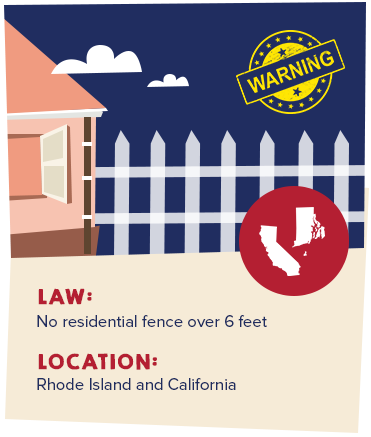
Want some privacy in your yard? No matter how much you dislike your neighbors, you can’t go all the way in building a fence on your property. There are laws that exist to dictate how high your fence can be. In Rhode Island, for instance, you can put up a fence but not more than 6 feet. Any fence higher than that is considered a “spite fence,” which is often constructed to annoy neighbors and as such, a private nuisance. The state will make you remove it or lower it immediately. This fence law is enforced so that residents can get unobstructed views and to prevent conflict between neighbors. On the other hand, California also has this kind of law that disallows spite fences exceeding 10 feet.

And while we’re discussing fences, putting up a traditional white picket fence is not allowed in Scranton, Pennsylvania.


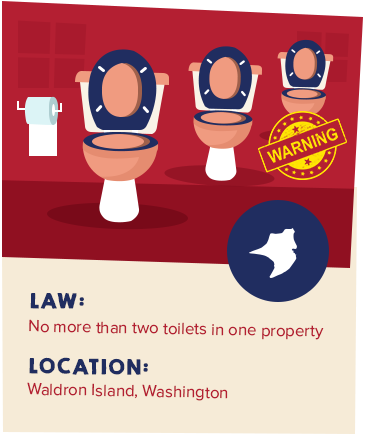
For any buyer, having the right number of bathrooms is crucial when looking for a home. But in Waldron, a tiny island located in the Puget Sound which sits between Washington State and Canada, there is a law that prohibits having more than two toilets in any property or building. The island isn’t yet fully developed but does have a small elementary school and a post office. The ban is intended to help limit development on the island, and also seems to aim to conserve the town’s water supply. People who live there like it to be kept private and quiet, and want to keep it that way. 


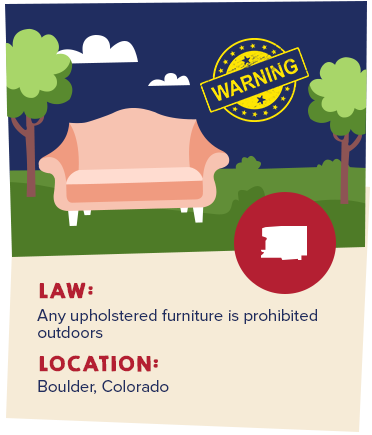
Couches, chairs, mattresses, chaise lounges—you name it. You cannot have any upholstered furniture, or any furniture not manufactured for outdoor use, in the yard or on the porch of your home in Boulder. The restriction was passed to curb the dangers of setting those things on fire. It is because local college students, who were known for their party atmosphere, would get drunk and had a habit of setting fires to the said couches. Since passing in Boulder, many other cities, such as Ames, Iowa, Lincoln, Nebraska, and Columbia, Missouri, decided to pass a similar law. Now, if you’re looking to live the outdoor life of your dreams in any of these cities, you wouldn’t mind the hard chairs, would you?


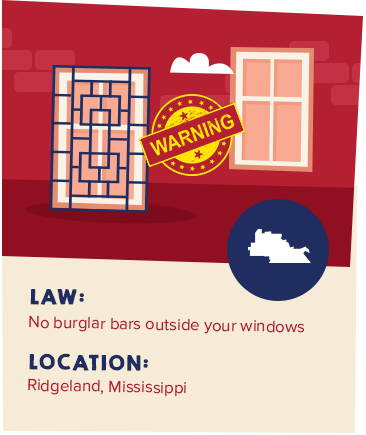
If you want to live in Ridgeland, do know that you are not allowed to put burglar bars outside of your windows. If you want to add an extra layer of security to your home and couldn’t let go of the burglar bars, you can always put them on the inside of the windows. Although admittedly, yes, they aren’t pretty. Also, you wouldn’t be able to open the windows and get some fresh air from time to time. However, if you bought an old home and it has burglar bars that were installed before 1996, you can keep them.


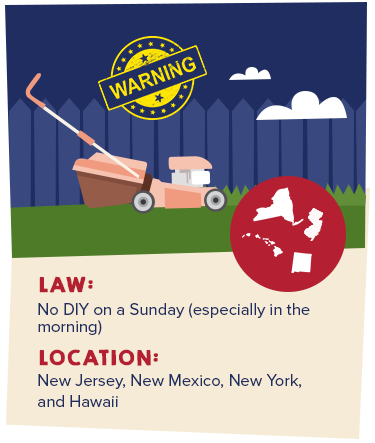
Want to sleep in a little longer on a Sunday? But you couldn’t because you got woken up early in the morning by a neighbor mowing their lawn, using a leaf blower, or fixing their roof. You won’t have this kind of problem in states like New Jersey, New Mexico, New York, and Hawaii. In these states, it is illegal for DIYs to be done on a Sunday, so as to avoid conflict between neighbors. 

Let’s take a closer look. In New Jersey, it’s illegal to do any house painting outside or do any roofing jobs on a Sunday. Likewise, in Schenectady, New York, it’s unlawful to fill nail holes with putty. In Hawaii, using a leaf blower is prohibited, while the ban for using lawn mowers is in place for residents of Santa Fe, New Mexico.


Want to move or just visit Aspen, Colorado to experience the cold winters and have some epic snowball fights? While millions of people flock to Aspen every year for some fun in the snow, be reminded that it is illegal to have snowball fights in the area. To put it clearly, you can’t throw snowballs at any public or private property, people, or vehicles, according to the Aspen municipal code. It takes the fun out of a snowstorm, eh?

Seller December 6, 2019

The 3 Things You Must Do Before Listing Your Home For Sale

Planning to sell your home this year? You’re probably feeling both anxious and excited about it. After all, it is where you’ve spent wonderful years building your family and your dreams, all of which bear unforgettable memories. But if you’ve already come up with the painful decision to list your house in the market, you need to set aside a couple of weekends to prepare it. Your main goal now is to make a good impression on potential buyers to increase your chances of receiving a solid offer and sell your home fast.

MUST-DO #1. Declutter, de-personalize, and clean the house.

“Because first impressions mean a lot…”

Cleaning and sprucing up your home shouldn’t be underestimated if you want to sell your home quick and for top dollar. You’d want buyers to turn up and see the home, not just to drive past it. You can ensure they’ll do by accomplishing these tasks:

  • Eliminate clutter

If you’re still having a hard time starting on the task, just think of it as a head start on the packing you’ll eventually have to do when you move. Purge your belongings and storage spaces of unwanted and unnecessary items. If you don’t want certain things to be thrown away, consider donating them to charity or community groups so they can be of use to others. A garage sale is also a good idea if you need some cash. 

Decluttering will make sure that when buyers visit your home, they will be able to focus on its features instead of seeing all the junk and knickknacks. Clean and organized closets, cabinets, and drawers are good signals for buyers who will be checking every storage space available.

  • De-personalize the space

Indeed, letting go can be very difficult. You’ve spent years living in your home, only to have your belongings packed away in a day. But once you decide to sell your home, you have to make that emotional break. You need to disassociate yourself with the home and think of it as a product that you need to sell, no matter how difficult it is. Remove family photos, photo albums, personal belongings, and any distractions. Your goal is to create a blank canvas on which buyers can visualize themselves and their family living in it and make them feel like they belong to the house. Let them imagine hanging their own photos on the walls and decorating it however they want. Just leave a few nice, framed photos around the home that will make it appear inviting.

Likewise, if you want to take certain fixtures and built-in appliances with you, now’s the time to remove them. If that stunning chandelier is a family heirloom, simply take it down and replace it with an understated piece. 

  • Deep clean

This step might be the most awful and time-consuming, but it will provide striking results in the overall appearance of your house. If it’s been years since you’ve done some spring-cleaning, expect the process to be tedious. Here are some things you need to do:

  • Wash the windows inside and out.

  • Pressure-wash the home’s exterior and the sidewalk. 

  • Polish the counters, faucets, mirrors, and other surfaces. 

  • Clean and scrub the bathroom, mop the floors, and clean the rugs and carpets. 

Also, make sure to tackle all nooks and crannies, even the hard-to-reach surfaces behind closets and cupboards. Ensuring that your home is as clean as possible might not be fun, but it will make things a lot easier for you when showings start.

MUST-DO #2. Take care of minor repairs.

Once you’ve successfully cleaned up the home, it’s time to take care of the minor problems. Fixing up these small things can go a long way to ensuring your house looks at its best. If you can’t DIY, make a list of the necessary repairs and call a handyman to do the job. Otherwise, even a missing doorknob or a lightbulb can have set a negative mindset on buyers, prompting them to think “What else is missing here?” and cause them to look for other defective areas throughout the home. They might conclude your home hasn’t been well taken care of, which can turn into a huge deal-breaker. 

These are all the basic updates you might be able to handle yourself:

  • Replace burned-out lightbulbs.

  • Fix broken windows and damaged window screens.

  • Repair loose cabinets, locks, handles, and doors that don’t close properly.

  • Fix any leaky faucets.

  • Replace cracked floor or counter tiles.

  • Patch any holes in the wall.

  • Fix chips or cracks in paint.

  • Consider painting your walls in neutral colors, especially if they’re currently in a screaming red or purple.

  • Give your front door a fresh lick of paint.

  • Fix and straighten up broken fences and the mailbox.

Further, this is also the time to note any major repairs and start looking into your options. Major home improvement projects such as re-doing an entire roof, remodeling a kitchen or bathroom, and updating insulation definitely won’t come cheap, but they can significantly add value to your home.

MUST-DO #3. Find a great real estate agent.

“When you hire people who are smarter than you are, it proves you are smarter than they are.” – Henry Ford

Resist the urge to sell your home by yourself or what they call “For Sale By Owner” and pocket the cash that would otherwise go to the seller’s agent. No matter how tempting it is, enlist the help of a professional real estate agent to list your home. In the 2018 NAR Profile of Home Buyers and Sellers, FSBOs typically sell for less than the selling price of other homes, which means you could be sacrificing precious time and money.

Do some research on who has some good track record and is highly knowledgeable about your specific market. Moreso, choose an agent who could be a friend in this stressful situation but also has a concrete plan on how he or she will sell your home. Set clear expectations with your agent about your goals so that you know exactly what to anticipate, especially when showing requests start.

BuyerHomeowner November 19, 2019

The Things You’ll Love and Hate About Being A Homeowner

It’s true what they say, “Owning a home is like having a ‘high-maintenance’ relationship”. Your home needs your complete commitment, time, effort, and money. There will be those initial moments that you will always reminisce about—the time you were handed your house keys. But there are also moments that you will hate being a homeowner and wish you could go back to your old landlord. You quickly realize that you’re stuck there for good or bad. But at the end of the day, there’s the undeniable pride of homeownership and the reality that you’re taking care of your biggest investment.

Buying your home for the first time, no matter your age, gives you a sense of true adulthood. The feeling that you’re getting your life together is unlike any other, especially if it’s your first time moving away from your parents’ home. While the path to owning a piece of property may have been difficult and complicated, the moment you got your house keys was definitely priceless.

Finally, you’re paying down your own debt and not someone else’s (Spell: Your landlord). While renting provides flexibility in terms of where you want to live, your rent increases and your landlord could make you move out when your lease is up. The average rent prices rose by 3% year-over-year, according to the Yardi Matrix data presented in RentCafe’s Apartment Report in April 2019. Owning a home means you’re no longer throwing away money on rent leaving you nothing to show for it.

Want to remodel the kitchen? Want to paint your bedroom walls in unicorn colors? Want to turn an extra room into your man cave? Go right ahead! There’s no one to stop you because you’re the landlord now. There’s no need to get your landlord’s approval to do any alterations to your home. You can even knock down a wall to create an open floor plan if it suits you. Your home is a blank canvass to express yourself, so it’s up to you to apply any modifications you want.

Prior to purchasing a home, you might not have even cared about the color or brand of your mattress, the plates you’re using, or even the shower curtains in the bathroom. But now trips to IKEA or any home improvement stores are absolute necessities and a fun way to spend the weekend. And admit it, home warehouse sales could now make or break you. You’re utterly drawn to that buy-one-get-one decorative pillows or that 20% sale on an outdoor coffee table just so you’ll have new excuses to redecorate your home. 

Who doesn’t take extra care of their things when they’re new? Whether it’s new shoes, gadgets, or a new car, you immediately try to keep it in its best shape for a few weeks. When you own a new piece of property, you are dead set to keep every nook and cranny as clean and organized as possible. So it can be torture when something breaks for the first time, especially now that you’re the landlord. But once you survived that incident, enjoy the feeling that you can now handle every challenge that will be thrown your way.

Being a homeowner is a ton of work, so there are sacrifices you have to make every now and then to take care of your beloved investment. Yes, you can always hire a handyman when something needs to be fixed or be replaced, but when the task is simple enough it might make more sense to handle it yourself instead of paying someone else to do it. And tasks such as changing a lightbulb, fixing a leaky faucet, and replacing air filters, are just some easy home maintenance tasks that you need to learn to be a better homeowner. It could mean passing on a Saturday brunch with some of your friends to prioritize these things, but it also means you can save some bucks when you DIY.

When you were renting your housing expenses were pretty fixed and predictable, such as rent and basic utilities. You can count on your landlord to handle everything else, especially for any unexpected maintenance costs. But now that you’re a homeowner, your monthly mortgage payments may never be up, but there are other expenses that you are now responsible for. There’s no landlord to handle payments for city services such as trash, water, and recycling collection, snow removal; or even the HOA fees and property taxes. That’s why you need to consider the “hidden costs” of homeownership before buying a house. You need to have a comfortable cushion of funds for these expenses. No homeowner wants to be house poor, right?

From your first housewarming party to every occasion there is (including Super Bowl games!), there’s more room to entertain a large crowd when you own a home. You can also cheer or party as loudly as you want without worrying about your landlord complaining about the noise, even into the wee hours. Just make sure to keep the noise reasonable for the sake of your neighbors. But nonetheless, you’ll be making good and lasting memories in your home without the fear of being caught or being told what to do.

One of the downsides of being a renter is you rarely engage in a conversation with your neighbors. You may have never even met most of the people living in your apartment building. But when you own a home, it paves the way towards other types of activities, such as contributing to the community. According to NerdWallet’s Millennials and Homebuying Study, one of the top reasons young renters choose to own is to feel engaged in their community. Owning a home in a community is one of the major reasons why residents become more civically involved. Don’t be surprised if you found yourself smiling and waving at your neighbors even when you’ve just moved in, or attending a community board meeting to participate in an issue you care about.

When you finally own your place, you can breathe easy knowing that there’s no landlord to scrutinize and judge your every move. And that feeling of true adulthood will again sink in.

Despite the bills that never seem to end, you can save a ton of money come tax time. There are tax credits that only homeowners can enjoy, such as for property taxes, mortgage interest, renewable energy products and upgrades, home equity loan interest, and even for certain home improvements. 

Buyer November 8, 2019

Here’s Everything You Need To Know About Mortgage Pre-approval

Even if you’re not in a competitive real estate market where you need to do everything to stand out, a mortgage pre-approval is your key to understanding your budget, help you speed up the process, and prove to the real estate world that you are serious about buying your dream home.

Here we’ve laid out everything you need to know about getting pre-approved, how long is your mortgage pre-approval good for, and what should you do if your pre-approval will soon come to an end. Heed these tips before even thinking of house-hunting so sellers will know you’re on top of your game!

Before starting your search, your first step should be to prove that you have the financial capability to purchase a home. In the pre-approval process, the lender reviews your loan application and your finances to determine whether you will qualify for a mortgage. They will have a preliminary examination of your credit, employment, income, assets, monthly debts, and other financial information.

Since the pre-approval letter will also indicate the actual loan amount you qualify for, you should use that as your guide when shopping for a home because your lender will only let you borrow up to that certain amount.

When you found a home you want, your real estate agent will submit the pre-approval letter together with your offer to the seller. This will prove to the seller that you are serious about buying and can obtain a mortgage.


Buying a house does take time. Your home search and loan approval process could go on for weeks, even months, before you could actually close the deal and get the keys to your home. If your journey to being a homeowner actually took a long cut, will your pre-approval letter still be valid by the time of your purchase?

While there is no definite duration for the validity of the mortgage pre-approval letter, in general, it is typically good for 60 to 90 days or about three months. Still, the actual time frame is indicated in your letter. So if you need a longer time frame, you have to ask for it beforehand.

However, many lenders and sellers may consider your letter too old after three months. Yes, making a decision as huge and remarkable as buying a home shouldn’t be put into such a short timeframe. However, your financial situation can change anytime within that three-month period. Lenders could have a hard time trusting you if your letter is more than a few months old because you could’ve done things that hurt your DTI and credit, like losing your job or buying a car. There is an expiration date to ensure the potential borrower has excellent DTI from the start until the end of his or her homebuying journey.

Also, the expiration date lenders placed on your pre-approval letter acts as a hastening mechanism so you can choose a home before the interest rate indicated in your letter goes up. It prevents you from taking a leisurely stroll through open houses for weeks and extending the buying process.


If your house-hunting journey is taking a bit longer than planned and your pre-approval letter is about to expire, you’ll likely need to renew it. However, there’s no need to go through all the trouble of applying all over again. Just take it back to your lender, together with your updated financial statements and pay stubs to show there’s been no change to your income, debts, or credit scores.

And since pre-approval letters are only valid for a certain period, it might be best to only get it when you’re already serious about looking for a home.


When you’re applying for a mortgage, having one or two checks on your credit report will indeed temporarily lower your credit score. It can lower your score for a few points, depending on your initial score and the number of payments you’re making, but it shouldn’t be significant. The problem comes when the hard checks or inquiries on your FICO score raise too many flags, which could get you disqualified from getting a loan.

If you don’t want the pre-approval process to cause any significant stress to your credit report, you can pull a soft report or a soft inquiry. Unlike hard checks, it won’t affect your credit score and you can use it as reference. Since soft inquiries are only visible to you, if you found out your score is lower than 620, it might be best to hold off purchasing a house for now and do the necessary steps to improve your score.

BuyerRetireeVacation Home October 30, 2019

The Pros And Cons of Purchasing A Rural Property

Rural properties are usually associated with the great outdoors, an escape from metropolitan areas where everything is loud and fast-paced. But even if this is the most popular reason why people see rural homes as a perfect investment for retirement, some buyers get attracted to them without doing extensive research on these properties.

Just like with any real estate purchase, buying a rural home has its pros and cons. If you intend to purchase a rural home for investment you have to consider that depending on the location of your land, the following setbacks are possible:

Low Population = Fewer Public Services

Due to the lower number of people moving to rural areas, the variety and quality of public services may not be the same as those in the big cities. Adjusting to the level of public service available within the rural area needs preparation and proper expectation-setting.


Limited Economic Opportunities

Rural properties should be considered as long-term investments given the smaller economy and market in the area. A rural homeowner usually waits for a long time to sell or lend the property since there’s not a lot of business opportunities.


Weak Tourism

Unlike metropolitan properties, listing a rural home as an Airbnb investment has its disadvantages in terms of average monthly rental due to the low number of rural area visitors. Because of its long distance from urban cities, fewer amenities and services, and the lack of tourist attractions, an investor might find it challenging to purchase a rural property for rental investment alone.

In addition, these are the things that should be checked when purchasing rural properties that are not noticeable or applicable to public properties:

  • Water sources for possible cases of drought or bushfire

  • Historical data of livestock and plant diseases

  • Pests and availability of exterminators in the area

  • Land or water chemical contamination which could determine the property value

  • Law requirement in weed or animal control

  • Land usage rights which could limit what you could or could not do with your property

Since the vendors may not be required to disclose this information as part of the sale always check with your real estate broker if it is legally possible to have these items reviewed before making a bid on the property.

Despite the number of things to check before even considering to view a listed rural property, potential investors remain enthusiastic due to the wide range of options available–from lake houses to farmhouses, and mountain cottages not just the typical countryside ranches.

Metropolitan real estate promises higher expected return and demand, but rural properties entice a significant number of investors that are looking to pay fewer taxes, spend less cash, and purchase more properties. Given the list of risks in buying rural property, what are the advantages of investing outside of the city? After careful assessment of the presented risks, let’s discuss the benefits of buying a rural property.


Fewer Restrictions

Compared to property development restrictions in big cities, restrictions on rural properties tend to be less than those in urban areas. This gives rural property owners more options in terms of extending their land for development. It also gives them the freedom to list their properties without having to deal with strict house listing regulations compared to big cities like New York or Los Angeles.


Land Development

Rural areas allow investors to purchase multiple properties and give them more opportunities to expand. Strategically, buying a rural property as a long-term plan could increase land value. It would also be profitable to sell should the investor decide not to pursue the land.


Significantly Cheaper Prices

A rural property investor would pay an average price of almost half the cost of the same size of an urban property–making it possible to purchase multiple properties at once that would fit an allocated budget. The next item heavily influences low prices on this list which is the lack of competition that causes prices to go low.


More Supply and Less Demand

The number of rural properties has been increasing, but the lack of demand from investors causes minimal competition in the market. It’s best to check for a feature that has a good access road so you could have the rural life without having to worry about driving back to the city every once in a while.


Rural homes present opportunities that can’t be found in urban cities, but it is essential to avoid common pitfalls–like failing to do your homework about the listed property before making a bid, and other forms of due diligence that may potentially derail your first rural property investment. Know the risks, check all potential setbacks, review your numbers, and set your expectations should you choose to live in the rural areas with your newly purchased property.

Buyer October 16, 2019

The 4 Biggest Myths That Are Holding Back Home Buyers

Buying a home for the first time can be confusing and intimidating. More so if many of the things you believe turn out to be myths that only hinder you from starting your home search or making an offer on a home.

We’re here to help you clear those misconceptions so you’ll have the right mindset and strategies on your path towards homeownership.

1. “I need a 20 percent down payment.”

Saving for a down payment isn’t only a challenge for many renters and non-owners alike; it’s a roadblock that hinders them from entering the housing market. And many first-time home buyers believe they still need a 20% down payment before they can get approved for a mortgage. That may be true a few decades ago, but that’s no longer the case these days. In fact, the median down payment for first-time buyers remains steady at 6 percent in the past several years. Times are changing, and through various government programs available, buyers are now allowed to put as little as 3.5% to achieve their American dream of homeownership.

Nowadays, you only need to be comfortable and confident in deciding how much you will give as a down payment. Sure, you must pay more for your mortgage each month (including Private Mortgage Insurance or PMI) if you put less than 20% of the home’s purchase price, but it’ll help you save more money on other financial goals and have a cushion for emergencies.

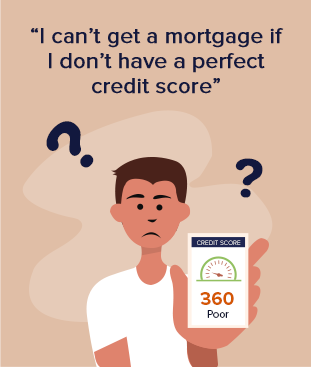
2. “I can’t get a mortgage if I don’t have a perfect credit score!”

Similar to the 20% down payment, many Americans are also misinformed about the FICO score needed to qualify for a mortgage. They think that they need to have a “good” credit score of 780 or higher. But the truth is your credit score doesn’t have to be perfect. The median credit score range for many approved mortgages in the past years is 670 to 739.

There are other factors that lenders take into consideration when deciding whether you’ll be approved for a mortgage, including your employment history, debt-to-income (DTI) ratio, and the amount you can give as a down payment. Also, the required credit score also depends on the type of loan you’re getting. Conventional loans have the strictest standards and require a score of at least 620. Meanwhile, FHA loans need a minimum credit score of 580. So if you have a lower credit score, don’t think that you’re already out of the game. There are measures you can take to improve it before applying for a mortgage.

3. “I’ll skip hiring a real estate agent to save money.”

There are many costs associated with buying a home, but there’s no good reason for you to skip working with a realtor thinking that you can save money. In reality, you can get all the advantages of having a buyer’s agent working for your best interest for free. Yes, they do get a commission, but it is usually paid by the seller and is built into the home’s selling price. Even if you show up without an agent thinking that you can get a discount on the price, the consequence of that could be stress, and wasted time and money.

Using their expertise, negotiation skills, and comparables, realtors can help you get the lowest purchase price for your dream home. They can also help you understand the complicated real estate contracts and guide you through things like home appraisals, inspections, contingency clauses, among others.

4. “I’ll wait until spring to start my home search.”

Traditionally, the housing inventory is greater in spring. Buyers are flooding the housing market and most sellers are putting their single-family homes or condominiums for sale. This heightened activity usually translates to escalating prices and multiple offers on properties. However, it’s wrong to think that spring is the only “best” time for buying a home. All real estate markets are different, and you should base your decision on your personal circumstances and the local market conditions.

Sure, many people are looking to sell or buy in spring when the weather is nice and everyone is motivated, but there are ways to make a home attractive even in fall or winter. In some markets, it is better to start your search before or after the spring. There may be fewer homes available, especially during winter, but you might even find better bargains since sellers may want to relocate quickly or may be desperate to sell.

BuyerSeller October 4, 2019

What Things Stay in the House and What Should Go With You After A Home Sale?

One thing that makes a real estate transaction so confusing is the issue of what stays with the house and become the new owner’s, and what goes with the seller once they move out of the property. Oftentimes, sellers believe that if it’s something that they have installed in the home and spent money on, they can take it with them. Their views of what are fixtures and what can be considered as their personal belongings may be shrouded by their attachment to the home. Unfortunately, that’s just not how it works.

Taking out something you haven’t disclosed upfront, including in writing, or even negotiated to keep with you, can cause the most heated debates during and even after the home sale. Also, it’ll be annoying for any buyer to find items like kitchen door handles to be missing from their rightful place.

It’s important that you clearly spell out and negotiate in your real estate purchase contracts what is included and what is not included in the sale of the home. It’s something that needs to be agreed upon by both parties to ensure a smooth transaction.

So, what stays in the house and what goes with you when you move?

Anything that is bolted, mounted or nailed down

What is a fixture and what is not? According to real estate website Inman, a fixture is any personal property that is physically attached to the land or structure by bolts, nails, screws, cement, or any other attachment method. These are immovable elements of the home that are converted to real property. Likewise, if a house has been modified to fit an item perfectly, it is considered a fixture.

Fixtures can be a major cause of misunderstanding between sellers and buyers during the home sale process especially if they are not included in writing. If a wall has a hole that accommodates an air-conditioning unit, then it is most likely a fixture. If the home has a ceiling fan installation, a seller should replace his personal lovely ceiling fan with an old one he doesn’t want to take. Fixtures stay with the house even if the sellers want it.

Likewise, the most common gray areas with fixtures are mirrors and flat-screen TVs and their mounting mechanisms. Mirrors are considered fixtures if they are bolted to the bathroom or bedroom wall. But if they are just hanging on a wall, sellers could take them since they are considered personal property.

Flat-screen TVs, on the other hand, are considered personal property of the sellers, especially if they are expensive, high-definition type. Similarly, they can also take the television’s mounting mechanism, unless it is detailed in the sale that the TV will be part of the home sale or the buyer wants to include it in the real estate negotiations.

Appliances

Sellers are not really required to leave large and heavy appliances with the house, including the refrigerator, washer, and dryer, or stove. If such appliances are not permanently affixed to the property, then they can simply be unplugged and removed. It’s already up to you as a seller to decide whether you’d want to take it or include it in the listing price of the property. Most buyers will be willing to include the appliances in their offer price, anyway.

But remember that there are certain types of financing or mortgage lenders whose conditions call for a stove or an oven to be installed before they approve a loan.

Anything that is built-in or cemented into the ground

Backyard items like a basketball hoop, a swing set, or a trampoline can also cause a misunderstanding between the two parties during a home sale. Normally, anything that is built-in or cemented into the ground should be considered as part of the property. The ones that are freestanding or detached are of the seller’s personal property, hence, they can take it with them.

Lighting fixtures

The classic example of this is that impressive chandelier in the center of your dining room or any appealing light fixture the buyer has already seen as part of your home. As a seller, you need to know that buyers want to get what they saw during the showing. They expect everything they saw to be included when they write an offer for your home. If you packed it up with you and left electrical wires hanging to where it should have been, you’re in for a sticky situation. Experts have warned that changing something in your home after the date the buyer gave an offer is actually illegal.

If you intend to take any light fixture with you, remove it even before you list your house for sale. Then put in something acceptable as a replacement but can still help emphasize your home’s best features.

Window treatments and coverings

Whether the window treatments and coverings stay is another issue that can cause nasty confusion during and after a sale. Rods and blinds, even expensive custom blinds, are considered part of the property and should go to the new owner since they are usually attached. Curtains, on the other hand, are almost always considered as personal property since you can easily slide them off. If you want the existing drapes and coverings, exclude them from the sale and specify it in writing.

Hardware on the kitchen and bathroom

While this should be a case of “common sense,” still, it’s not uncommon to hear stories of buyers who have complained about missing doorknobs, toilet paper holders, kitchen cabinet pulls and handles bath fixtures, and well, the horror stories go on. The rule is that any hardware should stay and transfer to the new homeowner since they are attached to the property.

The only situation where it might be acceptable that the seller remove all fixtures and finishes from the home is during a foreclosure. It might be their last chance to salvage part of the house and make money out of it. So for buyers who are looking into a foreclosed home, remember that since it is already owned by the bank, it is sold “as-is.” Yes, even without the doorknobs and cabinet handles.

Plants, trees and any landscaping

One scenario: part of what made the buyer fall in love with your home is that lovely rose patch in your front yard. And then you intend to take it with you once you go? Oh, no. We know it’s beautiful and that you spent hours of tireless work looking after it. However, if the property listing doesn’t specifically mention you want your plants or trees, you cannot remove them. Since any landscaping is a great part of your curb appeal, the right thing to do as a seller is to request to take it with you, particularly if someone gave it to you as a gift. Otherwise, you can’t take the plants and leave a patch of dirt that can displease any buyer.

Above-ground spa and/or swimming pool

As discussed, anything that is built-in or cemented into the ground goes with the house. So you can take your above-ground spa or swimming pool with you once you leave. A free-standing spa can be considered personal property and is likely to be easily removed. However, if you don’t want to take these features with you and the buyer doesn’t want it either, you may still need to remove it. The buyer can specify it that he/she wants to see it go by closing.

For Sellers,

  • After discussing what stays and goes, specify the things you want to take with you on your property listing. As the seller, be specific and avoid saying uncertain things like “probably” or “most likely.” Be sure to document it all in writing and in your marketing materials so there won’t be any confusion with the buyer. It’s a crucial thing for buyers especially when they make an offer for the home.

  • Take anything you want to keep with you before listing your home for sale. Then replace them with something else that might go as fine or acceptable. Don’t make a show-stopping chandelier a part of your home staging if you have no plans to leave it on the house and pass it to the new owner.

  • We understand the mixed feelings you have as you sell your home, but avoid giving any sentimental value on simple tools like doorknobs, 60-watt light bulbs, or pegboard hooks. Never take them with you when you vacate the property. Often, these are things that aren’t really worth chasing after but can annoy the new homeowner. Hiring an experienced local real estate agent can help you sell your home for top dollars so you don’t have to worry about leaving petty hardware behind.

For Buyers,

  • Perhaps it would be safer not to assume that everything you see on the property comes with it and will be part of the home sale. If there’s something you really like and want it to stay in the house once you become the new owner, don’t be afraid to speak up! Include all of the items in your purchase offer and be as detailed as possible. That way, both parties will avoid any confusion, disappointment, or worse — nasty exchange of emails and even a lawsuit for the seller — once the deal closes.