Buyer February 9, 2018

5 Reasons Why A 30-Year Mortgage May Be The Right Choice For You

If you’re a home buyer deciding between getting a 15-year and a 30-year mortgage, there’s a great chance that you’ve already consulted with friends and family, and may even have done tons of research online. You know that there are pros and cons for each type of mortgage, and that the 15-year mortgage is technically the cheaper alternative since you’ll be paying smaller interest rates. It’s true that there are a lot of practical reasons for choosing a 15-year loan, but you shouldn’t feel guilty for wanting to commit to 30 years of relatively small monthly payments instead. There’s a reason why the 30-year mortgage remains the most popular financing option among home buyers.

There are a lot of reasons why a 30-year mortgage can be just as good or even better than its 15-year counterpart. Depending on how efficiently you handle it, you’ll see that there are many ways you can take full advantage of a 30-year loan.


1. You can free up funds for other goals.

Buying a home may be one of the most significant achievements of adulthood, but it isn’t the only goal for a lot of people, including you. 

One of the main advantages of a 30-year mortgage is its relatively low monthly payment — and even if you know that you’ll technically be paying more for your house in the long run, lower monthly fees allow you to free up funds to pursue other goals.

The extra money that isn’t going to paying off your house can be used for other worthwhile investments such as pursuing higher education, setting up a business, or buying your very first car. If you’re someone who believes in working on multiple goals simultaneously, then a 30-year mortgage can aid you in achieving them more comfortably.

2. You can always decide to pay off your mortgage early.

With careful planning and consultation with your lender, you can take advantage of the safety of a 30-year mortgage with one of the main benefits of a 15-year mortgage – which is claiming full ownership of your home quickly.

You can start working on some strategies to you pay off your mortgage early if — during the 30-year period of your mortgage — you feel that you’re growing more capable of settling your debt. Ask your lender for an amortization schedule that can help you come up with a plan to own your home fully within the new timeline of your choosing.

3. You won’t be dealing with unwanted surprises.

The great thing about 30-year mortgages is that no matter what happens, you can be sure that your interest rate stays the same for the full 30-year term unless you sell or refinance the home.

Having a fixed mortgage rate will give you a sense of stability and will allow you to be more certain about the money you can use to build up your savings.

4. You can qualify for a bigger or more expensive house.

The lower monthly payments associated with a 30-year mortgage will allow you to buy more house than you could afford with a 15-year loan. 

If you firmly believe that the perfect home for you and your family is one that you can only comfortably afford by stretching out payments over an extended period, then you’re better off taking a 30-year loan.

5. You have a better chance at building an emergency fund.

Because monthly payments for a 30-year loan are relatively low as compared to payments for 15-year loans, you’ll have a better chance at saving up for a rainy day.

If you follow a strict budget and are disciplined enough to set aside a fixed amount to grow your emergency fund, you’re likely to feel more secure about your choices.

15-year mortgages require monthly payments that are at least 50% higher than those of 30-year mortgages. On top of this, there are also property taxes and insurance to worry about — not to mention mortgage insurance premium for those who put less than a 20% down payment. With all of these on your plate, high monthly fees would make it difficult for you to build an emergency fund or even respond to emergencies and other unexpected expenses. This may leave you with no choice other than to sell, refinance, or foreclose.


Buyer February 9, 2018

5 Ways Millennials Are Changing The Real Estate Scene

Millennials.

They’re the generation of people born between the 1980s to early 2000s, or also called the Generation Y. Many stereotypes have influenced how they have been viewed by the public, including the typical assumptions that they jump from one job to another, that they couldn’t even save for a down payment, or that they overspend.

But the recent 2018 Better Money Habits Millennial Report by Bank of America says otherwise. “Millennials deserve more credit — both from themselves and from others — for their mindfulness when it comes to money and their lives, ” says Andrew Plepler, Global Head of Environmental, Social and Governance. This key takeaway is related to how millennials are saving and managing their money. And when it comes to saving, at least 33 percent of millennials prioritize saving towards buying their first home.

In the NAR Home Buyer and Seller Generational Trends Report 2017, it is expected that 66 percent of millennials will buy homes in the next five years. And while each generation is different, there’s no doubt that millennials have their own set of unique attitudes and preferences towards home buying.

“Millennials are shaping the market more than anyone realized,” says Jeremy Wacksman, Chief Marketing Officer at Zillow Group. According to the 2016 Zillow Group Report on Consumer Housing Trends, 50 percent of today’s US home buyers are under 36 or those who are called Millennials, which means they are shaping the future of real estate. They are having an impact on the industry through their growing influence on the market.

Here’s how the millennial generation is changing the real estate market:

1. They are tech-savvy researchers

More than any other generation, millennials prefer to approach the home buying process in a more digital fashion. The Zillow report further stated that the process of finding or selling a home is a much more collaborative process for them. They bring all available tools to the process, such as their smartphones, social media and online networks.

In the NAR Real Estate in a Digital Age 2017 Report, a whopping 99 percent of Millennials searched on online websites while looking for a home, compared to the 89 percent of Older Boomers and only 77 percent of the Silent Generation. At least 58 percent of millennials also found the home they decided to purchase on their mobile devices. They also rely on online customer reviews more than any other generations.

As they technically live in a world that is ruled by technology, real estate investors, firms, and even real estate agents need to boost their online presence in order to attract more millennial buyers and sellers.

2. They are very comfortable trusting a realtor when purchasing their home

Despite being the most tech-savvy home buyers, millennials were the number one buying group to purchase their home from a realtor. They might have done their research first before stepping into homeownership, but they are still very comfortable in trusting the experts. At least 92 percent of millennials purchased their home through a realtor, and 74 percent said they wanted help in understanding the purchase process. They value the personal experience and insights that only a top real estate agent can provide. Millennials expect real estate agents to become trusted advisers and strategic partners. Likewise, it might also be related to the fact that their age group had more difficulty handling paperwork and understanding the process than any other generation.

3. They want specific must-have features in a home

As the real estate sector becomes more focused on millennials as home buyers, the market is also focusing on what millennials specifically want in their homes.

Millennials mostly want to buy newly-constructed homes, rather than fix-uppers, to avoid dealing with renovations and other plumbing and electricity problems. Likewise, they also have specific features that they want in a home they purchase. Some of the features they prefer include a spacious kitchen and an open floor plan, a dedicated workspace for those who are working from home, energy efficient appliances, updated kitchen and bath, and new technology and smart home systems.

A unique study was also conducted by Northshore Fireplace in 2016 to know what millennial buyers are looking for in a home. The results have revealed millennials value these features most: new appliances, a large master bedroom, a 2-car garage, solar panels/energy storage, and a luxury kitchen.

Millennials are also most likely to choose a home that is located closer to their work, so they can save time and gas. At least 65 percent say convenient location to their job is the most important factor when choosing a neighborhood.

4. They are least likely to view homeownership as permanent

Only 11 percent of millennials said they view homeownership as permanent, compared to 37 percent of seniors and 29 percent of baby boomers. It was also revealed in the Bank of America 2017 Homebuyers Insights Report that 68 percent of millennial homeowners say their current home is only a stepping stone towards their dream home. They see the value in buying early but realize it may mean putting their dream home on hold for now. It also reflects the average of six years that millennials are keeping their home before selling, compared to 10 years for the rest of homebuyers. This trend can influence would-be buyers to purchase sooner.

5. They highly associate homeownership with the American Dream

This is probably one of the main reasons why they currently dominate the housing market. At least 65 percent of people aged 18-34 associated home ownership with the American Dream, more than any other age group. It is despite the fact that they wait longer to buy their first home compared to their older generations. Most of today’s home buyers are also redefining the so-called “starter homes,” which is now as large as the median homes for “move-up buyers.”

Seller February 2, 2018

Home Sellers: Don’t Be Guilty Of These 5 Home Inspection Mistakes

Preparing for a home inspection definitely pays off in the long run, and you don’t even have to shell out tons of cash for it. You just have to make sure that the process goes smoothly for the inspector so that you can have a well-standing report for your potential buyer.

Take note that professional home inspectors check for all issues in your home, both in the exterior and interior parts of the house. It also includes recommendations for fixing and improvement, as well as pointing out safety issues that you may not even be aware of. You can choose to see this to your advantage because it lets you be aware of problems in your home and gives way for transparency between you and your buyer during the transaction.

Here are five mistakes you wouldn’t want to be guilty of as a home seller, as well as how to prevent them:

“I did not prep the house for inspection!”

First, you have to remember what the inspection is for: It’s for you and the buyer to know what needs fixing in the house. You can’t “pass” or “fail” an inspection, and it is for your benefit as much as it is for the buyer.

If you know that major parts in the house such as the roof or the floor are not in good condition, do take note in your agreement that you are going to have it fixed, whether it’s you or the buyer who will shoulder the expenses. Though in most cases, it’s the seller who pays for major fixtures.

However, that doesn’t mean that you can just leave the house that you’re selling as is! There are several things you can do to prepare for inspection without even spending. For one, make sure that your pets are secured and not running around the house. Also make sure that utilities are on, and that your lights bulbs are all working properly. Ensure that there are no locks on gates and doors that need to be accessed, namely the doors to your attic, crawl space, etc. Remove the panel cover from the electrical panel and the furnace cover from the furnace, as these need to be checked. And lastly, make sure that remote controls for amenities could be easily identified (suggestion: label them) so that inspectors know which one is for which.

Inspectors prefer that the owner of the house is not inside of it while they conduct the inspection, so you need to do these things mentioned in order to make sure that the process goes smoothly for them.

“I underestimated minor fixtures.”

You may choose to ignore minor fixtures but remember that when they pile up, they can make a big difference on the impression of both the house inspector and your prospective buyers with regards to the house that you’re selling.

Remember: The inspector will take note of ALL the issues in your home, even the tiny ones.

If you have tools, you can definitely fix some of these minor fixtures on your own. Check for broken door knobs, sockets, light bulbs, and rusting and sagging gutters. Other things you can examine is possible leaking under the sink and around faucets, and if electrical outlets, smoke detectors, and toilet flushes are working. Also, test your garage door if it correctly reverses against pressure.

If you get a headstart in fixing minor fixtures, your house will have a better chance of looking good to both the inspector and your potential buyer.

“The house was so messy and full of clutter!”

You don’t want to have your inspector remove your dirty laundry from your washing machine or your dryer. Take care of those before inspection, as well as other unnecessary stuff that could obstruct ease of access throughout the entire house. 

Also, make it a point that your oven and stove top are clear and clean so that the inspector can test them without setting off the smoke alarm.

“I tried to conceal defects  to no avail!”

Home inspectors are professionals. They are trained to spot defects no matter how good you manage to hide them. They may even take note on their report that you did, so it’s best just to be honest. Don’t take the risk of losing your buyer’s confidence.

Keep in mind that the home inspection is not a warranty since the home inspector is only there for a couple of hours, without knowledge of the home and its systems of being built — so he/she has no idea about any quality control processes. One way to address this is that you file all the reports and receipts on the maintenance and repairs that your home has undergone, including annual or semi-annual inspections or repairs for your furnace, roof, chimney, etc. If you’ve had an insurance claim on your house, keep those documents together, too, so you have proof that you took care of the issue.

“I skipped home inspection!”

Possibly the biggest mistake any seller can make regarding home inspection is skipping the process entirely. Your buyer will have it inspected anyway, and this may leave you with little or no time to address the issues on your own time and budget.

It’s always better to have an inspection prior to negotiations, or a pre-listing inspection. This is a win-win for you and your buyer — and will save you from a lot of trouble and inconveniences in the long run. By having your home inspected early, you can prep your house better and be more confident in selling it at the price you want, and the buyer will be at peace knowing that the home he or she is buying is in its best form.

Buyer January 31, 2018

7 Clever Questions to Ask the Neighbors Before Buying A Home

Your trusted real estate agent can basically tell you anything you need to know about the home you’re planning to buy, especially if it’s information that may affect the home’s marketability.

However, the old adage that says “learn from the experience of others” can also be very helpful before closing the deal on your prospective property. Talking with the neighbors and knowing their first-hand experience while living in the area can be crucial for you to make sure that your chosen home and neighborhood are absolutely perfect.

After looking up the area’s demographics, its latest crime rates, local events and school districts online, talking to the current residents can validate your research and will help you get an accurate feel of the neighborhood. Neighbors can also potentially share solid facts that the seller might have forgotten to mention, or purposely didn’t disclose. Your conversation with them may help you avoid making a big buying mistake and move into a neighborhood that can make you miserable in the future. Because aside from your local real estate agent, no one probably knows the area better than they do.

So do your mini-survey: take the time to walk through the street, approach some of the residents, and ask if they won’t mind answering a few questions. It’s also a great start if you want to know more about your potential neighbors and whether you can get along.

Here are some discerning questions that will help you uncover useful information before buying a home:

This flexible question appropriately follows the usual ‘How long have you lived here?’ greeting. It allows the neighbors to tell anything they might want to share without restriction — especially about the things they love and hate most about the area. Their answers (and even stories!) can offer sensible information and let you catch a glimpse of the lifestyle they have in the neighborhood.

If the positive things they say outnumbered those they least like about the area, then it can be a good indication that you’re on the right track. Because despite the physical signs that could suggest the neighborhood is thriving, some things are not what they seem and the residents surely know better.

This is a good follow-up question, especially for the things that the residents probably hate about the area. They can discuss any common concerns or inconvenience that might also affect you as a potential homeowner.

Perhaps you’ve already checked out the crime rate in your prospective neighborhood when looking for your ideal home. You must have looked up the area’s crime statistics in online safety resources such as My Local Crime, or from the local police department. However, those won’t clearly tell you about the real situation of the area. It is the locals who will help you understand what’s really going on, and whether there’s anything that you need to watch out for once you settle down.

Inquire about what really goes on in the neighborhood and if there are recent problems with loitering, vandalism, frequent fights, or incidences of stray dogs running down the street. Ask if they have security systems installed in their homes — which could tell you whether you’ll also need to install one. Find out how the neighborhood responds to crimes; if they have a neighborhood watch and how active it is. It may also help to ask if people feel safe to go out late at night or if they let their children play outside with minimal supervision. Those little details can actually make a big difference if you want to live peacefully in the area.

One of the social benefits of homeownership is community involvement. Homeowners are more likely to participate in civic groups and tend to be more involved in their communities. Asking the neighbors about how they socialize can help you learn whether you’re a great fit for the neighborhood, and also determine what type of community they have. Ask them whether they hold events like backyard barbeques, weekend festivals, neighborhood meetings, dinner parties, farmers markets, and others on a regular basis. It may also say a lot about whether the families living in the area really get along.

You’ve probably toured the place with your agent multiple times at different hours to really make sure that everything is absolutely perfect. You’ve already driven to the places that you will most likely visit often, like the grocery store, the schools, clinics, nearby restaurants and cinemas, etc. However, asking the locals about what the traffic is like during rush hour could give you more insight of the daily road situation. You also need to know the transportation options available in the area; whether there is a reliable public transport; the road conditions during particular seasons; if there are enough parking spaces, and any truthful information that will help you determine how much time you might spend on the road and how quickly you’ll get around to and from your home.

Even for singles or young couples without children, schools should be a major concern when buying a home. It’s because homes located near top-rated school districts usually translates into higher property values and have a huge resale potential. For those who have families and young children, you also need to make sure that your kids will grow in a safe neighborhood with plenty of good opportunities.

You can research about particular schools and their reputation online, but hearing the personal experience of residents whose kids were enrolled in the local schools is more valuable. You can also find out what it’s really like learning from a specific school, or if there are great after-school programs or individualized education programs available for children.

After asking insightful questions concerning the neighborhood, it’s best to also glean information about your prospective property. Neighbors might be willing to reveal more about the specific home — especially things that weren’t included in the disclosure. It’s best to know whether the home you’re considering has run into some problems that the seller failed to disclose, such as a high water table. Or if the house has endured damaging events like a storm or flood. They may also share bits of trivia about the house’s most appealing characteristic, or give you a backstory of why it is on the market.

However, there’s always a chance that personal relations with the seller could affect the neighbor’s response if you tell them which house you’re considering. Still, people have different opinions, so make sure to chat with several neighbors and ask the same questions so you can have a more accurate picture.

Buyer January 29, 2018

How To Factor Your Commute Time In Your Home Buying Decision

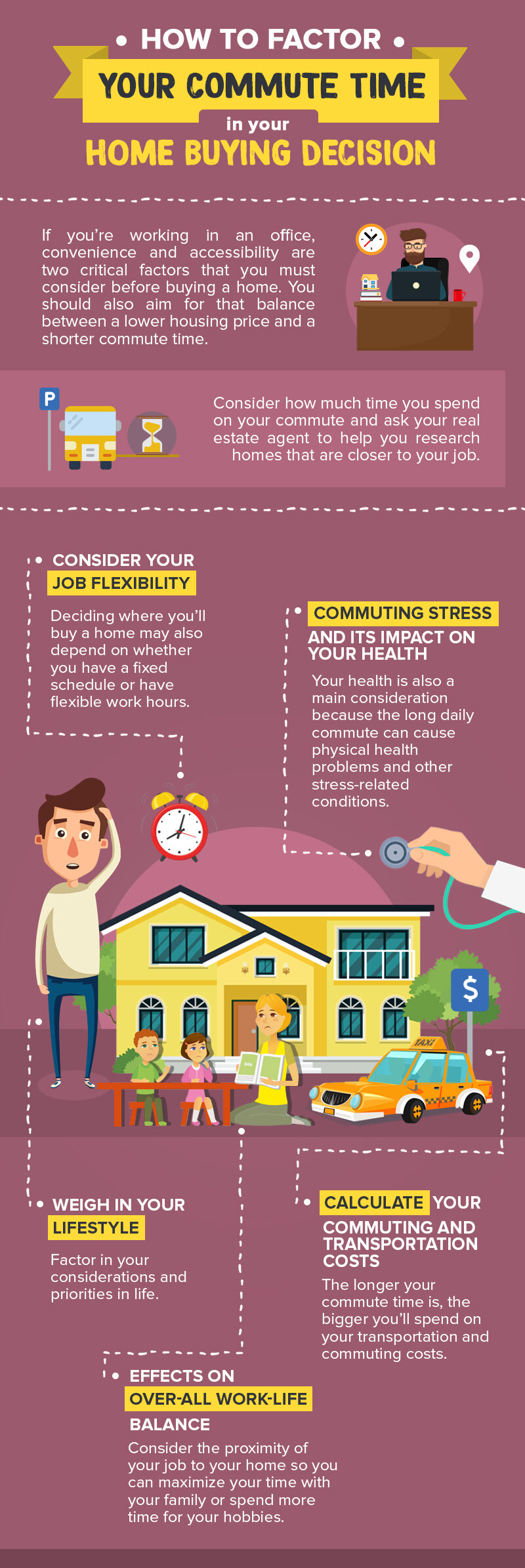
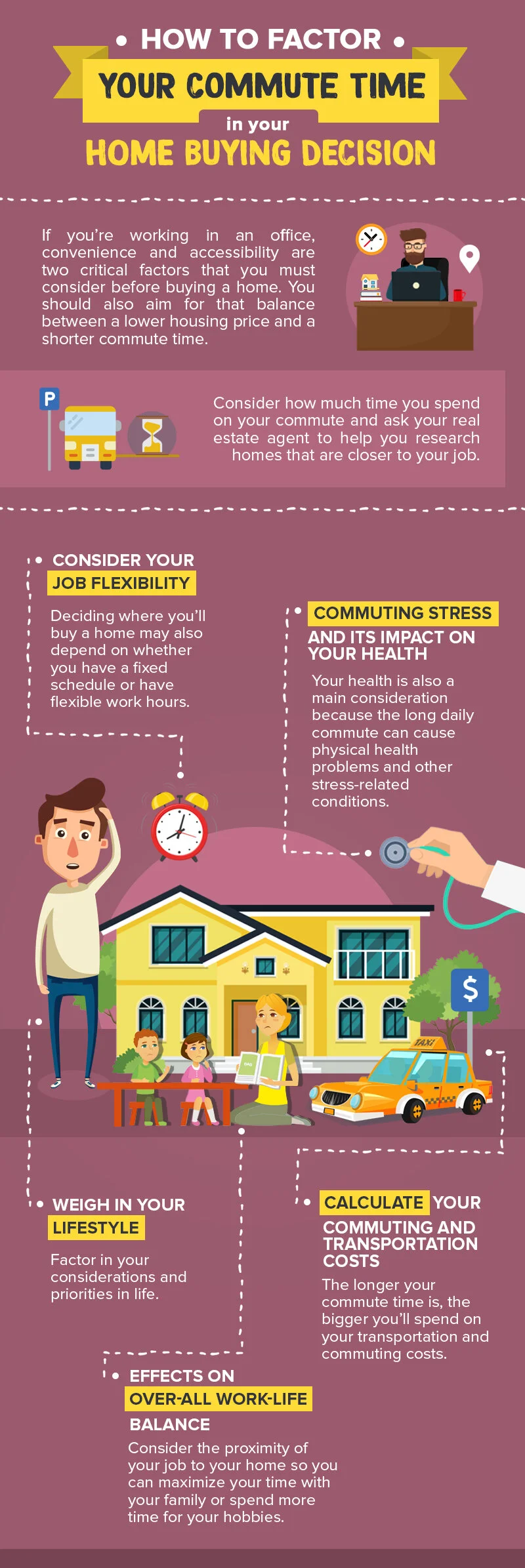
When looking for that perfect home, many factors should be put into consideration. There’s price, accessibility, proximity to a great school district, lower taxes, and others. However, if you’re working in an office, convenience and accessibility are two of the most critical factors you must consider before buying a home. During your home search, you should aim for that balance between a lower housing price and a shorter commute time — unless you’d want to waste countless hours in dreadful traffic every week that should rather be spent with your family or pursuing your hobbies.

According to the Census Bureau, the average commute time to work in the US is 25.4 minutes. But commute times also vary widely depending on location. Some of the metro areas with the longest commute time include New York City, Los Angeles, and Boston, which are obviously highly-populated areas. Apparently, metros which have the shortest commute times are those that have less population density and road congestion.

Consider how much time you spend on your commute

In a Trulia Report, most people said they would like to live closer to work because commuting times keep getting longer each year. Roughly 16% of working Americans picked either a “short commute to work” or “nearby public transportation” as the most important quality of the next neighborhood they would call home.

Before deciding where you want to live, factor your commute into your home buying process. While doing your house-hunting, it would be best to ask your real estate agent to do some research on homes that are closer to your job. Your realtor will help you weigh the pros and cons that can help you make an informed decision on what would be the best home — and commute — for you.

Here’s how to factor in your commute time when deciding to buy your dream home:

Calculate your commuting and transportation costs

Transportation costs include how much you spend when you drive a car to and from work — including gasoline, vehicle maintenance, insurance, toll fees, parking, and others. For many Americans, gas is their biggest commuting expense. Meanwhile, your commuting costs amount to how much you spend on public transit, carpool, and others.

According to the Citi ThankYou Premier Commuter Index, the average cost of an American commute is $2,600 a year. Many home buyers don’t even realize how expensive their transportation expenditures can be if they fall in love with a house that takes a long commute to their job. Commuting costs are gradually rising, as well as the price of gas. And the longer your commute time is, the bigger you’ll spend on your travel costs. It’s important to factor in the number of hours you’ll spend in your commute, then add in your transportation and commuting costs.


Consider your job flexibility

Deciding where you’ll buy a home may also depend on your job flexibility. If you have a fixed 9-5 job, then accessibility is a crucial factor. For people who are lucky enough to have flexible work hours, they may adjust their work schedule to avoid the rush hour traffic.

Likewise, telecommuting has now become a new option for many employees. In the 2017 State of Telecommuting in the US Employee Workforce report, roughly 3.9 million employees are now able to telecommute or work from home at least half of time. Those who have that luxury may be inclined to buy a house in the suburbs that require a longer commute.


Weigh in your lifestyle

It’s important to factor in your considerations and priorities in life. Millennials who want access to the nightlife, restaurants and retail centers, or outdoor parks, are most likely to buy in urban areas. They place a high emphasis on both affordability and convenience.

But for those who have a family and are raising young children, they would likely want a short commute so they can spend more time with them. In the NAR Home Buyer and Seller Generational Trends Report 2017, the neighborhood choices of buyers aged 37 to 51 (which make up 28% of recent home buyers) are driven by their convenience to their job and the quality and convenience of school districts.


Commuting stress and its impact on your health

Your health is also a main consideration in relation to your commute time. Recent studies have established that longer commute contributes to work-related stress conditions. The long daily commute can cause both physical and mental health problems, like higher cholesterol and blood sugar levels, neck and back problems, and even anxiety and depression. It also leads to less exercise and less sleep and can be the reason for poor food choices and habits.

Some people won’t mind the long commute because it gives them time to do things they weren’t able to do during normal hours, like listening to new music, podcasts or even watching videos. However, it may cause a wear and tear in the person in the long run.


Effects on over-all work-life balance

Longer commute time may also have an impact on family and marriage and can cause marital problems. Especially for those with a young family or are single parents, you need to carefully consider the proximity of your job to your home so you can maximize your time with your children. A longer commute may also add financial burdens to the family, especially if more members are also commuting.

Prospective homeowners may want to carefully consider their commute time in their home buying decision. Because not only does commuting costs money, but it also sacrifices a lot of time that would be better spent with family or friends, or be used to improve one’s self that contributes to greater work-life balance.

Buyer January 26, 2018

Top 5 Home Buying Tips For Single Parents

If you’re a single parent, you may feel burdened with all the responsibilities on your plate, and you might think that with one income, it’s impossible for you and your family to have a house of your own. Well – it may be tough, but it’s definitely not impossible. There are several proactive ways for you to get the house you want for your family, so lighten up! Here’s a 5-step guide that can help you with that:

1. Determine your budget.

For a single parent, a budget is the first thing you must put in order before looking for a home. If you’re a newly single parent who is used to two incomes, you may need more time to adjust to your new life.

Don’t rush into it and don’t feel pressured into making several decisions all at the same time. Ease into your plan of purchasing a home, and start making a detailed budget. The goal is to find out how much more you can shell out for monthly mortgage payments while also paying for your current monthly dues such as utilities, car payments, school tuition fees, etc.

Once you’ve done the hard part of listing down all your monthly expenses and figuring out how to cover them with a single income, planning how to get a house will be a lot easier since you’ll know exactly how much you can allot for your mortgage loan every month.

And, when you do purchase a house, you also have to take into account the expenses of maintaining it. A free budget planning worksheet by Bankrate can help you with accounting and tracking of your expenses.

2. Be familiar with available assistance.

Acquaint yourself with The U.S. Department of Agriculture (USDA) and the Federal Housing Administration (FHA) programs that aid one-income households in buying their own homes.

USDA loans are especially useful if you’re buying a house in rural areas or counties. USDA also has a program catered for single-parent families, known as Section 502 Direct Loan Program, which offers payment assistance through a subsidy that reduces the mortgage payment amount for a short time so that you can increase your ability to repay. FHA, on the other hand, could give you loans that require you to provide just 3.5 percent of the down payment instead of the usual 5 percent.

If you happen to be a veteran or in the military, there’s a VA loan with the option of no money down plus a string of other benefits. Check with your state’s local government housing offices if they offer programs that let you just give a 3.5 percent rate on the down payment and the closing. If you’re planning to avail yourself of these programs, you have to make sure to find a lender that is certified to offer these programs. Ask your agent about it and work through it together.

3. Sort out credit issues.

If you have credit issues or you do not have a credit history of your own, there are loan programs backed by the government that are flexible on credit and even exempt you from waiting periods associated with bankruptcy or foreclosure.

These type of loans, which you can have access to through the FHA and USDA, allow you to create a credit history through other sources such as the bills you pay monthly – rent, utilities, and insurance premium payments, given that you have a minimum of a year in good standing on those accounts.

4. Use your first-time home buyer status to your advantage.

The U.S. Department of Housing and Urban Development (HUD) has a reference guide which you can check if you qualify as a first-time homebuyer.

If you qualify as one, hone in on HUD’s resource list so you can familiarize yourself with organizations certified by HUD to grant assistance to first-time homebuyers. Take note that there are also tax benefits for being a homebuyer (whether it’s your first time or not) such as deductions on home mortgage interest and loan origination fees.

5. Make a list of your family’s preferences in a home.

Time is another valuable resource, and you can save so much of it when you make a list of preferences for your home. How many bedrooms does your family need? Are schools and hospitals within the area? Does it have to be near your workplace?

Carefully assess what you need in a home based on your family’s lifestyle, and make sure to include your children if they’re old enough to help you decide. This doesn’t mean that you have to consult them every time you look at a home – just make sure that you show them their new potential home before you make your final decision to purchase it. Kids are often averse to change, especially if you’re relocating to a place they’re not familiar with, so it’s always best to make sure they’re more excited than scared. Having them weigh in on your decisions will be really helpful in the long run.

Buyer January 19, 2018

3 Easy Steps On How To Dispute Errors On Your Credit Report

Why Your Credit Report is Important

Your credit report is the sole source of information for your credit score — a number that lenders sometimes use instead of or in addition to your credit report. A variety of businesses may also view your credit report to make decisions related to you. Banks check your credit report and use it to evaluate your applications for credit cards and loans, including a mortgage or auto loan.

Especially for homebuyers who plan to apply for a mortgage loan, you must have an idea of your status in terms of credit based on your credit score. For renters, even landlords may review your credit report to decide whether to rent you. Hence, your credit report affects many parts of your financial life, so it’s important that the information included is accurate and positive.

Right To Dispute Errors

However, it’s very common for credit reports to contain errors, and these occur for a number of reasons. Some of the information that could mistakenly end up on your credit report can be anything from inaccurate late payments, to even a falsely reported bankruptcy.

As of 2017, the Consumer Financial Protection Bureau (CFPB) had handled approximately 185,700 credit reporting complaints. Some of those submitted by consumers include problems disputing complaints on their credit reports, complaints about inaccurate information on credit reports, and reports of confusion about credit scoring.

The federal Fair Credit Reporting Act gives you the right to an accurate and complete credit report. If you find any outdated, incomplete, or inaccurate information on your credit report, you have the right to dispute it and have it deleted or updated.

Steps On How To Dispute Inaccurate Information On Your Credit Report

1. Check and review your credit report for errors

The best way to find any inaccurate information on your credit report is to check a copy of it. There are several ways that you can get a copy. You can even get a free annual credit report from each bureau through the AnnualCreditReport.com, or order one directly from the bureau.

Once you have your credit reports, you should review all three of them to be sure that the information in each is complete and accurate, since you’ll never know which credit report will be used in a lending decision. Take some time to look through them and highlight the items to include in your credit report dispute.

Credit Report Errors You Can Dispute

You can dispute credit report items that are inaccurate, incomplete, out of date or that which cannot be verified. It can vary from minor and innocuous errors such as a misspelled name, an old address, birth date or your social security number. However, other errors could be detrimental to your credit score and could potentially cost you tens of thousands of dollars.

Negative items should only appear on your credit report for seven years, except bankruptcy, which can remain for ten. Thus, you can dispute any negative entries you have that are older than seven years. Other specific things you can dispute include but may not be limited to: payments reported late that were actually on time, accounts that aren’t yours, inaccurate credit limit/loan amount or account balance, inaccurate creditor, and inaccurate account status.

Options for Disputing Credit Report Information

  • With the credit bureau, the company responsible for compiling your credit report based on information received from your creditors. The three major credit bureaus are Equifax, Experian, and TransUnion.

  • Directly with the creditor or business who provided the information to the credit bureaus (also known as the information provider). You may do this when the credit bureau responds that the error you disputed was verified by the creditor.

2.  Place your credit card dispute

Here are 3 ways to place your credit card dispute:

  • Online – Disputing credit report errors online is probably the most convenient way. You can dispute inaccurate information directly on the credit bureau’s website. Each credit bureau should provide a way to upload, fax, or email documentation supporting your dispute. You can also check the status of your dispute online by providing your confirmation number. However, you can only get the results online and not by mail.

  • Mail – Placing your dispute by mail takes more time, but it provides you with the paper trail you’d need if the credit bureau doesn’t respond in a timely manner. You must write a dispute letter explaining the information that should be removed and specify the reason for why it is inaccurate. Also, include a copy of proof of the error and other supporting documentation (not the original copies). Send the letter via certified mail with return receipt requested so you’ll have proof of when you made the dispute and when the creditor receives it.

  • Phone – To dispute by phone, you need to have ordered a copy of your credit report within the past month and also provide your credit report number. However, you’ll still have to mail in any documentation or proof that supports your dispute.

3. Wait for the response of the credit bureau or the creditor to your credit report dispute

Businesses and credit bureaus have the same amount of time to investigate a dispute — 30 to 45 days from the date they received it. Once the investigation is complete, the credit bureau should provide you with the results, along with a free copy of your credit report if there had been some changes. If they don’t respond in that time frame, you have the right to sue in Federal court for up to $1,000.

Bonus Tips:

  • Make sure your disputes are legitimate and that you provided enough information to investigate it. Be careful not to do anything to make the credit bureaus think your credit report disputes are frivolous. Don’t dispute everything on your credit report and don’t send all your disputes at once. Also, avoid disputing an item multiple times. The credit bureau or the creditor can determine that your dispute is frivolous or irrelevant if you don’t give them enough information to investigate the dispute. They also have every right to reject it.

  • Check your credit reports periodically. Financial advisors and consumer advocates suggest that you review your credit report periodically to make sure the information is accurate, complete, and up-to-date before you apply for a loan for a major purchase like a house or car, buy insurance, or apply for a job. Likewise, when applying for a mortgage loan, improving your credit score will give you a better chance to get pre-approved, which is the first step in purchasing your dream home.

Seller January 15, 2018

Sell Your House Fast: 10 Cheap Home Improvement Tips

You might be dreading the idea of improving your home because it might cost you a fortune. Don’t fret! This list will enlighten you that simple and easy measures which you can do yourself will make a big (and positive!) difference in your home. You can ask your agent how to stage your home best, but it won’t hurt to get a headstart on making your home as presentable as it may be – without having to spend thousands of dollars.

  1. De-clutter – Making your place organized and free from clutter will give your potential buyers a good impression of you and your home, and what’s great about it is that it won’t cost you a cent. Start by clearing unnecessary items not just from easily visible spaces in the house but also in closets so that your clients can have a good idea of how much storage they could have.

  2. Hide signs of pets – Your client may be a dog or cat lover like you, but thick animal stench can still be off-putting for them when they’re trying to purchase their new home. If possible, ask someone to babysit your pets while potential buyers view your house. Make sure to stow away litter boxes, remove pet-related stains, and fix damages on furniture or any part of the house that have been caused by your pets.

  3. Arrange your furniture – Don’t overlook the small details! Even the simple act of reducing chairs on your porch will make your space look bigger and more presentable. Another thing you could do is to move furniture that obstructs entryways. Stage your house in a way that makes it more welcoming for potential buyers.

  4. Depersonalize your home – Make your house as base as possible, save for a few wall clocks and tasteful art. You want to make sure that your clients have plenty of room to visualize how they could make the space their own, and it’ll be hard for them to do that if you have too many photos of you and your family hanging on the walls.

  5. Upgrade your curb appeal – Again, small details can make or break your chances of selling your house. And when it comes to marketing property, it’s crucial that you make potential buyers fall in love with it at first sight. And, the first thing your client sees when they go to your house is your curb – so a swept walkway, nicely mowed lawn, and well-placed shrubs will make a really great impression.

  6. Add visible storage – A place for storage will always be a useful feature for your house. Hidden storage also helps, but visible ones will assist your clients’ visualization of where they could keep their stuff in place.

  7. Paint your walls and ceilings – This will surely brighten up your home and make it look clean. Take note that it’s always better to have your paint in neutral colors than in bold ones. Make your space look spacious and elegant by going with light colors such as white and beige.

  8. Change bulbs – In line with painting your walls, better lighting also makes for a brighter space which makes your house instantly appealing and inviting.

  9. Spruce up your kitchen – The kitchen can often make or break your chances of selling your home, and the best way to upgrade it is to make sure that things in it work properly. You can start out by adding new cabinet handles, updating lighting fixtures, and replacing faucet sets.

  10. Boost your bathroom – Next to the kitchen, the bathroom is what most buyers tend to be meticulous about. Spruce it up by cleaning your tiles and replacing your toilet seat.

Buyer January 12, 2018

Top 5 Things A Great Real Estate Agent Will Do For Home Buyers

According to NAR, 87% of homebuyers still choose to hire realtors. You might think that not hiring an agent will save you money, but being your own agent can actually cost you more in the long run. Also keep in mind that time is a resource, too. Hiring an agent can save you lots of time and spare you the hassle of juggling all your personal and home buying tasks.

1.    Provide you with excellent options  It could be a tiring and overwhelming experience when you’re house hunting, and as a buyer, there would be a good deal of emotions involved when choosing the home that you like and fits you and your family’s needs. On top of that, you also have to get a good deal that would fit your budget. An agent who is knowledgeable in the market and duly takes note of your preferences will make the buying process more comfortable for you. Given that, they could give you a list of homes to visit and provide you with advice on the neighborhood, surrounding schools in the area, spaces for recreation, weather/season hazards, and other valuable information that you need to know.

2.    Guide you through the whole process – It’s useful to educate yourself on the buying process, but there might be real estate jargon and some skills that only professional real estate agents would know and could play out well. It’s not a walk in the park to buy a home, and one of the most important things that you have to work through is examining a contract from the seller (and in some cases, making one of your own with the help of a lawyer) to protect you and would enable you to back out from the deal if certain conditions are not met. Contracts and conditions are what experienced agents work with on a regular basis, so you could trust them to know what you should and shouldn’t agree to, and what important conditions you have to lay out as a buyer. A good agent will also willingly suggest to you that you have the property be inspected by professional home inspectors so that you can know if there are any repairs to be made.

3.    Negotiate on behalf of you – Negotiating between a buyer and a seller is always tricky. An agent will act as a messenger for both sides and can properly communicate your preferences and apprehensions about the property that you’re buying – without offending the seller and putting the deal at stake.

4.    Monitor your loan commitments – One of the most important things to ensure when home buying is financing your home through a mortgage. According to The US Federal Reserve Survey of Consumer Finances, home-secured debt remains the most common type of debt held by families in the US. A good agent will have a huge network of lenders and other professionals that could make even the loaning process – from being pre-approved to being pre-qualified – safe and secure for you. If you’re a first-time buyer, it’s common to get yourself into mortgage mistakes, but an excellent agent would monitor your loan status and advise you on how to protect your approval. A good agent will remind you to put significant purchases on hold and to avoid taking new loans before you close the deal on buying a home.

5.    Get you through the closing – There is still is a pile of things involved in closing a home purchase deal, such as dealing with closing costs that include lender fees, insurance fees, and title fees. A diligent agent will walk you through everything that needs to be done upon closing and will tie loose ends for a smooth transaction.


Buyer January 12, 2018

5 Most Common Home Buyer Fears And How To Overcome Them

A home is possibly the largest purchase you’ll ever make, and it’s normal to overthink even the smallest details in the process – especially if it’s your first time to invest in real estate. A lot of cash is at stake, and you want to make sure that you’re getting the best deal for every penny.

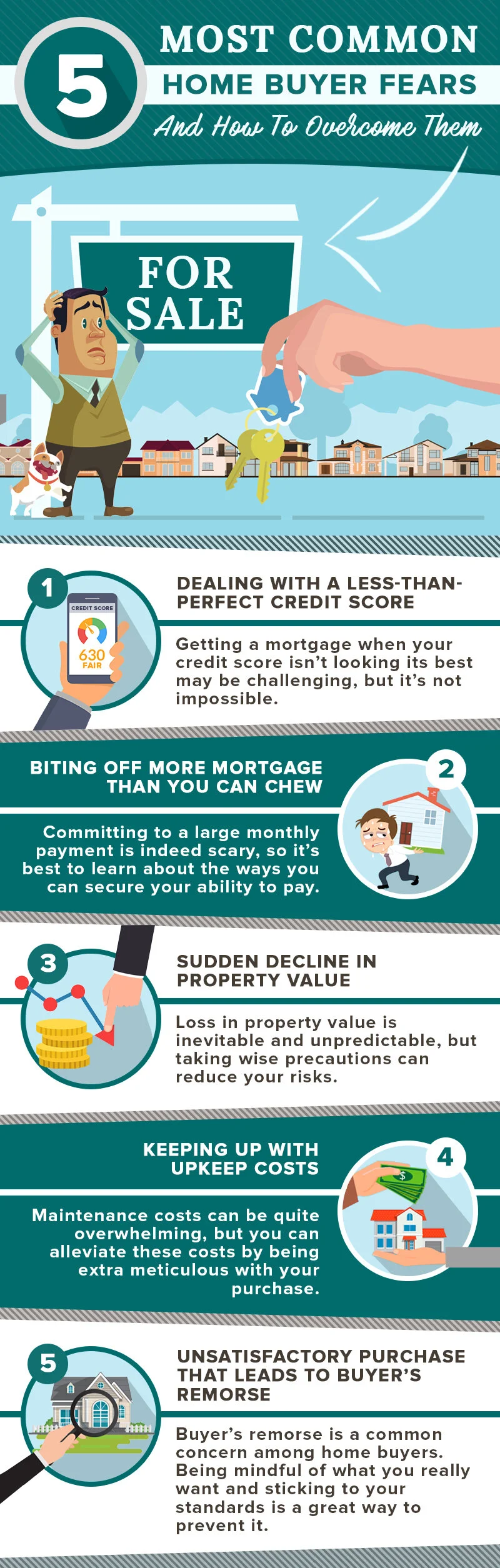
While buying real estate entails a lot of careful planning and extensive research, you won’t be going through it alone. Your agent will be there to help you every step of the way. Even so, we understand that peace of mind can still seem elusive and that your fears can bubble up to the surface even when you least expect it. To help you with this, we have listed down the top 5 fears homebuyers have, and a guide on how to overcome them:

1. Dealing with a less-than-perfect credit score

The thought of securing a loan when you have a less-than-perfect credit score can be quite stressful, and the fear of not getting approved may hold you back from working on a significant purchase such as buying a home.

If you’re convinced that you’re ready to buy a home, first get a copy of your credit report and make sure that there are no errors. According to a report done by the Federal Trade Commission, 1 in 5 Americans is being overcharged for his/her financial obligations due to a mistake in his/her credit report. If you’re familiar with loans, you know that the lower your credit score, the higher your interest rates will be. The accuracy of your credit report is crucial in ensuring that you won’t be unrightfully burdened with higher interest rates.

Still, if your credit is less than perfect, you have no reason to feel embarrassed and helpless. Many homebuyers are dealing with the same thing. The most practical thing you could do is to gradually pay off your delinquent accounts, improve your debt-to-income ratio, and try not to incur any new debt. Be proactive about your credit and start improving it until you’re confident enough to apply for a loan.


2. Biting off more mortgage than you can chew

A sizeable monthly payment can be overwhelming to think about, but you can combat your fears by having a firm understanding of your financial situation. To achieve this, you will have to prepare a budget that factors in all your current and ongoing bills. List down all your monthly payables, including credit cards, student loans, car amortizations, etc.

When you have an accurate account of your monthly cash flow, you’ll find it easier to determine how much you can afford to comfortably spend on a house. And, if you’re serious about purchasing a home in the very near future, the financial boundaries you’ve set for yourself will help you create sound decisions.


3. Sudden or gradual decline in property value

A decline in property value may occur for any home, regardless of size and location, and even without any form of disaster. While it is impossible to completely predict what will happen to home prices, you can still do your part in taking wise precautions to reduce your risks.

Nearby homes, surrounding facilities, and neighborhood features play a huge role in determining a home’s property value. If you want to ensure that your home wouldn’t suffer from a steadily decreasing value, learn how to spot unhealthy neighborhoods and avoid purchasing a home from those kinds of areas. Choose a well-kept neighborhood with a thriving community – a low crime area in which people feel safe walking down the street at night, especially children and women. Make sure that the area is mainly owner-occupied and with quality schools and hospitals nearby. You can even inquire with the local government about future development plans in the area.


4. Keeping up with upkeep costs

Even homes that are in the best shape will require some amount of upkeep, and every homeowner will have to deal with maintenance costs one way or another. Don’t worry, though, because while these expenses are inevitable, there are proven ways to mitigate them:

a)    Choose a well-maintained home that has recent upgrades and replacements, such as new plumbing and a strengthened roof.

b)    Hire a professional inspector to spot home defects that would otherwise go unnoticed.

c)    Repair small problems right away before they become major repairs.

d)    Set aside a substantial emergency fund, and regularly add to it over time.


5. Unsatisfactory purchase that leads to buyer’s remorse

It is natural to doubt your decisions before a major purchase, and it’s not uncommon for home buyers to question a lot of things even after closing a deal. However, if you want to lessen the anxiety that comes with buying a home, prepare a detailed list of everything you need AND want in a house. Discuss it thoroughly only with your immediate family, as too many people pitching in their advice will just be confusing and unhelpful.

Being firm with your standards and sticking to your budget will not guarantee that you’ll feel perfect after buying a home, but it will help you properly justify the decisions you’ve made and make you feel better about your purchase.